Smart Beta Explained for Investors: Why Some ETFs Lag 1% and How to Check Costs
Smart beta ETFs explained for investors: how factor rules work, why returns can lag by 1%, and what costs, liquidity and exposure to check before buying.
Smart Beta Explained for Investors: Why Some ETFs Lag 1% and How to Check Costs

Smart beta is a rules-based indexing approach that departs from market-cap weighting to target specific factors, offering the potential for improved risk-adjusted returns or better diversification. The trade-off is real: deviating from the standard benchmark means you can also underperform it, sometimes for years at a stretch. Getting smart beta explained properly means understanding both sides before you buy in.
TL;DR:
- Smart beta funds may underperform traditional market-cap weighted indexes by about 1% on average since their launch, often due to higher costs and trading expenses.
- They frequently tilt toward specific factors like value, momentum, or low volatility, but these factors can cycle in and out of favor over time, increasing risk.
- Higher turnover from more frequent rebalancing raises trading costs and taxable gains, especially in non-retirement accounts, which can offset potential benefits.
- Not all funds are truly diversified; some may be heavily concentrated in specific sectors, counteracting their intended risk-reduction purpose.
- Evaluating a smart beta ETF requires analyzing its methodology, costs, real factor exposure, liquidity, and how well it complements existing portfolio holdings.
Table of Contents
- What Is Smart Beta and How Do Smart Beta Funds Work?
- Common Smart Beta Strategies and the Factors They Target
- Benefits and Realistic Expectations of Smart Beta
- Risks, Common Pitfalls, and How to Avoid Them
- How to Evaluate a Smart Beta Fund: A Practical Checklist
- Examples and Practical Uses in a Portfolio
- How Evibe Helps You Monitor Smart Beta Exposure
- When Smart Beta Makes Sense
- Track Your Factor Bets Alongside Everything Else You Own
- Where to Read More on Smart Beta Methodology
- Sources
- FAQ
What Is Smart Beta and How Do Smart Beta Funds Work?
A traditional index fund weights holdings by market capitalization, so the biggest companies get the biggest slice regardless of whether they're a good value or a crowded trade. Smart beta funds throw out that default and use an alternative rule set instead, one built around measurable factors like value, momentum, or low volatility. Investopedia describes smart beta as a blend of passive and active investing, since the index is still transparent and rules-based, but the rules themselves reflect an active view about what drives returns.
Here's the mechanical difference that matters most:
- Selection: instead of "include every stock in the index by size," a smart beta fund might screen for companies with rising earnings, high dividend growth, or below-average price swings.
- Weighting: shares get sized by the target factor (revenue, dividend yield, volatility score) rather than by market value.
- Rebalancing: because factor scores shift over time, smart beta ETFs typically rebalance more often than cap-weighted funds, which can mean more trading and more cost.
ETFs are the common wrapper for this approach because they let an index provider publish a fixed methodology and let anyone track it at low cost. That's also why the methodology document matters more here than with a plain S&P 500 fund. A backtest showing 10 years of outperformance tells you how the rules would have worked in the past, not how they'll perform once real money and real trading costs enter the picture.
Common Smart Beta Strategies and the Factors They Target
Most smart beta strategies you'll come across fall into a handful of buckets, and once you can name them, fund descriptions stop sounding like marketing copy and start making sense.
- Equal-weighting gives every holding the same slice of the portfolio, which mechanically tilts the fund toward smaller companies since large caps no longer dominate.
- Fundamental-weighting sizes positions by financial metrics like earnings, revenue, or dividends instead of stock price, on the theory that market price can drift from business reality.
- Value targets stocks trading cheap relative to earnings or book value, and tends to shine coming out of market downturns when beaten-up companies snap back.
- Momentum follows stocks already trending upward, which works well in extended bull runs but can reverse sharply and fast when the trend breaks.
- Quality favors companies with strong balance sheets and stable profits, a factor that typically holds up better than most during recessions.
- Low volatility picks stocks with smaller price swings, which usually cushions downturns but can lag badly in a strong rally.
- Size tilts toward smaller companies, capturing a risk premium that shows up over long periods but with bumpier short-term results.
Multi-factor funds blend several of these exposures in one product, aiming to smooth out the cyclical nature of any single factor. iShares notes that combining uncorrelated factors can reduce the odds of a single-factor drawdown dragging down the whole portfolio, though it still requires watching for exposures you didn't intend to take on.
Benefits and Realistic Expectations of Smart Beta
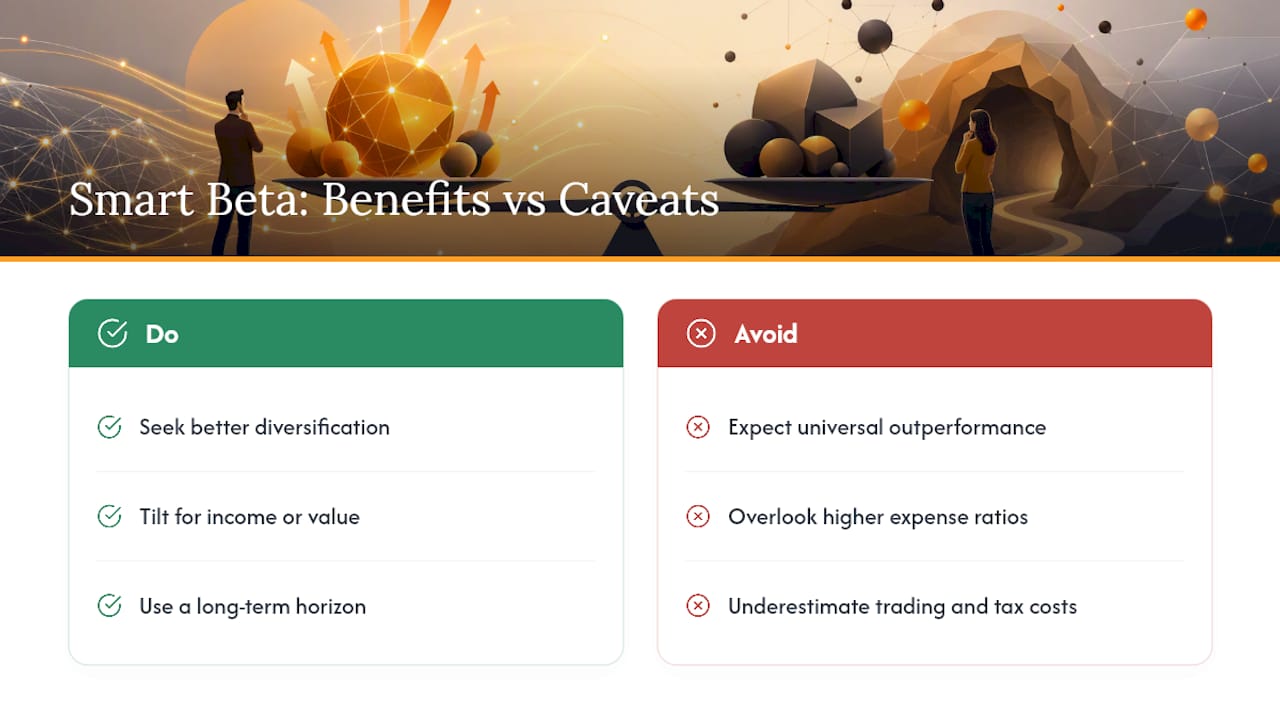
The appeal is straightforward: smart beta strategies aim to deliver better diversification, an income tilt, or improved risk-adjusted returns over long stretches, without abandoning the low-cost, rules-based structure that made index investing popular in the first place. A value-tilted fund can behave differently than the broad market during a rotation out of growth stocks, which is exactly the kind of diversification investors are usually chasing.
The catch is that "different from the benchmark" cuts both ways.
By the Numbers: One comprehensive analysis cited by FINRA found that smart beta strategies underperformed by about 1% on average since launch in that sample, and FINRA flags that these products often carry higher expenses than cap-weighted funds.
That single data point is worth sitting with. It doesn't mean every smart beta fund lags, but it does mean the marketing pitch of "smarter" returns doesn't hold up as a universal truth. Costs compound this gap. Expense ratios on smart beta funds tend to run higher than plain-vanilla index funds, and the more frequent rebalancing built into most factor strategies generates turnover, which means more trading costs and, in a taxable account, potentially more short-term capital gains. None of that erases the case for smart beta. It just means the benefit has to clear a higher bar than the fund fact sheet suggests.
Risks, Common Pitfalls, and How to Avoid Them
Every smart beta strategy asks you to accept a specific set of risks in exchange for its specific set of benefits. The trouble comes when investors don't realize which risks they've signed up for.
- Factor cyclicality: value, momentum, and low volatility all move in and out of favor for years at a time, and chasing whichever factor just had a hot run is a common way to buy high.
- Turnover and taxes: higher rebalancing frequency means higher trading costs and, outside a retirement account, a bigger tax bill from realized gains.
- Concentration risk: factor screens can quietly load a fund up on one sector. A "quality" fund heavy in tech, for instance, isn't giving you the diversification the label implies.
- Liquidity risk: newer or thinly traded smart beta ETPs can have wide bid/ask spreads, and FINRA specifically warns investors to check liquidity before buying in, since a wide spread quietly eats into returns every time you trade.
Pro Tip: Before buying any smart beta ETF, pull up its holdings list and check the top ten by sector. If seven of them are in the same industry, the fund isn't diversifying you the way its name suggests.
How to Evaluate a Smart Beta Fund: A Practical Checklist
Vetting a smart beta product before you buy takes maybe twenty minutes, and it beats finding out the hard way that the fund's "value tilt" is really a bet on three sectors.
- Read the index methodology and prospectus. This tells you the exact selection rules, how often the fund rebalances, and what triggers a holding to be added or dropped.
- Check the real cost. Add the expense ratio to the turnover-driven trading costs, and compare the fund's actual tracking error against the factor it claims to capture.
- Measure factor exposure directly. Don't take the fund name at face value. Compare its return pattern and sector weights against a core benchmark to see how much it actually deviates.
- Assess size, liquidity, and tax treatment. A small, thinly traded fund can have wider spreads and higher shutdown risk, and turnover-heavy strategies matter more in taxable accounts than in an IRA.
- Confirm it fits your allocation plan. A factor tilt should complement your existing holdings, not accidentally double up on a bet you're already making elsewhere.
The CFA Institute's research on indexing makes a point worth repeating here: smart beta sits on a spectrum between passive and active, and the design choices behind the rules are themselves an active decision, even when the resulting fund is rules-based and fully transparent.
Examples and Practical Uses in a Portfolio
The Vanguard Dividend Appreciation ETF (VIG) is one of the more widely recognized examples of a smart-beta-style fund. It screens for companies with a track record of raising dividends, which is a fundamental-weighting approach rather than a straight market-cap ranking. That single design choice tilts the fund toward established, cash-generative businesses and away from high-growth names that pay no dividend at all.
In practice, most investors don't replace their entire core holding with a fund like this. More common approaches include:
- Using it as a satellite sleeve, layered on top of a core index fund to add a specific tilt.
- Building an income-focused sleeve with dividend-growth ETFs for investors who want cash flow alongside appreciation.
- Adding a low-volatility sleeve for the portion of a portfolio meant to cushion drawdowns.
A common starting allocation is modest: 10% to 20% of a portfolio in one or two factor tilts, rebalanced annually, with the rest staying in core index exposure.
How Evibe Helps You Monitor Smart Beta Exposure
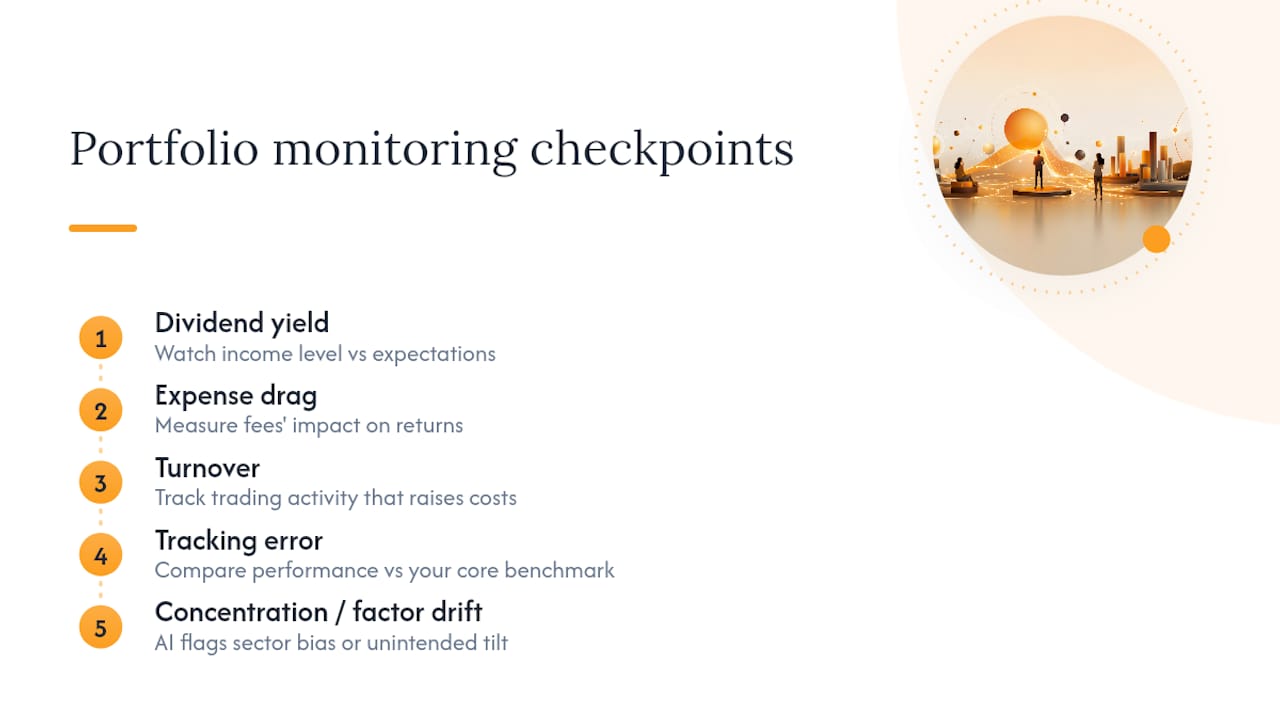
Once you own a factor-tilted ETF, the job isn't done. You need to watch dividend yield, expense drag, turnover, and tracking error against your core benchmark, ideally without opening five separate statements. Evibe syncs your brokerage accounts automatically and uses AI-driven analysis to flag concentration or drift you might miss on your own, whether that's a sector bias hiding inside a "quality" fund or a factor tilt that's grown larger than you intended. The ETF tracking tools make periodic rebalancing checks something you can actually do in minutes, not a quarterly chore you keep postponing.
When Smart Beta Makes Sense
Smart beta works best as a researched complement to a core passive holding, not a replacement for one. If you're drawn to a factor tilt, prioritize low-cost, transparent methodologies over impressive backtests, and track the real-world outcome with a portfolio benchmarking approach rather than assuming the fund fact sheet tells the whole story.
— Vincent
Track Your Factor Bets Alongside Everything Else You Own
Evibe consolidates your smart beta ETFs, dividend stocks, crypto, and every other asset class into one dashboard, so a factor tilt never hides in a separate brokerage login you forget to check. 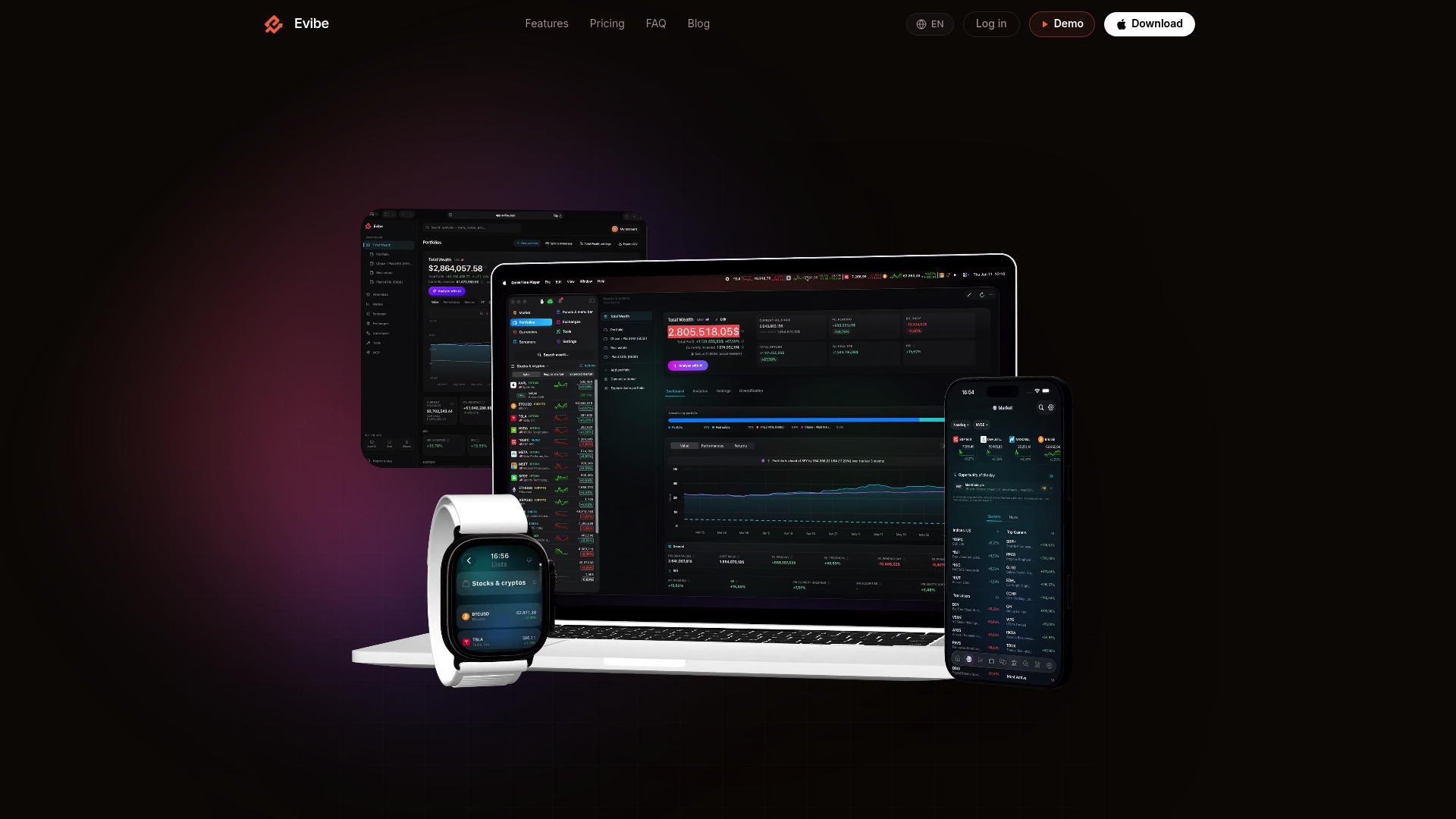
Because Evibe syncs accounts automatically and applies AI-driven analysis to your holdings, you can see how a fund like VIG is actually pulling your risk and diversification numbers, not just guess based on the fund name. The dividend tracker breaks down declared, executed, and estimated payouts across every dividend-growth position you hold, which matters more once you're running a smart beta sleeve alongside your core portfolio. Evibe is available via subscription; current pricing details are on Evibe's website. Start tracking your full portfolio and see exactly where your factor exposure stands today.
Where to Read More on Smart Beta Methodology
For readers who want to go straight to the primary sources, FINRA's investor guidance on smart beta covers cost and liquidity risk in plain language, while Investopedia's smart beta ETF breakdown walks through fund structures and examples. The CFA Institute's paper on indexing and direct indexing offers a deeper look at where these strategies sit between passive and active management.
This article is general information, not a substitute for advice from a qualified financial advisor. Consult a qualified financial professional about your own circumstances before acting on anything here.
Sources
- Smart Beta — Investopedia
- Smart Beta—What You Need to Know — FINRA
- Smart beta and direct indexing — CFA Institute
FAQ
What Is a Smart Beta Strategy and How Does It Work?
A smart beta strategy is a rules-based index approach that weights holdings by a factor like value, quality, or low volatility instead of market capitalization. The fund follows a fixed, published methodology and rebalances on a set schedule to keep that factor exposure current, as Investopedia explains.
Is Smart Beta Really Smart?
It depends on the period and the specific strategy. Some analyses have found smart beta strategies underperforming by about 1% on average since launch in that sample, so the label doesn't guarantee better results, only different ones.
What Is Warren Buffett's 70/30 Rule?
This isn't a formally defined smart beta concept, and it's not something the standard indexing literature addresses directly. It's typically referenced informally in discussions of asset allocation between stocks and bonds rather than as an official Buffett rule.
How Can Evibe Help Me Track a Smart Beta ETF?
Evibe syncs your brokerage accounts automatically and applies AI-driven analysis to show factor concentration, dividend trends, and drift from your core benchmark in one dashboard. Evibe is free to use, and a Premium subscription costs $9.99 per month or $99.99 per year.
What's the Difference Between Smart Beta and Traditional Index Funds?
Traditional index funds weight companies by market capitalization, so the largest companies dominate the fund regardless of valuation. Smart beta funds use alternative rules, such as equal-weighting or factor screens, to break that link and target specific investment characteristics instead.