Is It a Good Time to Buy ETFs? What Investors Need to Know
Wondering if it’s a good time to buy ETFs? Research shows investing now often outperforms waiting for the “perfect” moment. Discover key insights.
Is It a Good Time to Buy ETFs? What Investors Need to Know

TL;DR:
- Investing immediately in ETFs benefits long-term growth more than waiting for ideal conditions.
- Market timing is risky, as missing top trading days can severely reduce investment returns over time.
Is it a good time to buy ETFs right now?
Yes. For most long-term investors with capital ready to deploy, the answer is straightforward: invest now rather than wait for a better entry point that may never feel quite right.
The evidence behind this is not opinion. Schwab Center research analyzed every possible starting point for annual investments from 1926 to 2021 and found that investing immediately at the start of each year outperformed delay in the vast majority of scenarios. ETFs themselves are attracting record capital: equity and bond ETFs collected nearly $1 trillion in inflows in the first half of 2026 alone, the fastest pace ever recorded.
A few conditions where buying now makes clear sense:
- You have a time horizon of 10 or more years
- Your high-interest debt is already paid off or under control
- You can stay invested through corrections without panic-selling
- You are targeting diversified, low-cost broad-market ETFs rather than concentrated sector bets
Table of Contents
- 1. Why trying to time the market usually backfires
- 2. Time in the market drives wealth more than any other factor
- 3. Key personal financial considerations before buying ETFs
- 4. How Evibe helps you manage your ETF portfolio with confidence
- 5. How interest rates affect ETF performance
- 6. How to evaluate sector-specific ETFs right now
- 7. Valuation metrics every ETF investor should watch
- Key Takeaways
1. Why trying to time the market usually backfires
The math on market timing is brutal. JPMorgan data shows that missing just the 10 best trading days over a 20-year period cuts returns roughly in half. Miss the best 30 days and you would likely have lost money outright.
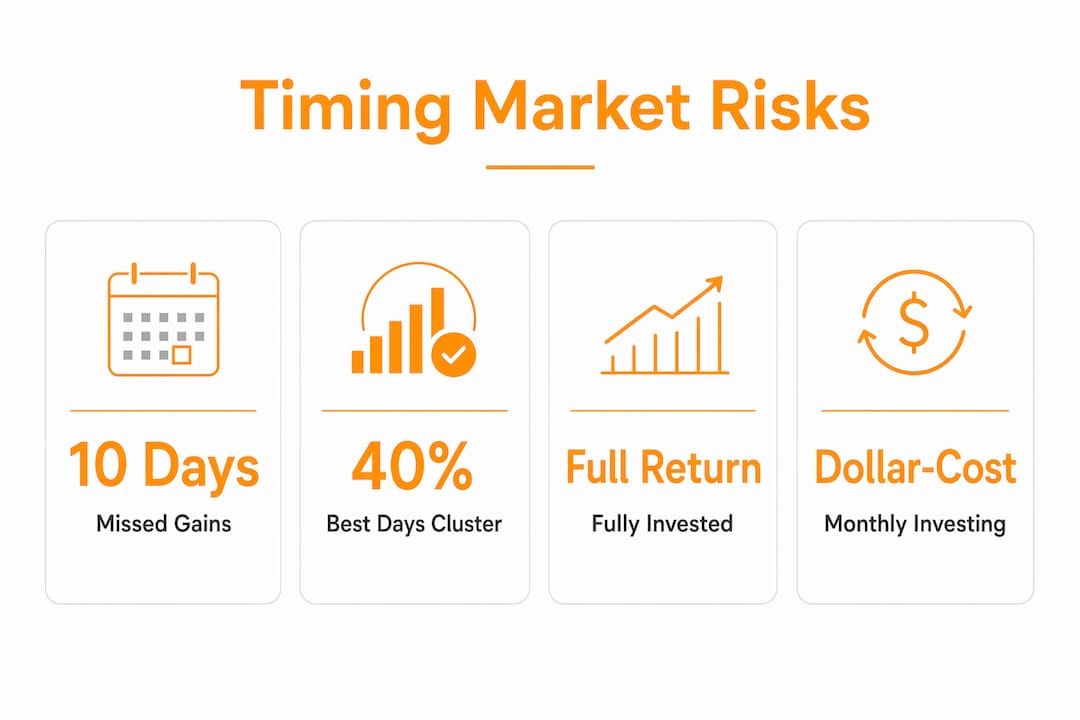
What makes this especially punishing is where those best days tend to cluster. Over 40% of the S&P 500's best days since 2005 occurred during bear markets or immediately after sharp declines. If you sold during a downturn waiting for conditions to improve, you almost certainly missed the recovery bounce that generated a disproportionate share of long-term gains.
Pro Tip: Use dollar-cost averaging through automatic monthly investing. It removes the temptation to time entries entirely and ensures you capture gains on both calm and volatile days.
| Scenario | 20-Year Outcome |
|---|---|
| Fully invested | Full compounded return |
| Missed 10 best days | Returns cut roughly in half |
| Missed 20 best days | Near breakeven |
| Missed 30 best days | Likely net loss |

Source: JPMorgan Asset Management
2. Time in the market drives wealth more than any other factor
Expert consensus is consistent on this point: starting early and staying invested long-term is the primary driver of wealth, not interest rates, not valuations, not economic headlines.
The S&P 500 has never produced negative total returns over any 10-year period in the last 82 years, according to Capital Group data. That track record holds through recessions, rate hikes, geopolitical shocks, and market crashes. Broad-market ETFs like VOO or VTI are built to capture exactly this long-run compounding.
Core principles for a long-term ETF strategy:
- Invest a fixed amount on a regular schedule, regardless of market conditions
- Reinvest dividends automatically to accelerate compounding
- Keep expense ratios low, ideally under 0.10%
- Hold through corrections rather than rotating to cash
Market highs should not deter you either. A healthy, growing economy produces new all-time highs regularly. Avoiding the market at every peak would have meant missing most of the best investing opportunities in history.
3. Key personal financial considerations before buying ETFs
Not every investor is in the same position, and a few personal factors genuinely change the calculus before you commit capital to ETFs.
- Pay off high-interest debt first. The guaranteed return from eliminating 20%+ credit card debt exceeds any realistic market return. This is the one scenario where delaying investment makes financial sense.
- Assess your risk tolerance honestly. If a 20% portfolio drop would push you to sell, a more conservative allocation or a smaller initial position reduces that behavioral risk.
- Match your time horizon to your ETF type. Money needed within three years belongs in high-yield savings or Treasury bills, not equity ETFs.
- Use limit orders, not market orders, especially near the open or close. Bid-ask spreads widen in the first and last 15–30 minutes of the trading day, and a limit order caps the price you pay.
4. How Evibe helps you manage your ETF portfolio with confidence
Knowing when to invest is one thing. Knowing how your ETF holdings are actually performing across your full portfolio is another. That is where Evibe comes in.
Evibe is a portfolio tracking app that consolidates every asset class, including stocks, ETFs, crypto, real estate, and more, into a single real-time dashboard. Accounts sync automatically from 1,000+ banks, brokerages and crypto exchanges across the US, Canada and Europe, so you always have an accurate picture without manual entry.
Key features relevant to ETF investors:
- AI-driven analysis that assesses your portfolio's risk level, diversification, and performance against major indices
- ETF-specific analytics covering holdings breakdown, sector exposure, and cost basis
- Smart alerts that notify you of meaningful market changes before they affect your plan
- Dividend tracking with executed, declared, and estimated payouts in one view
- Benchmarking against indices so you can see whether your ETF mix is keeping pace
Track your ETF portfolio in real time and get the AI-powered clarity to stay disciplined through volatility, rather than reacting to it.
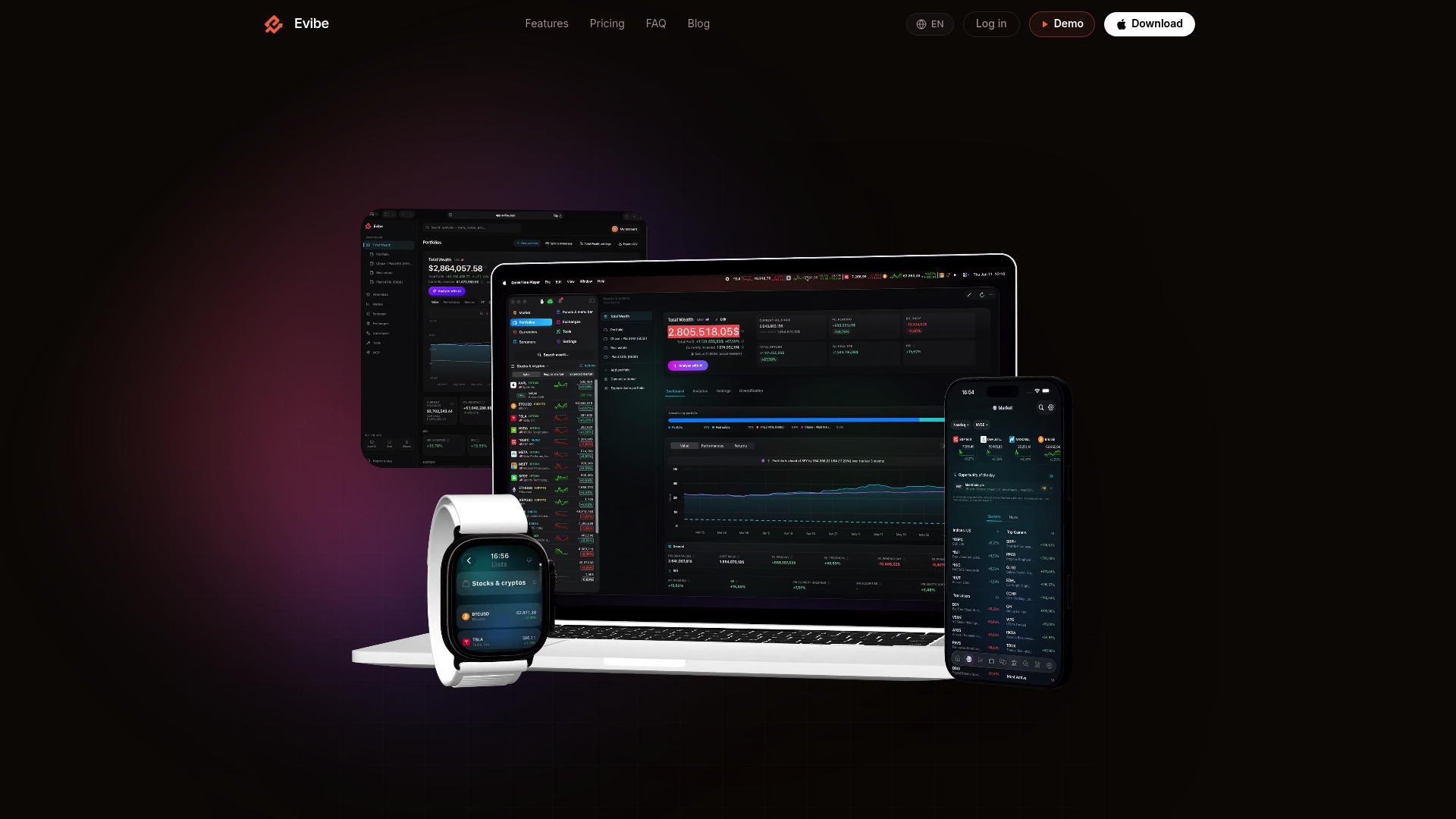
Start tracking your full net worth with Evibe at evibe.com.
5. How interest rates affect ETF performance
The Federal Reserve held the federal funds rate at 3.50%–3.75% through mid-2026, with nearly half of policymakers projecting at least one additional hike by year-end. That "higher for longer" environment historically favors dividend ETFs and quality-factor ETFs, while compressing valuations on high-growth, long-duration assets.
Bond ETFs are worth a second look in this context. After years of near-zero yields, short-duration and investment-grade fixed-income ETFs now offer meaningful real yields again. Rising rates hurt bond prices in the short term, but investors entering now lock in higher coupon income going forward. For equity ETFs, the key risk is a surprise rate hike triggering a risk-off selloff, particularly in tech-heavy funds. Broad-market ETFs absorb that sector volatility better than concentrated positions.
6. How to evaluate sector-specific ETFs right now
Sector ETFs can amplify returns, but the concentration risk is real. In 2026, returns across sectors have been sharply divergent, with some technology sub-sectors down significantly while broad-market funds held up. That divergence is a reminder that sector bets require a higher conviction threshold than a simple index fund.
For most investors, broad-market ETFs should form the core of any portfolio, with sector ETFs as satellite positions sized to reflect their higher volatility. If you do add sector exposure, favor areas with structural tailwinds and reasonable valuations rather than chasing recent momentum. Dividend-focused sector ETFs, such as those targeting utilities or financials, tend to hold up better in rate-sensitive environments than pure growth plays.
7. Valuation metrics every ETF investor should watch
The cyclically adjusted price-to-earnings ratio (CAPE ratio) for the S&P 500 is hovering near 40, a level not seen since just before the dot-com bubble. That is a legitimate reason for caution on near-term return expectations, though research confirms that CAPE has little predictive value for market timing over periods shorter than a decade.
What CAPE does tell you is that forward returns from elevated starting valuations tend to be lower than historical averages. That is not a reason to stay out of the market. It is a reason to set realistic expectations, keep costs low, and avoid over-concentrating in the most expensive segments of the market. Price-to-earnings ratios at the individual ETF level, expense ratios, and tracking error are the three metrics worth checking before any purchase.
Key Takeaways
Long-term investors who buy diversified ETFs consistently and stay invested through volatility will almost always outperform those who wait for the "right" moment.
| Point | Details |
|---|---|
| Invest now, not later | Schwab research from 1926–2021 shows immediate investing beats delay in most scenarios. |
| Missing best days is costly | Missing just the 10 best trading days over 20 years cuts returns roughly in half. |
| Pay off high-interest debt first | Eliminating 20%+ interest debt offers a guaranteed return that beats expected market gains. |
| Rates favor quality and dividends | A "higher for longer" rate environment benefits dividend ETFs and investment-grade bond ETFs. |
| Track what you own | AI-driven tools like Evibe give you real-time visibility into ETF risk, diversification, and performance. |