Alpha vs Beta: What Investors and Readers Need to Know
Discover the key differences between alpha and beta in finance. Learn how these concepts affect investment strategies and market performance.
Alpha vs Beta: What Investors and Readers Need to Know

In finance, alpha is the excess return an investment earns above what its risk-adjusted benchmark predicts, while beta measures how sensitive that investment is to market movements. As Investopedia explains, consistently achieving positive alpha is difficult, and a small minority of active funds outperform over long periods after fees and taxes. In social slang, "alpha" and "beta" are borrowed from animal ethology to describe personality dominance hierarchies, but as Wikipedia documents, that transfer to human behavior is a loose metaphor, not a scientific classification.
The distinction matters because one set of terms is measurable and actionable, while the other is a folk label with limited scientific backing:
- Alpha (finance): excess return above a risk-adjusted benchmark, expressed as a percentage
- Beta (finance): a number showing how much an asset moves relative to the market (benchmark beta = 1.0), as Fidelity defines it
- Alpha/beta (social slang): informal personality labels derived from animal dominance studies, popularized by internet culture
Key Takeaways
In finance, alpha and beta are precise, computable metrics; in social slang, they are informal labels with no rigorous scientific basis and limited practical value.
| Point | Details |
|---|---|
| Finance alpha is measurable | Alpha equals actual return minus the CAPM-predicted return; a +2.8% alpha means the asset outperformed its risk-adjusted benchmark by that amount. |
| Beta captures market sensitivity | A beta of 1.2 means an asset tends to move 20% more than the market; benchmark beta is always 1.0. |
| Benchmark choice is critical | Fewer than 10% of active funds sustain positive alpha after fees; mismeasured alpha often reflects a wrong benchmark, not real skill. |
| Social labels lack scientific support | Alpha/beta personality terms derive from animal ethology and do not map onto established human personality frameworks like the Big Five. |
| Evibe automates the measurement | Evibe syncs accounts, benchmarks against indices, and surfaces alpha/beta analytics automatically, removing manual calculation errors. |
Table of Contents
- How do alpha and beta compare across finance and social contexts?
- What do alpha and beta actually mean in investing?
- How do investors actually use alpha and beta?
- How do you measure and monitor alpha and beta for your portfolio?
- Where do "alpha" and "beta" as personality labels come from?
- Are alpha and beta personality labels actually useful?
- What is the practical verdict on alpha vs beta?
- Evibe tracks your alpha and beta automatically
- Sources
How do alpha and beta compare across finance and social contexts?
The same two words carry very different weight depending on the context. Here is a side-by-side view:
| Dimension | Alpha | Beta |
|---|---|---|
| Definition | Excess return above a risk-adjusted benchmark | Sensitivity of an asset's return to market movements |
| Computation | Actual return minus expected return (from CAPM) | Covariance of asset returns with market returns, divided by market variance |
| Typical use cases | Evaluating active manager skill; identifying excess-return sources | Portfolio risk budgeting; measuring market exposure |
| Limitations | Benchmark-dependent; confounded by omitted factors and fees | Assumes linear, stable relationship with the market; changes over time |
| Example | A fund returning 12% when its benchmark predicts 10% has alpha of +2% | A stock with beta 1.2 tends to rise or fall 20% more than the index |
| Social definition | Dominant, assertive personality type (pop culture label) | Passive, deferential personality type (pop culture label) |
| Social limitations | No rigorous scientific basis for human classification | Oversimplifies personality; reinforces stereotypes |
Two points worth keeping in mind:
- For investors: the single most actionable difference is that beta is passively captured by holding a broad index, while alpha requires active decisions and carries real measurement risk.
- For social readers: the most important caution is that these labels map poorly to actual personality science and should not be used to predict behavior or relationship outcomes.
What do alpha and beta actually mean in investing?
Precise definitions and the CAPM framework
Alpha in finance is the return your investment earns above what a risk model says it should earn given its level of market exposure. CNBC's explainer frames it cleanly: alpha and beta measure different things, and a high alpha paired with high beta may not suit a conservative investor at all.
The standard framework is the Capital Asset Pricing Model (CAPM):
Expected return = Risk-free rate + Beta × (Market return − Risk-free rate) + Alpha
Alpha is the residual: what is left over after accounting for the risk-free rate and the market premium your beta exposure earned. A positive alpha means the investment outperformed on a risk-adjusted basis; a negative alpha means it underdelivered.
Beta measures how much an asset's price tends to move for every 1% move in the benchmark. The formula:
Beta = Covariance(asset returns, market returns) / Variance(market returns)
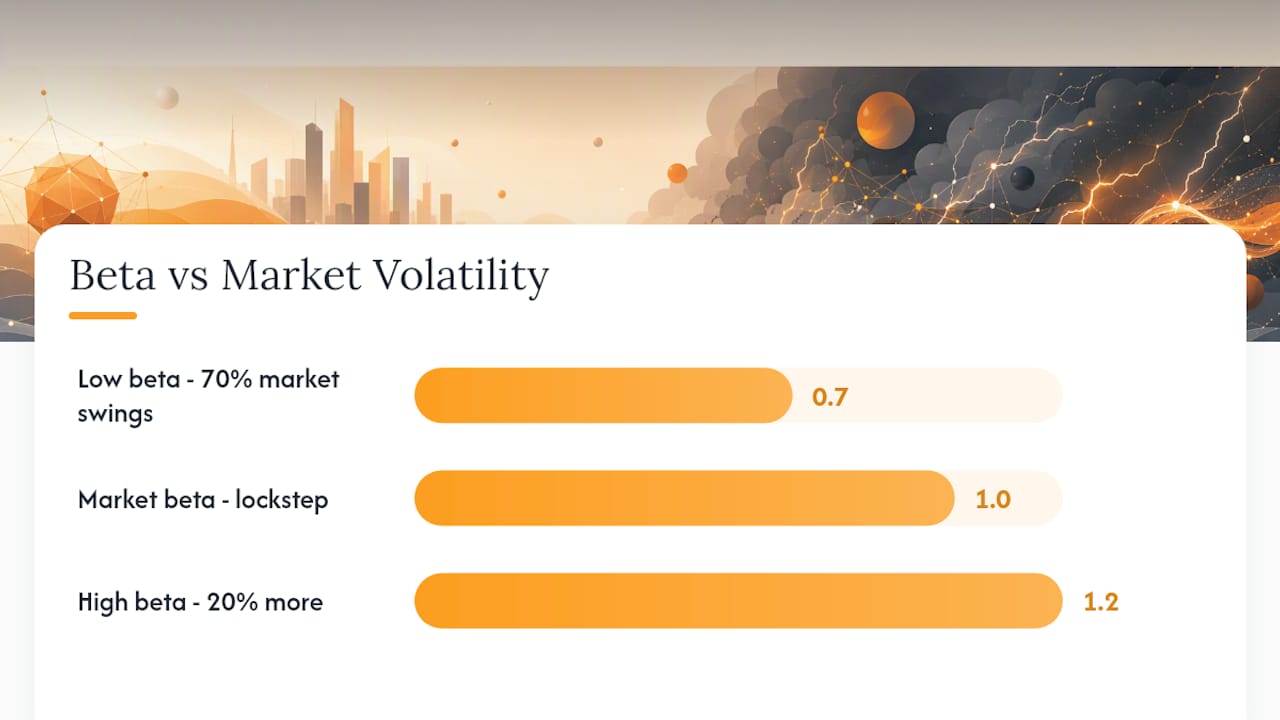
A beta of 1.0 means the asset moves in lockstep with the market. A beta of 1.2 means it tends to move 20% more, up or down. A beta of 0.7 means it absorbs only 70% of the market's swings, as SoFi's portfolio beta guide illustrates with weighted portfolio examples.
Worked numeric example
Here is a four-step example using simple numbers:
- Gather monthly returns. Suppose Stock A returned 14% over a year and the S&P 500 returned 10%. The risk-free rate (e.g., 3-month T-bill) was 4%.
- Compute beta. From a regression of Stock A's monthly returns against the S&P 500, you calculate a covariance of 0.018 and a market variance of 0.015. Beta = 0.018 / 0.015 = 1.2.
- Compute expected return via CAPM. Expected return = 4% + 1.2 × (10% − 4%) = 4% + 7.2% = 11.2%.
- Compute alpha. Alpha = Actual return − Expected return = 14% − 11.2% = +2.8%.
What this means in practice: a beta of 1.2 tells you the stock amplifies market moves by 20%. The alpha of +2.8% tells you it delivered that much above what its market exposure alone would predict. Whether that alpha reflects skill or luck requires more data points and a longer time horizon.
Wikipedia notes that in an efficient market the expected alpha of any strategy is zero, because prices already reflect available information. Generating consistent positive alpha requires exploiting genuine inefficiencies, which is rare.
How do investors actually use alpha and beta?
Beta is the workhorse of risk management. Investors use it to size positions, build diversified portfolios, and set expectations for how a holding will behave in a downturn. Alpha is the scorecard for active decisions: did the manager or strategy earn more than passive exposure would have delivered?
Common use cases:
- Active manager evaluation: comparing a fund's realized alpha against its benchmark to judge whether fees are justified
- Portfolio construction: separating a "beta core" of broad index ETFs from an "alpha sleeve" of higher-conviction active positions, so performance attribution stays clean
- Risk budgeting: using beta to control total portfolio volatility while allocating a defined portion to alpha-seeking strategies
Limits and pitfalls to watch:
- Benchmark choice distorts everything. A small-cap fund benchmarked against the S&P 500 will show inflated alpha simply because the benchmark is wrong. PIMCO warns explicitly that mismeasured alpha often reflects omitted-factor betas rather than pure skill, particularly in private assets and niche strategies where liquidity premiums are large.
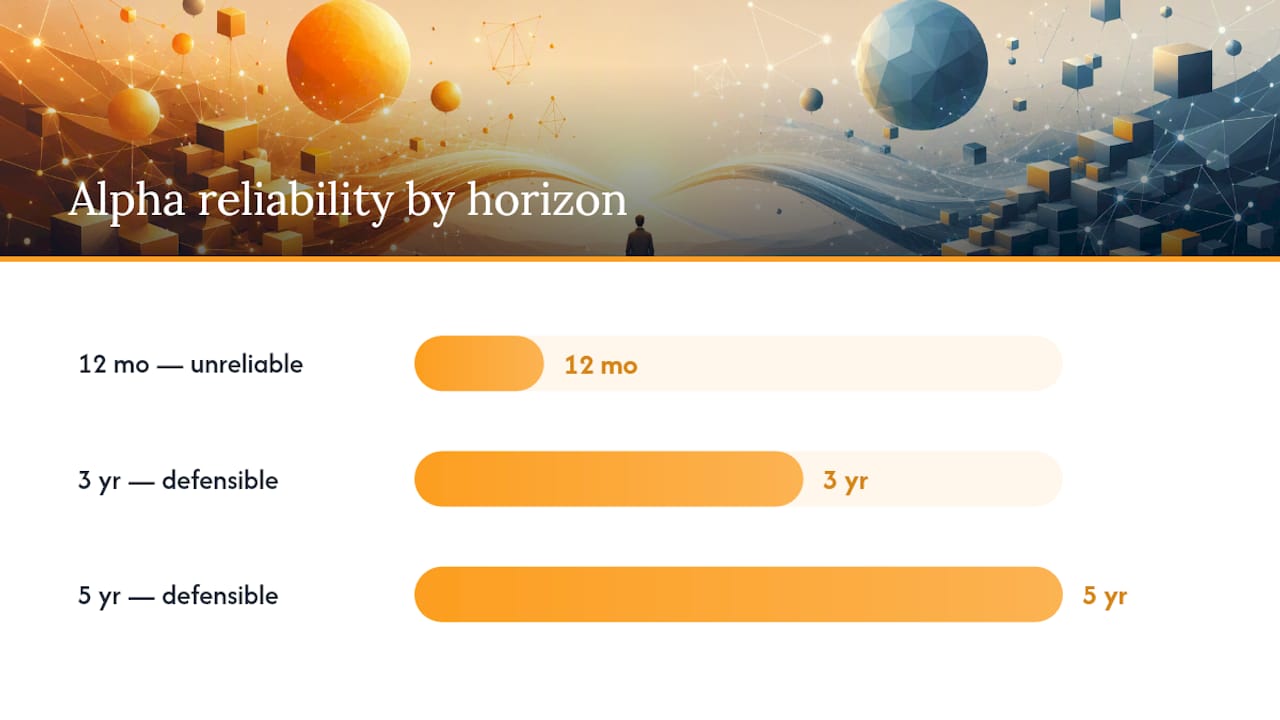
- Short time horizons are noise. A 12-month alpha figure is statistically unreliable. Three to five years of consistent data is a more defensible minimum.
- Fees erode alpha fast. A gross alpha of +1.5% can turn negative after a 1% management fee and transaction costs.
- Smart beta blurs the line. Fidelity's smart beta content describes rules-based, factor-oriented indexing that sits between pure passive and active management, capturing factor premia at lower cost than traditional active funds.
Statistic to keep in mind: Investopedia reports that a small minority of active funds sustain positive alpha over long periods after fees and taxes. That figure alone should calibrate how skeptical you are of any alpha claim.
Pro Tip: When an advisor or fund pitches strong alpha, ask three questions: What is the benchmark? How long is the track record? Does the strategy hold illiquid assets that inflate measured returns? If any answer is vague, treat the alpha claim with caution. You can also verify advisor credentials and disciplinary history through FINRA BrokerCheck before acting on performance claims.
How do you measure and monitor alpha and beta for your portfolio?
The math is only as good as the inputs. Here is a practical checklist:
- Choose a relevant benchmark. Match the benchmark to the asset class: S&P 500 for large-cap US equities, Russell 2000 for small-caps, a blended index for a multi-asset portfolio. A mismatched benchmark produces meaningless alpha.
- Pick a consistent timeframe. Use at least 36 monthly data points for a statistically meaningful regression. Shorter windows amplify noise.
- Run the regression or use platform metrics. A spreadsheet with monthly returns and the COVAR and VAR functions can produce beta in minutes. Portfolio trackers with built-in benchmarking automate this entirely.
- Check factor exposures. If your alpha looks high, ask whether the portfolio has unintended tilts (size, value, momentum) that a single-factor CAPM misses. A multi-factor model (Fama-French three-factor, for example) will often absorb what looked like alpha.
- Adjust for fees and liquidity. Subtract all costs before comparing to the benchmark. For illiquid holdings, note that mark-to-market valuations may smooth returns and distort beta estimates.
- Repeat on a fixed schedule. Quarterly recalculation keeps your numbers current without overreacting to short-term noise.
Tools that help:
- Portfolio trackers with automatic sync and index benchmarking reduce manual data entry errors and keep return series consistent
- Broker analytics dashboards often include beta and Sharpe ratio calculations natively
- Spreadsheet regression (Excel or Google Sheets) works for simple single-asset beta, though it requires manual data maintenance
Pro Tip: Split your holdings into two explicit buckets: a beta portfolio (broad index ETFs capturing market return) and an alpha portfolio (active positions, sector bets, alternatives). Tracking them separately makes it immediately clear whether your active decisions are adding value or just adding volatility.
Where do "alpha" and "beta" as personality labels come from?
The social usage of these terms has almost nothing to do with finance. Wikipedia traces the origin to animal ethology, specifically studies of wolf pack hierarchies conducted in the mid-20th century, where researchers labeled the dominant animal "alpha" and subordinate animals "beta." The terms migrated into popular self-help and pickup-artist communities in the 1990s and 2000s, then spread widely through internet forums and social media.
In everyday use, "alpha" typically gets associated with:
- Assertiveness and social confidence
- Leadership and decisiveness
- High status and physical presence
"Beta" typically gets associated with:
- Deference and agreeableness
- Conflict avoidance
- Lower social status
The problem is that these pop-culture attribute lists are not drawn from peer-reviewed personality research. They do not map onto established frameworks like the Big Five (OCEAN) model, and they collapse a wide range of context-dependent behaviors into a single static label.
Are alpha and beta personality labels actually useful?
They are not, at least not as predictive tools. The labels oversimplify human behavior and can reinforce stereotypes that have no grounding in personality science.
Common myths and the reality behind them:
- "Alphas are always leaders." Leadership research consistently shows that effective leaders adapt their style to context. Dominance alone predicts neither leadership effectiveness nor team outcomes.
- "Betas are weak." Agreeableness and conflict avoidance are distinct traits with measurable benefits in collaborative environments. Labeling them "beta" is a value judgment, not a scientific observation.
- "Alpha males attract more partners." Relationship satisfaction research focuses on communication quality, shared values, and emotional availability, not dominance rank.
- "You are either one or the other." Personality is dimensional and situational. The same person may be assertive in one context and deferential in another.
Practical advice for relationships and social contexts:
- Focus on specific behaviors (how someone communicates under stress, how they handle disagreement) rather than assigning a category label.
- Compatibility research points to shared values and emotional responsiveness as stronger predictors of relationship quality than personality archetypes.
- When you hear someone describe themselves or others as "alpha" or "beta," treat it as a rough shorthand, not a diagnostic.
Quick answers to common questions:
Which is stronger, alpha or beta? In finance, neither is inherently stronger: beta captures market return efficiently, while alpha represents excess return that is hard to sustain. In social slang, the framing of "stronger" is itself the problem; both labels are oversimplifications.
Can an alpha and a beta be in a relationship? The question assumes the labels are fixed and meaningful. They are not. Relationship success depends on communication, compatibility, and mutual respect, not on which pop-culture archetype each person fits.
Do these personality types exist scientifically? No established personality science uses a binary alpha/beta classification for humans. Rigorous frameworks like the Big Five measure traits on continuous scales across multiple dimensions.
What is the practical verdict on alpha vs beta?
Use the finance definitions when making investment decisions. Treat the social labels as informal shorthand with limited value.
For investors:
- Use beta to understand and manage market exposure; use alpha to evaluate whether active decisions are paying off net of fees.
- Verify benchmarks before trusting any alpha claim, and check advisor credentials through FINRA BrokerCheck.
- Separate your portfolio into a beta core and an alpha sleeve to keep attribution clean.
For social contexts:
- Recognize that alpha/beta personality labels come from animal behavior studies and do not translate reliably to human psychology.
- Prioritize concrete, observable behaviors over categorical labels when assessing people or relationships.
- When the slang adds no precision, skip it entirely. Most conversations are clearer without it.
A note on when to ignore the slang entirely
If a conversation about personality, relationships, or leadership relies heavily on alpha/beta labels to make its point, that is usually a signal the argument lacks more precise evidence. The labels survive because they are memorable, not because they are accurate.
An investor's honest take on chasing alpha
The finance version of this debate is genuinely interesting, and the social version is mostly noise. After spending time with the data on active fund performance, the conclusion that sticks is this: most investors are better served by owning beta cheaply and being very selective about where they pay for alpha.
The alpha/beta split as a portfolio construction technique is underused by retail investors. Most people hold a mix of active and passive positions without ever measuring what each bucket is actually contributing. Running even a rough regression once a year changes that. You stop guessing whether your active picks are adding value and start knowing.
On the social labels: they are a shortcut that costs more than it saves. They flatten context, encourage fixed thinking about personality, and tend to end conversations rather than advance them. The finance terms earned their place through math. The social terms borrowed credibility they never had.
Evibe tracks your alpha and beta automatically
Measuring alpha and beta manually means maintaining clean return series, matching the right benchmark, and rerunning calculations every time you add a position. Evibe removes that friction entirely.

Evibe syncs your brokerage and bank accounts automatically, tracks every asset class from stocks and ETFs to crypto and real estate, and benchmarks your portfolio against major indices in real time. The AI-driven analysis surfaces risk and performance metrics in plain language, so you can see whether your active positions are generating genuine excess return or just adding volatility. Smart alerts flag significant market moves before they distort your numbers.
If you want to know your actual alpha and beta without building spreadsheets, start tracking with Evibe today. It's free to use, and every new account gets 7 days of Premium directly in the iOS or macOS app.
Sources
- Understanding Alpha in Investing: Definition and Examples
- Alpha, Beta, and Smart Beta - Fidelity
- The Alpha Equation: Myths and Realities | PIMCO
- Alpha and beta: CNBC Explains
- Alpha and beta male — Wikipedia
- How To Calculate Portfolio Beta: Formula & Examples | SoFi
This article is general information, not a substitute for advice from a qualified financial advisor. Consult a qualified financial professional about your own circumstances before acting on anything here.