Best Mint Alternatives for Investors: 2026 Guide
Discover the best Mint alternatives for investors in 2026, including Evibe’s private, Apple-native portfolio tracking with smart AI insights. Explore now!
Best Mint Alternatives for Investors: 2026 Guide

TL;DR:
- Evibe is the leading Mint alternative for investors seeking comprehensive multi-asset portfolio tracking with real-time analytics. It consolidates diverse assets like stocks, crypto, real estate, and collectibles into one dashboard, offering AI-driven insights and detailed options analytics. For broader financial monitoring, Empower provides a free, basic investment dashboard, while YNAB, Credit Karma, and Simplifi serve specific budgeting or credit needs.
For investors who need consolidated, multi-asset portfolio monitoring, Evibe is the strongest Mint alternative available today. It consolidates stocks, ETFs, crypto, real estate, options, and custom assets into a single real-time net-worth dashboard with AI-driven analysis. Multi-asset investors tracking private equity, collectibles, or foreign holdings will find the depth here unmatched by any budgeting-first app.
- Best for portfolio-focused investors: Evibe (multi-asset coverage, dividend and options analytics, AI insights, API for ChatGPT/Claude/Gemini)
- Best free investment dashboard: Empower (formerly Personal Capital), strong for basic investment tracking at no cost
- Best for envelope budgeting: YNAB, if spending control is your primary need
- Best for credit monitoring with light budgeting: Credit Karma, though it lacks core budgeting features that Mint users relied on
- If budgeting is your main goal: Simplifi by Quicken delivers a polished mobile experience
Table of Contents
- How do the top Mint alternatives compare for investors?
- How do you choose the right Mint replacement?
- Evibe vs. Empower: which is right for your portfolio?
- What do YNAB, Credit Karma, and Simplifi offer investors?
- How to switch from Mint: migration checklist
- What changed after Mint shut down?
- Final recommendation and next steps
- Key Takeaways
- Why consolidated portfolio visibility is worth paying for
- Evibe: portfolio tracking built for serious investors
- Useful sources and further reading
How do the top Mint alternatives compare for investors?
| App | Best for | Investment depth | Asset classes | Auto sync | Privacy model | Pricing | Platform | Unique features |
|---|---|---|---|---|---|---|---|---|
| Evibe | Multi-asset investors | Deep | Stocks, ETFs, options, crypto, real estate, art, vehicles, loans, collectibles, cash | Yes (US, Canada, Europe, crypto exchanges) | Subscription, no ads, no data selling | Free plan; Premium $9.99/mo or $99.99/yr | iOS, Mac, web | AI analysis, options Greeks, dividend tracking, API for AI assistants |
| Empower | Free investment dashboard | Moderate | Stocks, ETFs, funds, basic net worth | Yes | Free tier, financial advisory upsell | Free (dashboard) | iOS, Android, web | Retirement planner, fee analyzer |
| YNAB | Envelope budgeting | Minimal | Basic account balances | Yes | Subscription | Paid subscription | iOS, Android, web | Zero-based budgeting, goal tracking |
| Credit Karma | Credit monitoring | Very limited | Basic net worth | Yes | Ad-funded, data-driven | Free | iOS, Android, web | Credit score, credit report |
| Simplifi | Mobile budgeting | Limited | Basic account balances | Yes | Subscription | Paid subscription | iOS, Android, web | Spending plan, watchlists |
Signal lines for investors:
- Evibe: The only option here that covers options Greeks, expiry calendars, dividend history, multi-currency FX rates, and private/custom assets in one place. No ads. No data selling.
- Empower: Widely noted by reviewers as the best free option for investors who want a solid investment dashboard without paying a subscription.
- YNAB: Purpose-built for budgeting discipline. Investment tracking is not its strength.
- Credit Karma: Intuit's designated Mint replacement, but it does not replicate Mint's budgeting or investment features.
- Simplifi: Clean, mobile-first budgeting with reliable sync. Portfolio analytics are shallow.
Pro Tip: Prioritize automatic sync for liquid accounts (brokerage, bank, crypto exchange) and use manual entry for illiquid or private assets like real estate and collectibles. Sync reliability varies by institution, so test your key accounts before fully committing.
How do you choose the right Mint replacement?
Start by identifying your primary pain point. Analysts consistently recommend this as the first step because the post-Mint market has split into specialized tools: no single app dominates both portfolio monitoring and granular expense categorization.
Investor diagnostic — ask yourself:
- Do you need options analytics (Greeks, expiry calendar)? → Evibe
- Do you track private assets like real estate, art, or startup equity? → Evibe (manual custom-asset entry)
- Do you want a free investment dashboard with no subscription? → Empower
- Is envelope budgeting your primary need? → YNAB
- Do you mainly want credit monitoring? → Credit Karma
- Do you want mobile-first budgeting with reliable sync? → Simplifi
Non-negotiable features for serious investors:
- Asset-class coverage beyond stocks and ETFs
- Dividend history and yield-on-cost tracking
- Multi-currency support with historical FX rates
- Manual custom-asset entry for private holdings
- CSV or OFX export for data portability
- Two-factor authentication
- iOS, Android, and web access
Pro Tip: Before committing to any platform, verify CSV/OFX export support and test a sample import. Many apps limit export history or use proprietary formats that complicate future switching.
Evibe vs. Empower: which is right for your portfolio?
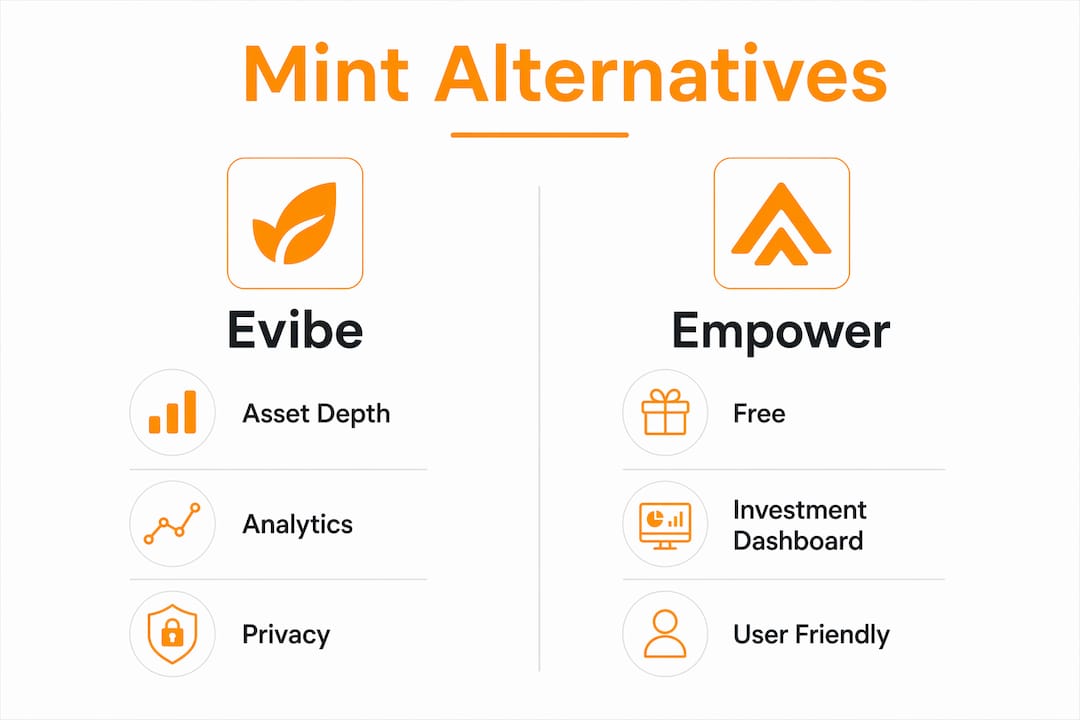
Evibe leads on asset-class depth, analytics, and privacy. Empower holds its own as a free, capable investment dashboard. Here is where each pulls ahead.

| Feature | Evibe | Empower |
|---|---|---|
| Pricing | Free plan; Premium $9.99/mo or $99.99/yr | Free dashboard |
| Asset classes | Stocks, ETFs, options, crypto, real estate, art, vehicles, loans, collectibles, cash | Stocks, ETFs, funds, basic net worth |
| Options analytics | Greeks, expiry calendar | Not available |
| Dividend tracking | Executed, declared, estimated | Basic |
| Multi-currency / FX | Yes, with historical rates | Limited |
| Custom/private assets | Manual entry | Limited |
| AI analysis | Yes (risk, diversification, performance) | No |
| API for AI assistants | ChatGPT, Claude, Gemini | No |
| Platform | iOS, Mac, web | iOS, Android, web |
| Data selling | No | No (advisory upsell) |
Evibe strengths for investors:
- Covers every asset class an active investor is likely to hold, including collectibles, vehicles, and startup equity
- Options tracking with Greeks and expiry calendars is rare at this price point
- Dividend tracking covers executed, declared, and estimated payments
- AI-driven insights surface risk and diversification gaps without requiring manual analysis
- API endpoints let you query your portfolio directly from ChatGPT, Claude, or Gemini
Empower strengths:
- Free dashboard with solid investment account aggregation
- Retirement planner and fee analyzer are genuinely useful tools
- Broad institutional connectivity in the US
Who should pick which:
- Multi-asset investor with private holdings, options positions, or dividend focus → Evibe
- Investor who wants a free basic investment dashboard and does not track private assets → Empower
For a detailed side-by-side, see the Evibe vs. Empower comparison.
What do YNAB, Credit Karma, and Simplifi offer investors?
These three apps serve specific needs well. None of them are portfolio-first tools, but each fits a particular investor profile when paired with a dedicated tracking app.
-
YNAB (You Need a Budget): Zero-based, envelope-style budgeting. If you want to control spending with precision, YNAB is the most disciplined option on this list. Investment tracking is minimal — account balances sync, but there is no asset-class breakdown or dividend data. Best used alongside a portfolio app for investors who also want strict cash-flow control.
-
Credit Karma: Intuit's designated Mint replacement, but the gap is real. It does not replicate Mint's budgeting or investment features. Credit score monitoring and basic spending views are its strengths. Useful for credit-focused investors, not for portfolio monitoring.
-
Simplifi by Quicken: Commonly recommended as a close Mint-like replacement for full-dashboard budgeting with reliable bank sync. Mobile experience is polished. Investment tracking is limited to account balances. Pair it with Evibe if you want both budgeting and portfolio depth.
No single app perfectly replicates Mint. The market has split, and a two-app workflow — one for budgeting, one for portfolio monitoring — is a practical solution many investors now use.
How to switch from Mint: migration checklist
Follow these steps to migrate cleanly without losing historical data or cost-basis accuracy.
Week 1:
- Export your Mint data as CSV before the account goes stale
- Export brokerage statements (CSV or OFX) from each institution
- Map your Mint spending categories to the new app's category structure
- Verify holdings and cost basis against your brokerage records
Week 2:
- Import CSV data into your new app and reconcile the first month's transactions
- Manually enter custom assets (real estate, private equity, collectibles) that cannot sync automatically
- Connect liquid accounts via automatic sync; test each connection
First month:
- Change passwords on all linked financial accounts
- Enable two-factor authentication on the new platform
- Confirm CSV or OFX export works in the new app before deleting Mint data
Pro Tip: Apply automation for routine accounts and manual entry for illiquid or complex assets. "Sync fatigue" is common — account connectivity differs by institution, and successful long-term users combine both approaches to maintain an accurate net worth.
What changed after Mint shut down?
Intuit shut Mint down on March 23, 2024 and directed users to Credit Karma. The market responded quickly, and the shift has been meaningful: apps have moved from ad-funded aggregation toward subscription-first models.
Subscription-based apps generally align their incentives with user privacy. When the product is the subscription, there is less pressure to monetize user data through targeted ads. Understanding why data-selling apps carry real risks helps clarify why this shift matters for investors who share sensitive financial data.
Privacy checklist for any new app:
- No third-party ad targeting
- Clear data-sharing policy (read it)
- Bank-grade encryption in transit and at rest
- Two-factor authentication
- CSV/OFX export available (data portability)
- Transparent business model (subscription vs. ad-funded)
Pricing has shifted accordingly. Free, ad-supported aggregation is less common among quality apps. Subscription costs vary: privacy-first manual-entry apps like Finny have been reported at relatively low monthly prices, while full-featured portfolio apps generally carry higher subscription prices. The trade-off is straightforward: pay with money, or pay with data.
Final recommendation and next steps
For investors who track multiple asset classes, Evibe is the right call. The combination of automatic sync, manual custom-asset entry, AI-driven analysis, and options and dividend analytics covers the full picture of a modern investment portfolio. Empower is the right free alternative for investors who do not need that depth. YNAB and Simplifi belong in a hybrid setup when budgeting discipline matters alongside portfolio monitoring.
Two steps to take this week:
- Export your Mint CSV and brokerage statements now, before data access becomes unreliable
- Sign up for Evibe and test the import with one brokerage account to verify sync and holdings accuracy
Key Takeaways
For investors, the best Mint alternative is Evibe: it covers every major asset class, tracks dividends and options, and uses AI analysis to surface portfolio risk and diversification gaps.
| Point | Details |
|---|---|
| Pick by primary pain point | Portfolio monitoring needs Evibe; strict budgeting needs YNAB; free investment dashboard needs Empower. |
| Evibe leads on asset depth | Stocks, ETFs, options, crypto, real estate, collectibles, and custom assets in one real-time dashboard. |
| Verify export before switching | Confirm CSV or OFX export works in any new app before deleting your Mint data. |
| Hybrid workflow is practical | Use automatic sync for liquid accounts; manually enter illiquid or private assets for accuracy. |
| Privacy follows the business model | Subscription apps sell a service; ad-funded apps often sell data — know which model you are using. |
Why consolidated portfolio visibility is worth paying for
The conventional wisdom after Mint's shutdown was "just use a free app." That framing misses the point for investors. A free dashboard that shows account balances is not the same as a tool that tracks your options Greeks, calculates yield on cost across dividend positions, and lets you query your entire net worth through a ChatGPT prompt.
The real cost of a fragmented setup is not the subscription fee. It is the decisions you make without a complete picture. An investor who tracks stocks in one app, real estate in a spreadsheet, and crypto on an exchange dashboard is not managing a portfolio — they are managing three separate lists. The consolidation is where the insight lives.
Consistency matters more than feature count. An investor who actually uses a slightly simpler app will outperform one who abandons a cumbersome tool after two weeks. But when a tool covers your actual asset mix and fits your workflow, the case for using it every day is obvious. That is what we built Evibe to be.
Evibe: portfolio tracking built for serious investors
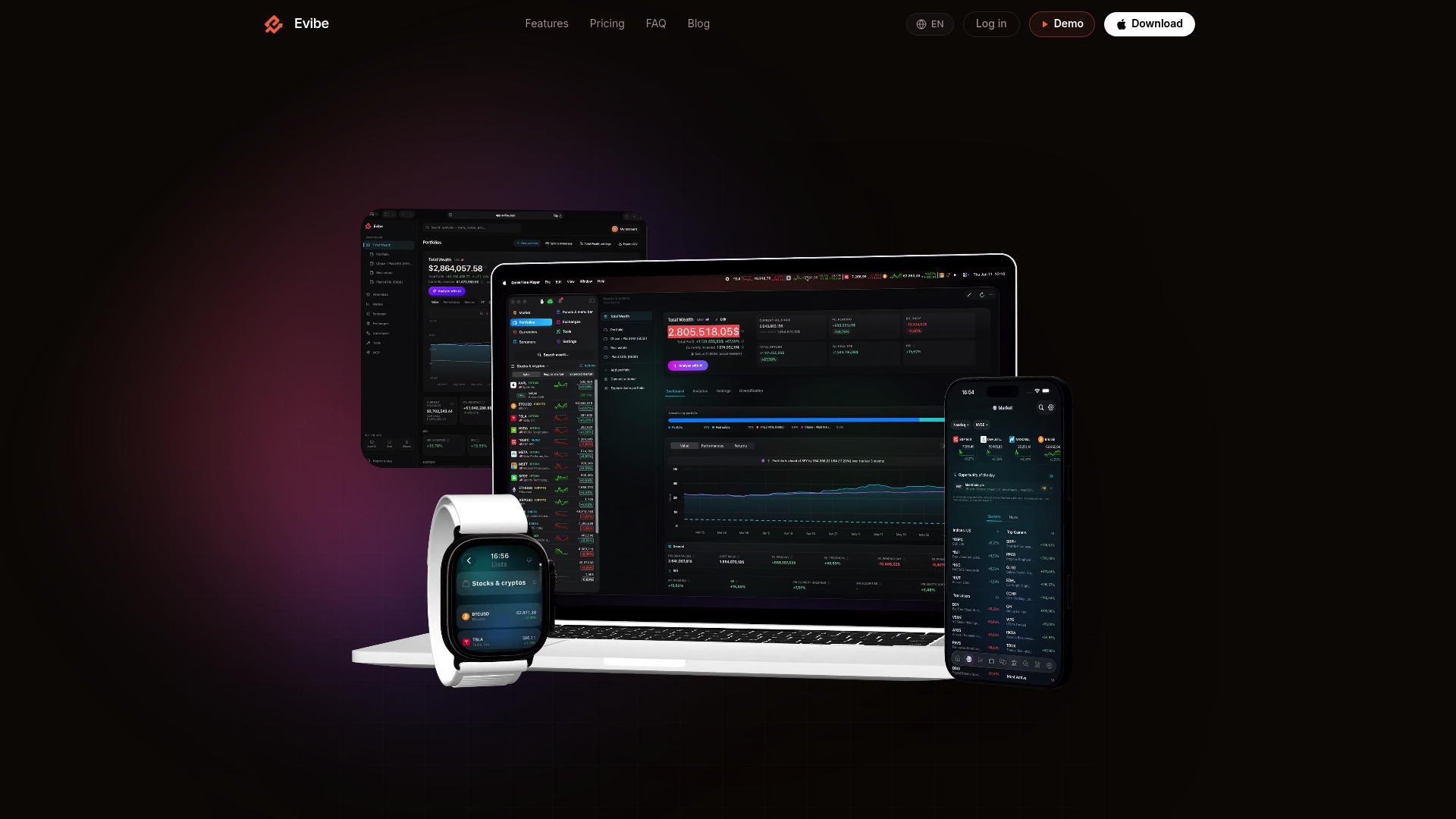
If you tracked investments in Mint and found it shallow, Evibe is the direct upgrade. It consolidates every asset class — stocks, ETFs, options, crypto, real estate, art, vehicles, loans, collectibles, and cash — into a single real-time net-worth dashboard. Dividend tracking covers executed, declared, and estimated payments. Options analytics include Greeks and expiry calendars. AI-driven insights flag risk and diversification gaps without requiring you to run the numbers manually.
No ads. No data selling. Subscription only, managed through the Apple App Store. CSV export is supported. If you are ready to replace Mint with a tool built around your investment portfolio, start with Evibe today. Already tracking dividends? The dividend tracker feature is a good place to start your first import.
Useful sources and further reading
- Evibe — Track your entire net worth, in real time — primary product page with full feature details
- Evibe vs. Empower comparison — side-by-side trade-off analysis for portfolio investors
- Best net worth tracker apps compared — Evibe blog — broader comparison of net-worth tracking platforms
- Engadget: best Mint alternatives — independent roundup with CSV/OFX export notes
- WalletHub: what happened to Mint — timeline and feature comparison of post-Mint options
- Benefits of expense tracking apps — practical overview of tracking app value and privacy considerations
Reminder: verify CSV or OFX export in any new platform before you delete your Mint data or close your old account. Historical transaction data is difficult to recover once access is lost.