Investor Grade Rental Property Tracking: 5 Inputs, 3 Step Routine
Treat rentals as portfolio assets: record five core per-property inputs and follow a three-step monthly cadence. Use automation to keep net worth accurate...
Investor Grade Rental Property Tracking: 5 Inputs, 3 Step Routine

Rental property tracking means treating each property as a portfolio asset defined by three numbers: monthly cash flow, equity, and current market value. You calculate cash flow from rent minus expenses and debt service, equity from market value minus mortgage balance, and value from recent comps. Automated syncing tools cut the manual upkeep by pulling account data and applying AI-driven analysis, so the next step is setting up the per-property metrics that feed the whole dashboard.
TL;DR:
- Automated syncing tools help track property data more efficiently, reducing manual updates to about 10 to 30 minutes per month.
- Weighted calculations for portfolio metrics, such as cap rate and cash-on-cash return, more accurately reflect overall performance based on investment size.
- Regularly update rent, expenses, and mortgage balances monthly to prevent inaccuracies that can distort property valuation and cash flow calculations.
- Tracking equity separately from cash flow reveals long-term wealth growth through mortgage paydown and appreciation, even when cash flow looks weak.
- Monitoring tenant delinquency and setting variance alerts ensures more accurate cash flow projections and guards against operational surprises.
Table of Contents
- Which Per-Property KPIs Should You Track?
- How Do You Roll Properties Up Into Portfolio Totals?
- Where Should Property Data Come From?
- What's the Minimum Monthly Routine?
- What Mistakes Distort Your Rental Numbers?
- How Do Taxes Factor Into Rental Tracking?
- How Should You Track Maintenance and Capital Expenditures?
- How Do You Track Tenant Payments and Delinquency?
- Can You Connect Rental Data to Accounting Software?
- What Legal and Compliance Records Should You Track?
- An Editorial Take on Where Rental Tracking Goes Wrong
- See Your Rental Properties Alongside Every Other Asset You Own
- Sources
- FAQ
Which Per-Property KPIs Should You Track?
Every rental in your portfolio needs the same core data set, whether it's a single condo or one of a dozen doors. Miss a field here and your net-worth number drifts from reality within a few months.
At minimum, record:
- Gross scheduled rent (what the unit should collect at full occupancy)
- Vacancy loss (rent lost to empty months)
- Itemized operating expenses (taxes, insurance, maintenance, property management fees, utilities you cover)
- Debt service, meaning principal and interest (P&I) on the mortgage
- Monthly net cash flow (what's left after everything above)
This lines up closely with the seven-item baseline that spreadsheet frameworks recommend for per-property tracking and portfolio roll-ups.
From those five inputs, you can calculate the four numbers that actually tell you how a property is performing.
Pro Tip: Net Operating Income (NOI) is your foundation metric. NOI = gross rent − vacancy loss − operating expenses (debt service is excluded). Cap rate = NOI ÷ market value. Cash-on-cash return = annual pre-tax cash flow ÷ total cash invested. Gross rent multiplier = market value ÷ gross annual rent.
Equity is a separate track from cash flow: market value minus current mortgage balance. Every mortgage payment shifts a slice of that P&I toward principal, quietly building equity even in a month when cash flow is flat or negative. That's why combining metrics rather than watching one in isolation is standard practice for real estate KPI tracking. A property can look weak on cash-on-cash and still be building real wealth through paydown and appreciation.
How Do You Roll Properties Up Into Portfolio Totals?
Once each property has its own numbers, the portfolio view is just arithmetic, with one caveat: averages have to be weighted, not simple.
Total portfolio value is the sum of every property's current market value. Total equity is the sum of each property's market value minus its mortgage balance. Total monthly cash flow and total annual NOI are simple sums too, since they're already in dollar terms.
Cap rate and cash-on-cash return are different. You cannot just average the individual percentages, because that treats a $90,000 condo and a $900,000 fourplex as equally important to the outcome. Instead:
- Weighted cap rate = total portfolio NOI ÷ total portfolio value × 100
- Weighted cash-on-cash = total annual cash flow ÷ total cash invested across all properties
But if the large property represents 80% of your invested capital, your real portfolio yield sits much closer to 5.6%. That's the number lenders and your own net-worth math should be using, and it's the same logic behind weighted portfolio-level tracking that treats value-weighted metrics as the accurate read on performance.
Most investors save a snapshot of these totals periodically and use lender-ready exports when refinancing or applying for new financing, since underwriters want portfolio-level cash flow, not property-by-property spreadsheets.
Where Should Property Data Come From?
Your dashboard is only as good as its inputs, and rental data comes from more places than a stock ticker does.
The realistic source list includes:
- Bank or brokerage account syncs for rent deposits and mortgage payments
- Monthly mortgage statements for principal and interest breakdowns
- Rent-roll or property-management exports (CSV files) if you use a management company
- Prior-year tax records for expense categories
- Market rent comps and recent sale comps for valuation updates
A spreadsheet works fine for one or two properties if you're diligent about monthly updates. Past that, the math changes. Industry data on rental tracking suggests spreadsheets typically break down between three and five properties because the manual reconciliation time grows faster than the portfolio does. If you're spending more than 15 minutes a month per property just updating numbers, that's your automation trigger.
This is exactly the gap Evibe's automatic account syncing and AI-driven analysis are built to close, alongside a multi-asset tracking routine that keeps real estate sitting next to stocks and crypto instead of in a separate file.
Pro Tip: Automated valuations are a starting point, not gospel. Spot-check any auto-generated value against two or three recent comps and confirm the comparable's lease terms and unit condition actually match yours.
What's the Minimum Monthly Routine?
A dashboard that requires an hour of upkeep per property will get abandoned by month three. The goal is a routine light enough to survive a busy quarter.
- Monthly: Reconcile rent deposits against expected rent, update the mortgage principal balance and current cash flow, and flag any lease expiring in the next 90 days.
- Quarterly: Refresh market rent comps for units coming up for renewal, and check for insurance or property tax changes that would shift your expense line.
- Annually: Take a full portfolio snapshot for net-worth tracking and prepare lender-ready exports or a tax-year summary.
Manual maintenance runs 10 to 30 minutes per property each month depending on how many income and expense lines you're tracking. Syncing tools compress that down to a quick review of numbers that already updated themselves.
What Mistakes Distort Your Rental Numbers?
The two most common errors both come from letting a number sit too long without a check.
Stale rent or expense inputs are the biggest one. If a tenant's rent went up eight months ago and your spreadsheet still shows the old figure, your NOI, cap rate, and portfolio value are all quietly wrong, sometimes by thousands of dollars in implied value. The second mistake is ignoring principal paydown and equity in favor of cash flow alone; investors who only watch monthly cash flow sometimes sell a property that's building real long-term wealth through paydown and appreciation, just because the cash-on-cash number looks thin that quarter.
- Budget a CapEx reserve line into every property, since major repairs are a certainty, not a surprise.
- Track equity as its own line, separate from monthly cash flow.
- Set variance alerts so a rent drop or expense spike gets flagged instead of discovered three months later.
A wide gap between budgeted and actual numbers is usually an early warning of an operational problem, not noise to ignore.
How Do Taxes Factor Into Rental Tracking?
Tax treatment is where a lot of net-worth dashboards fall short, because taxable rental income rarely matches your monthly cash flow. Depreciation reduces your taxable income without touching your bank account, which means a property can show negative taxable income while still generating positive cash flow, and vice versa in some structures.
Track these separately from your cash-flow calculation:
- Annual depreciation deduction claimed on the property
- Deductible operating expenses versus capital improvements (these are treated differently by the IRS)
- Mortgage interest paid, which is deductible, versus principal, which is not
- Any passive activity loss carryforwards if your rental income is limited by income thresholds
Total ROI calculations that fold in appreciation, principal paydown, cash flow, and tax effects together can reveal something a pure cash-flow view misses entirely: a property with negative monthly cash flow can still deliver strong total return once you account for equity growth and tax benefits. That's a good argument for running the total-ROI math annually, not just glancing at monthly cash flow. Keep a folder of tax documents, whether digital or physical, organized by property and by tax year, so your accountant isn't reconstructing a year's worth of receipts every April.
How Should You Track Maintenance and Capital Expenditures?
Maintenance and capital expenditures (CapEx) hit your numbers differently, and mixing them up understates your true operating costs. Maintenance is routine and recurring: a leaking faucet, a furnace tune-up, gutter cleaning. Capital expenditures are larger, less frequent investments that extend the property's useful life: a new roof, a full HVAC replacement, a kitchen remodel.
Routine maintenance belongs in your monthly operating expense line and flows directly into your NOI calculation. CapEx typically doesn't hit NOI the same way. Instead, seasoned investors set aside a monthly CapEx reserve, often a percentage of gross rent, so a $12,000 roof replacement doesn't blow up a single month's cash flow figure. Without that reserve line, under-budgeting for CapEx is one of the most common reasons an investor's cash flow projections turn out to be too optimistic.

Track each CapEx item with the date, cost, and expected useful life. This matters for two reasons: it feeds your tax depreciation schedule, and it gives you a real sense of a property's age and condition when you're deciding whether to hold or sell. A property with a newer roof, updated electrical, and a recent HVAC system carries a fundamentally different risk profile than one with the same rent roll but original 1995 systems, even if this month's numbers look identical.
How Do You Track Tenant Payments and Delinquency?
Tenant payment tracking feeds directly into your vacancy loss and cash flow numbers, so it can't be an afterthought. The core habit is simple: log rent due, rent received, and the date received, for every unit, every month.
Delinquency is where the real signal lives. A single late payment might mean nothing. A tenant who's 15 or more days late two months running is a pattern that should trigger a closer look at that unit's contribution to your portfolio numbers, and possibly a conversation about a payment plan or, in persistent cases, next steps toward turnover. The distinction between surface-level occupancy and durable, economic occupancy matters here: a unit that's technically occupied but chronically underpaying is providing less real cash flow than your rent roll suggests, even though it looks "full" on paper.
Build a simple delinquency threshold into your monthly review: flag any tenant more than 10 days late, and treat repeated flags as a reason to update that property's realistic cash flow projection rather than assuming the rent roll figure will always be collected. This is also where your CapEx and maintenance reserves earn their keep, since covering a mortgage payment during a vacancy or delinquency stretch is exactly what that reserve exists for.
Can You Connect Rental Data to Accounting Software?
Most investors eventually want their rental numbers talking to whatever handles their taxes and bookkeeping, and the connection point is usually a clean CSV export or a direct integration. Property-management platforms that generate a rent roll can typically export income and expense data in a format your accountant, or your own bookkeeping software, can ingest without a full manual re-entry.
The practical workflow: your property-level data (rent, expenses, debt service) lives in your tracking dashboard for portfolio and net-worth purposes, while a parallel export feeds your accounting software for tax preparation and expense categorization. Keeping these in sync monthly, rather than reconciling once a year, avoids the scramble every April where three months of receipts need to be matched against bank statements from memory.
If you're using a portfolio tracker for the net-worth view and a separate accounting tool for tax categorization, the same underlying numbers, gross rent, operating expenses, debt service, should match in both places. A mismatch usually means one system has stale data, and it's worth tracing which one before you trust either number for a lender application or a tax filing.
What Legal and Compliance Records Should You Track?
Rental compliance tracking rarely makes it into a financial dashboard, but a lapsed license or a missed inspection can turn into a real cost, sometimes fast enough to erase a month of cash flow. Depending on your city and property type, you may need to track:
- Rental license or permit renewal dates
- Required inspection schedules (fire safety, occupancy, lead paint disclosures in older buildings)
- Insurance policy renewal dates and coverage limits
- HOA or condo association compliance items, if applicable
None of these show up in a cap rate calculation, but every one of them is a real liability if it lapses. A rental license that expires unnoticed can mean fines or, in some jurisdictions, an inability to legally collect rent until it's renewed. The practical fix is treating compliance dates the same way you treat lease expirations: flag anything coming due in the next 90 days as part of your regular review, rather than discovering a violation notice in the mail. This is a smaller line item than your rent and expense tracking, but it belongs in the same monthly habit, because compliance failures tend to surface at the worst possible time, usually right when you're trying to refinance or sell.
An Editorial Take on Where Rental Tracking Goes Wrong
The biggest blind spot in rental property tracking isn't a missing formula. It's the assumption that a property's financial story is told by whichever metric you happen to be looking at that day. Investors who watch cash flow exclusively sell winners too early. Investors who watch appreciation exclusively get blindsided when a market cools and cash flow was quietly negative the whole time. The properties that actually build wealth tend to be the ones tracked on all three pillars at once: cash flow, equity, and market value, reviewed together rather than in isolation.

What's underappreciated is how much of this comes down to habit rather than sophistication. A retail investor with one duplex and a disciplined monthly routine will out-track a landlord with ten units and a spreadsheet nobody has opened since March. Evibe's approach reflects that: automatic account syncing and AI-driven analysis exist specifically to keep the habit alive without demanding an hour of data entry every weekend, and the same multi-asset structure that handles your ETF and dividend positions extends naturally to a rental property sitting in the same net-worth view. On privacy, Evibe's stated approach, anonymized data storage, never seeing account passwords, and GDPR-aligned deletion, matters more for real estate than people assume, since mortgage and property data is some of the most sensitive financial information a household holds.
If there's a contrarian point worth making, it's this: obsessing over precision in your KPI formulas matters less than simply updating the numbers on a fixed schedule. A cap rate calculated to two decimal places on data from eight months ago is less useful than a rough estimate updated last week.
— Vincent
See Your Rental Properties Alongside Every Other Asset You Own
Some portfolio trackers fold rental properties into the same dashboard as stocks, ETFs, and crypto, so equity and cash flow update through automatic account syncing instead of a spreadsheet you have to remember to open.
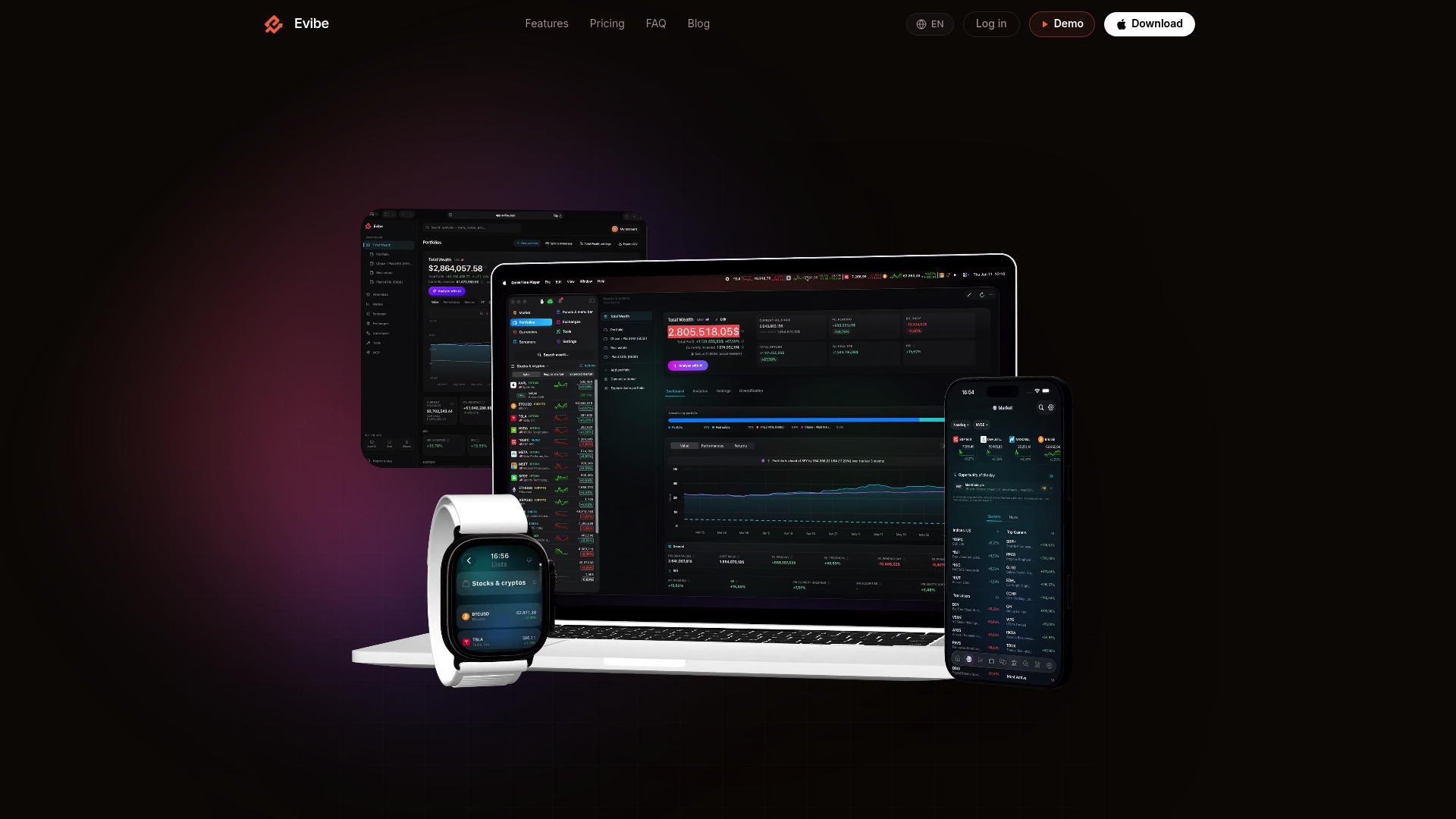
You still enter the property details and mortgage terms yourself, but AI-driven analysis and smart alerts handle the ongoing work of flagging drift in cash flow or equity, the same way it tracks options positions or dividend income elsewhere in your portfolio. For $79 per year, Evibe gives you one place to watch net worth move, real estate included, and every plan starts with a 7 day free trial. Validate your comps and lease terms yourself, keep your own records for tax season, and let the dashboard handle the daily math. Start your trial today and see where your rentals actually fit in the bigger picture.
Sources
KPI definitions and portfolio practices above draw on the Galleon rental spreadsheet guide, the ARVCalc ROI calculator, Smart Rental Investor's portfolio tracking features, and NetSuite's real estate metrics primer.
This article is general information, not a substitute for advice from a qualified financial advisor. Consult a qualified financial professional about your own circumstances before acting on anything here.
- Rental Property Spreadsheet: What to Track, How to Set It Up, and When to Replace It
- Rental Property ROI Calculator: Calculate Total (2026)
- Real estate metrics — NetSuite
FAQ
How often should I update my rental property tracking?
Update rent deposits and mortgage balances monthly, refresh market comps quarterly for any unit near renewal, and take a full portfolio snapshot annually. Tools with automated syncing reduce this to a quick monthly review since values update on their own.
Does principal paydown count toward my net worth?
Yes. Principal paydown increases your equity in the property (market value minus mortgage balance), and that equity is part of your net worth even in a month when cash flow is flat or negative.
How do I handle vacancies in my tracking?
Record vacancy as lost gross rent for that period rather than leaving the field blank, since it factors directly into NOI and cash-on-cash calculations. A vacancy that isn't logged makes your historical cash flow numbers look better than they actually were.
Can Evibe track rental properties alongside stocks and crypto?
Yes, Evibe consolidates real estate with stocks, ETFs, crypto, and other assets into one net-worth dashboard, using automatic account syncing and AI-driven analysis. A subscription is $79 per year with a 7 day free trial.
What's the difference between cash-on-cash return and cap rate?
Cash-on-cash return measures annual cash flow against the actual cash you invested, including your down payment, while cap rate measures NOI against the property's current market value regardless of financing. Both matter, since combining metrics gives a fuller read than either one alone.