15 Minutes a Month: Multi Asset Portfolio Tracking for U.S. Investors
Track stocks, crypto, real estate, and FX to see your true net worth in one place. Setup takes 20 minutes, upkeep just 15 a month. Try Evibe free for 7 days.
15 Minutes a Month: Multi Asset Portfolio Tracking for U.S. Investors

A practical multi-asset tracker pulls every holding, stock, ETF, crypto, real estate, private deal, into a single net-worth view, converts it all to one currency at accurate historical exchange rates, and reports both time-weighted and money-weighted (XIRR) returns so you know what you actually earned. Add a short monthly reconciliation routine, and you get allocation and risk signals you can act on instead of a spreadsheet that's already out of date.
TL;DR:
- Multi-asset trackers must accurately convert multi-currency holdings using historical FX rates to measure true returns and avoid misleading performance reports.
- They should support automatic account aggregation without sharing login credentials and provide manual entry options for illiquid assets like real estate and collectibles.
- Regular reconciliation, especially for manual valuations, is essential to prevent drift from actual asset values and maintain allocation accuracy.
- Performance metrics should include both time-weighted returns and XIRR, with clear risk signals and detailed tax lot tracking for effective tax planning.
- Real-time alerts for liquid assets and customizable visual reports help investors act promptly and understand portfolio diversification and risk levels.
Table of Contents
- Why Multi-Asset Portfolio Tracking Matters for Active Investors
- Core Features and Metrics Your Tracker Needs
- How to Set Up Multi-Asset Portfolio Tracking in One Sitting
- How Different Investors Should Use a Multi-Asset Tracker
- Why Evibe Fits the Multi-Asset Tracking Problem
- How Long Setup Actually Takes and What Maintenance Looks Like After
- Tax Reporting and Compliance Features to Look For
- Real-Time Data Updates and Alerts That Actually Help
- Customizable Reporting and Visualization Tools
- Security Best Practices for Portfolio Tracking Tools
- Author Perspective: Manual vs Connected Tracking Tradeoffs
- Start Tracking Every Asset in One Place With Evibe
- Sources
- FAQ
Why Multi-Asset Portfolio Tracking Matters for Active Investors
Most investors don't lose money from bad picks. They lose it from not knowing what they own. If your brokerage account, your crypto exchange, and your rental property live in three different places, you can easily double-count a holding, or miss that 40% of your net worth sits in one sector without realizing it.
Consolidated visibility fixes that. It also enables decisions you can't make from four disconnected apps:
- Rebalancing based on your real allocation, not a guess
- Spotting concentration risk before a single stock or sector dominates your net worth
- Timing tax-loss harvesting because you can see unrealized gains and losses across every account at once
- Comparing your actual performance against a benchmark, in your base currency, not in whatever currency each account happens to report
That last point matters more than most investors realize. A portfolio that's up 12% in local currency terms might be flat, or negative, once you revalue it against the dollar using historical FX rates. Skip multi-currency revaluation, and you're not measuring returns. You're measuring noise.
Core Features and Metrics Your Tracker Needs
Not every portfolio app is built for someone holding stocks, crypto, and real estate at once. Before you commit to one, check it against this list:
- Automatic account aggregation with secure credential handling. The tracker should sync brokerage and bank accounts without asking you to hand over your actual login credentials to a third party.
- Multi-currency valuation with historical FX conversion. Real-time conversion is table stakes; historical rate accuracy is what separates a serious tool from a toy, since Endute notes that daily FX data is what makes multi-currency returns trustworthy.
- Crypto and on-chain handling. Staking rewards, lending positions, and NFTs need either native support or a clean manual-entry path.
- Both TWR and XIRR performance reporting. Time-weighted returns show how your strategy performed; money-weighted returns (XIRR) show what your actual cash flows earned, deposits and withdrawals included.
- Allocation, concentration, and basic risk signals. You want to see, at a glance, how exposed you are to one asset class, one sector, or one currency.
- Dividend and options tracking. If you collect income or trade derivatives, generic net-worth trackers usually fall short here.
- Manual valuation for illiquid assets, plus real privacy controls. Real estate, art, and private equity don't have live prices. A good tracker lets you enter and update those manually without weakening your account security elsewhere.
Pro Tip: Don't judge a tracker by how many logos it supports. Judge it by whether it separates market movement from your own deposits and withdrawals, that distinction is the difference between an accurate return and a flattering guess.
How to Set Up Multi-Asset Portfolio Tracking in One Sitting
Setup takes less time than most people expect, but skipping steps here is where accuracy problems start later.
- Inventory everything first. List every brokerage, bank, crypto exchange, wallet, property, and outstanding debt, along with tax lot details for major holdings if you have them.
- Connect accounts or import holdings. Link what you can sync automatically, and import the rest as a starting balance. Set your base currency once, up front, so every valuation converts consistently.
- Classify each holding. Separate cash, equities, crypto, real estate, and private investments into their own categories so allocation reporting actually means something.
- Turn on dividend and options tracking if you hold either. Set alerts for price moves, dividend payments, or expiring options so you're not checking manually every day.
- Build a monthly maintenance habit. Reconcile balances, update manual valuations for property or collectibles, and act on any alerts that flagged something worth reviewing.
Most of this takes under an hour for a typical portfolio spanning three or four institutions. The ongoing cost is closer to fifteen minutes a month, assuming your automatic syncing is doing its job.
How Different Investors Should Use a Multi-Asset Tracker
The same app supports very different workflows depending on what you're actually trying to see.
The active trader needs frequent syncing, real-time position profit and loss, and an options expiry calendar if derivatives are part of the strategy. Intraday alerts on price swings matter more here than anywhere else, since a delayed sync can mean missing a move entirely.
The dividend investor cares less about minute-to-minute price action and more about income. Executed-versus-declared dividend tracking, a clear income runway, and visibility into payout adjustments matter more than intraday alerts.
- Track ex-dividend and payment dates separately from declared amounts
- Watch yield on cost, not just current yield, to see how income has grown relative to your original investment
- Flag any dividend cuts immediately rather than discovering them a quarter later
The net-worth monitor takes a slower approach entirely. Monthly valuations for property, vehicles, or collectibles, combined with an FX-normalized total and a benchmark comparison against a major index, give a clear read on long-term progress without daily noise.
Why Evibe Fits the Multi-Asset Tracking Problem
Evibe was built around one idea: the picture is finally complete when stocks, ETFs, crypto, real estate, and custom assets like art or startups sit in the same dashboard instead of four separate apps. Automatic syncing handles the brokerage and bank side of that equation, which cuts down manual entry and keeps the numbers current without you refreshing five tabs.
AI-driven analysis is where Evibe goes further than a basic aggregator. Instead of a raw list of holdings, you get plain-language signals on diversification, concentration, and risk, the kind of read that used to require pulling numbers into a spreadsheet yourself.
Multi-currency support with historical FX rates means a rental property in one currency and a brokerage account in another both roll up into one accurate net-worth figure, not two disconnected numbers you have to reconcile by hand.
Dividend investors get dedicated dividend tracking that separates declared, executed, and estimated payments. Traders get options tools built around Greeks and expiry calendars. Investors curious how Evibe stacks up against single-purpose apps can read the comparison against Mint for more detail on where broader coverage actually pays off.
How Long Setup Actually Takes and What Maintenance Looks Like After
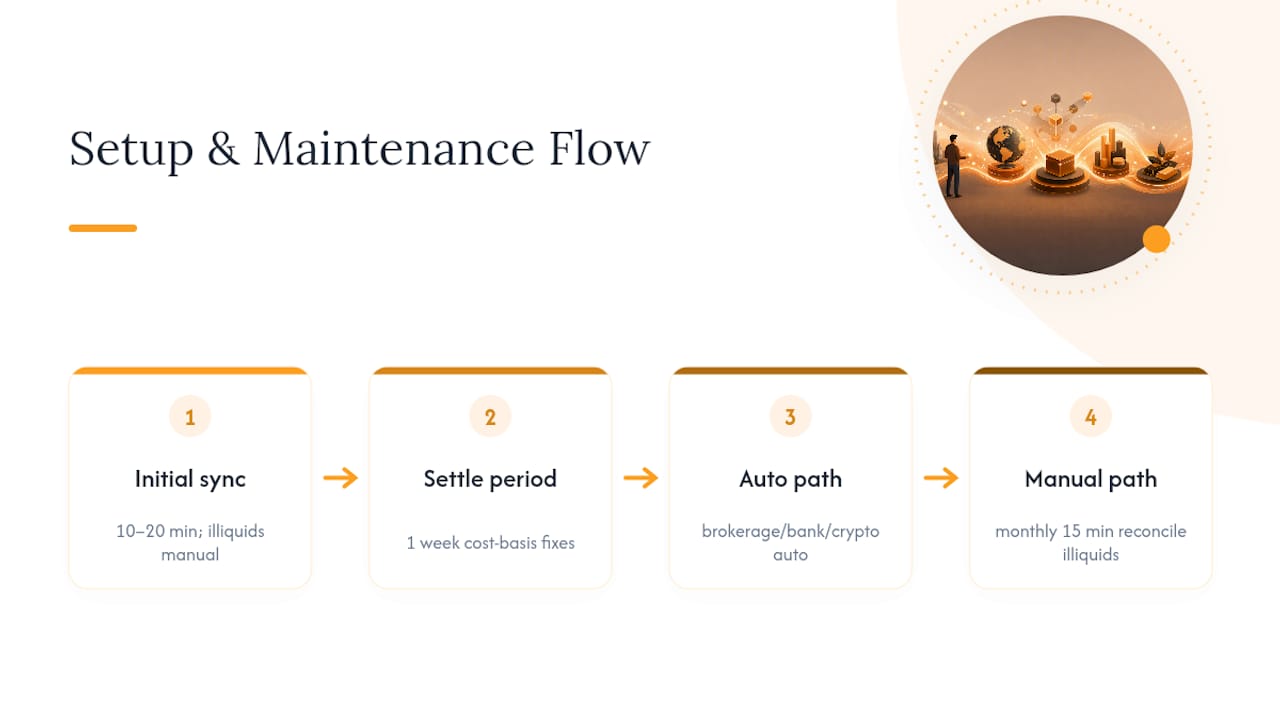
Initial sync for most portfolios takes ten to twenty minutes once you have your account credentials ready, brokerage, bank, and crypto exchange connections tend to complete almost instantly, while real estate and private holdings take a bit longer since you're entering purchase price, current estimated value, and any debt tied to the asset by hand.
Expect a short settling period after that first sync. Cost basis on older positions occasionally needs a manual correction, especially for assets transferred between brokers years ago where the original purchase data didn't travel cleanly. Give it a week to surface any mismatches before you trust the numbers completely.
After that, maintenance is light. Connected accounts, brokerage, bank, most crypto exchanges, update automatically, so there's nothing to do there beyond occasionally re-authenticating if a connection drops. The real work sits with illiquid assets: property values, private equity stakes, collectibles. Those need a deliberate monthly touch, updating an estimated value based on a comparable sale, an appraisal, or a market index if you're tracking something like a private fund.
Budget fifteen minutes a month for that reconciliation. Skip it for three or four months, and your allocation percentages start drifting from reality, which defeats the entire purpose of consolidating in the first place. The automatic side of tracking is nearly maintenance-free. The manual side is where discipline still matters.
Tax Reporting and Compliance Features to Look For
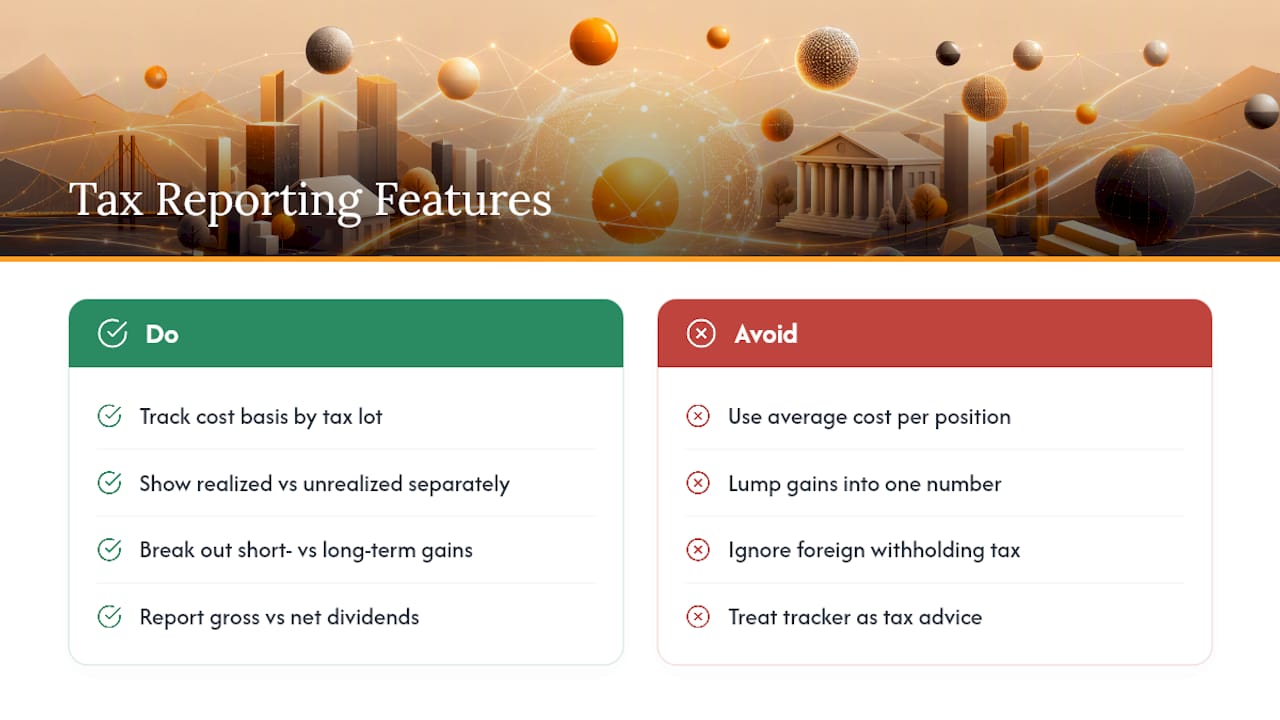
A tracker that shows performance but ignores tax lots is only doing half the job. Cost basis tracking, ideally down to individual tax lots rather than an average cost per position, is what lets you actually plan a tax-loss harvest instead of guessing which shares to sell.
Realized versus unrealized gains should be visible separately, and broken out by short-term versus long-term holding periods given how differently those are taxed in the United States. A tracker that lumps everything into one number forces you to redo that math yourself at the worst possible time, in April.
Dividend and interest income reporting matters just as much, particularly for investors holding foreign stocks or funds where withholding tax already came out before the payment hit your account. Being able to see gross versus net dividend income across every holding saves real time when you or your accountant sit down with the actual filing.
None of this replaces a tax professional or filing software, and no portfolio tracker should be treated as one. What a good tracker does is organize the underlying data so that conversation, and that filing, take an hour instead of a weekend.
Real-Time Data Updates and Alerts That Actually Help
Real-time pricing matters most for liquid, fast-moving assets, stocks, ETFs, and crypto, where a delayed quote can mean acting on stale information. For real estate, private equity, or collectibles, "real-time" isn't realistic or even useful; monthly or quarterly manual updates make more sense given how those markets actually move.
Alerts are where real-time data earns its keep. A price alert on a concentrated position, a notification when a dividend is declared, or a warning that an option is approaching expiry all turn passive tracking into something you can act on. The goal isn't to check your portfolio constantly, it's to be told the moment something requires your attention and otherwise leave it alone.
Pro Tip: Set alerts on percentage moves relative to your position size, not flat dollar amounts. A $500 swing means very different things depending on whether it's 1% or 20% of that holding.
Customizable Reporting and Visualization Tools
Raw numbers tell you what happened. Visualization tells you what it means. Allocation breakdowns by asset class, sector, and currency should be viewable at a glance, and the best trackers let you slice that view multiple ways, by account, by entity, or by time period, without exporting anything to a spreadsheet.
Performance charts that separate market movement from your own deposits and withdrawals matter more than a simple line going up. That's the same TWR versus XIRR distinction covered earlier, and it should show up visually, not just as a number buried in a settings page.
Custom date ranges, benchmark overlays against a major index, and the ability to filter by asset type turn a tracker from a static report into an actual research tool. If a platform only offers one fixed dashboard layout, you'll likely outgrow it once your portfolio gets more complex.
Security Best Practices for Portfolio Tracking Tools
Handing an app read access to your entire financial life is not a small decision, and it's worth treating it that way. Look for a provider that uses read-only bank connections through an established aggregation layer rather than one that asks for your actual brokerage password directly.
Data encryption both in transit and at rest should be standard, not a premium feature. Two-factor authentication on your own account login matters just as much as anything the provider does on their end, since a weak password on your side undermines strong security everywhere else.
Check how a provider handles your data when you're not using the app. A privacy-first approach that never sees your actual login credentials, and that supports full account deletion, is meaningfully different from a free app quietly monetizing your financial data through ads or third-party sales. Read the privacy policy once before connecting anything, not after.
Author Perspective: Manual vs Connected Tracking Tradeoffs
Most investors treat automatic syncing as an all-or-nothing decision. It isn't. I'd connect brokerage and bank accounts automatically without hesitation, that's low-risk, high-value convenience. Real estate, private deals, and anything genuinely unusual, I'd enter manually every time. The friction of typing a number once a month is a small price for not exposing credentials somewhere they don't need to be.
Reconciliation cadence should match volatility. Crypto and equities deserve a weekly glance. Real estate and collectibles need monthly attention at most, since manual verification works fine when the underlying value barely moves week to week.
Watch for duplicated holdings after reconnecting an account, and unexplained FX swings that don't match actual currency movement. Both usually mean a connector is drifting, not that your portfolio actually changed.
*— Vincent
Start Tracking Every Asset in One Place With Evibe
Spreadsheets and single-purpose apps force you to choose: track your stocks well, or track your crypto well, or track your real estate well, but rarely all three with the same accuracy. Evibe is built to close that gap. Automatic account syncing keeps your stocks, ETFs, and crypto current without manual entry, while custom assets like real estate, art, or startups slot in with manual valuations you control. AI-driven analysis then turns all of it into plain-language signals on diversification and risk, and multi-currency support means your net worth adds up correctly no matter where each asset is denominated.
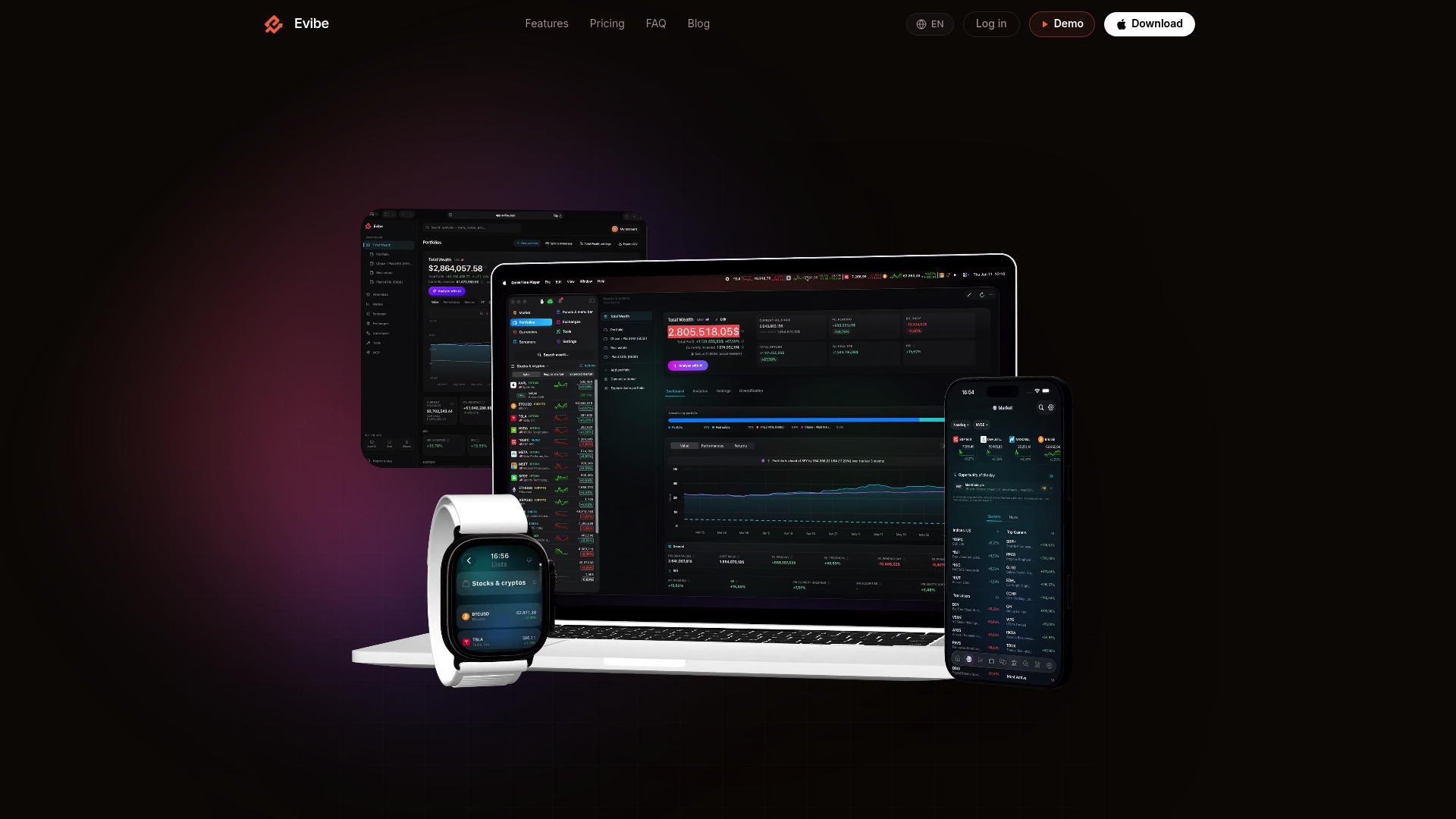
Evibe is free to use, and every new account starts with 7 days of Premium — broker sync included — giving you enough time to connect your accounts and see whether the picture matches what you expected. Data handling stays privacy-first throughout: the service never sees your login credentials, doesn't run ads, and doesn't sell your information. If you're tired of reconciling four apps by hand, start free today and see your full net worth in one dashboard.
Sources
For deeper detail on the concepts covered here, see Endute's breakdown of TWR and XIRR, Kubera's approach to multi-entity net worth, and Assetli's take on mixing live and manual valuations. For Evibe-specific detail, see the multi-currency tracker guide and ETF tracking page.
This article is general information, not a substitute for advice from a qualified financial advisor. Consult a qualified financial professional about your own circumstances before acting on anything here.
FAQ
What Is the Difference Between TWR and XIRR?
Time-weighted return (TWR) measures how well your investment strategy performed, stripping out the effect of when you added or withdrew cash. Money-weighted return, calculated as XIRR, reflects what your actual dollars earned given the timing of your deposits and withdrawals. Both matter: TWR compares your strategy to a benchmark, while XIRR tells you your personal result.
How Do I Track Crypto and Stocks in One Place?
A multi-asset tracker connects to brokerage accounts and crypto exchanges through secure, read-only aggregation, then converts everything into one base currency for a combined view. Evibe supports this consolidation automatically, alongside manual entry for wallets or holdings that don't sync directly.
Is It Safe to Connect My Bank and Brokerage Accounts to a Tracker?
It's safe with providers that use read-only, encrypted connections and never store your actual login credentials. Check the provider's privacy policy for data deletion rights and confirm two-factor authentication is available on your own account before connecting anything.
How Much Does Evibe Cost?
Evibe is free to use: the Free plan covers one portfolio of up to 50 holdings. Premium is $9.99 per month or $99.99 per year, and every new account starts with 7 days of Premium. No ads or data sales involved.
Do I Still Need a Spreadsheet if I Use a Tracker?
Most investors don't, once real estate, private equity, and other illiquid assets are entered manually inside the tracker itself. A mixed approach of live pricing for liquid assets and manual valuation for everything else typically replaces the need for a separate spreadsheet entirely.