Portfolio Rebalancing Rules: 5 Point Checklist, 60/40 Example, Evibe
Rules first portfolio rebalancing: quarterly checks, a 5 point trigger, contribution first sequencing to avoid taxes, plus Evibe tracking to automate the...
Portfolio Rebalancing Rules: 5 Point Checklist, 60/40 Example, Evibe

Use a hybrid rule: review your portfolio quarterly, but only trade when a major asset class drifts more than 5 percentage points from target. Prioritize rebalancing inside your 401(k) or IRA first, then use new contributions and dividends to fix taxable accounts before selling anything. This approach, backed by Vanguard and the Bogleheads 5/25 rule, keeps you managing risk instead of chasing returns.
TL;DR:
- Rebalancing should be triggered only when a major asset class drifts more than 5 percentage points from its target, not on a fixed schedule alone.
- Prioritize rebalancing within retirement accounts first to avoid taxable events before adjusting taxable accounts with new contributions and dividends.
- Using a hybrid approach of scheduled checks combined with threshold triggers offers the best balance between responsiveness and trading costs.
- Tighter thresholds are advisable near retirement, especially for narrower margins like 3 or 5 points, due to sequence-of-returns risks.
- Automating tracking with multi-account support and drift alerts helps maintain discipline and prevents costly emotional decisions.
Table of Contents
- The Core Rebalancing Checklist Every Investor Needs
- Calendar, Threshold, or Hybrid: Which Rebalancing Method Fits?
- How Often Should You Actually Check Your Portfolio?
- Why Your Retirement Accounts Should Be Rebalanced First
- Rebalancing Without Selling a Single Share
- A Worked Example: Rebalancing a 60/40 Portfolio
- What a Good Tracking Tool Should Do for You
- The Rebalancing Mistakes That Cost the Most
- Where These Rules Come From
- Why Most Rebalancing Advice Misses the Point
- Sources
The Core Rebalancing Checklist Every Investor Needs
Before you touch a single trade, write down your rules. Vanguard's own guidance treats a documented policy as the difference between disciplined investors and ones who freeze during a market swing. Here's what belongs in yours.
Define the framework first:
- Target allocation: List every sleeve that matters (US stocks, international, bonds, cash, alternatives) and its target percentage.
- Trigger unit: Decide whether you're measuring absolute percentage points, relative percentage change, or dollar amounts.
- Cadence: Set a check frequency (monthly, quarterly, annually) separate from your action trigger.
- Valuation date: Use a consistent date each period. Comparing Monday's prices to last quarter's Friday close introduces noise that isn't real drift.
Then set the execution rules:
- Decide your action destination: full reset to target, partial rebalance toward target, or contribution-first (direct new money to underweights before selling anything).
- Set tax guardrails: retirement accounts get rebalanced before taxable accounts, every time.
- Assign execution responsibility: are you doing this yourself, or does a held-away account need a phone call?
- Log every trade with date, reason, and resulting allocation, so your future self can audit the decision.
A written policy sounds like overkill until the market drops 15% and you're deciding in real time whether to sell bonds to buy stocks. Rules made in calm moments protect you from decisions made in panic.
Calendar, Threshold, or Hybrid: Which Rebalancing Method Fits?
Every rebalancing approach reduces to three variations, and Vanguard's own framework treats all three as valid, depending on how much monitoring you're willing to do.
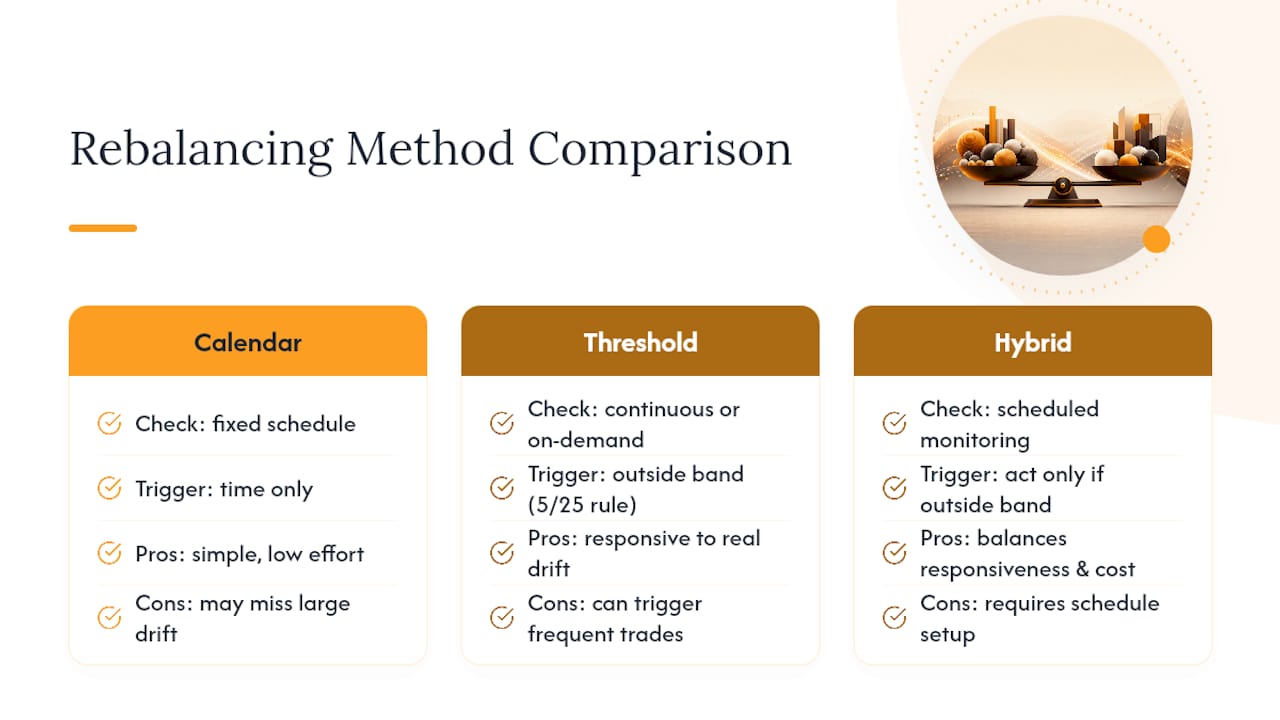
Calendar-based rebalancing means you check and trade on a fixed schedule, like every January or every quarter, regardless of drift. It's simple and low effort, but it can leave you either trading when drift is trivial or ignoring a portfolio that's badly out of balance for months.
Threshold-based rebalancing triggers a trade only when an asset class moves outside a defined band, checked as often as you like. This is where the 5/25 rule comes in: rebalance when a major sleeve drifts by an absolute 5 percentage points (say, target 60% stocks drifting to 65%), or when a smaller sleeve moves by a relative 25% of its own target (a 4% emerging-markets allocation drifting to 5% trips the relative rule even though the absolute move is tiny). The Bogleheads wiki documents this dual threshold precisely because a flat 5-point rule would almost never catch drift in small, volatile sleeves.
Hybrid rebalancing combines both: check on a schedule, act only when outside the band. Research on rebalancing frequency suggests this approach gives the best trade-off between responsiveness and cost, since monitoring is nearly free but every trade carries friction, from bid-ask spreads to tax events.
Pro Tip: If more than half your sleeves are under 10% of your total portfolio, lean on the relative 25% trigger. A pure absolute threshold will let those small positions run unchecked for years.
The tighter your threshold, the more often you'll trade. That's the entire trade-off in one sentence.
How Often Should You Actually Check Your Portfolio?
Frequency and threshold size move together, and getting the pairing wrong is where most self-managed investors lose money to friction. Morningstar's guidance points retail investors toward 3 to 5 percentage point bands checked quarterly or annually, with tighter monitoring reserved for people closer to retirement.
- Annual review: Fits younger investors with long horizons and simple two or three-fund portfolios. Less to monitor, fewer decisions, fewer chances to second-guess yourself.
- Quarterly review: Fits most self-managed investors with five or more sleeves, or anyone holding individual stocks alongside funds.
- Tighter bands near retirement: A 60-year-old drawing down a portfolio faces sequence-of-returns risk, meaning a bad market right before or during retirement does outsized damage. Morningstar's guidance supports narrower thresholds here, since a 10-point drift into equities during a downturn compounds withdrawal risk in a way it simply doesn't for a 30-year-old.
Compare two investors: a 32-year-old with a 90/10 stock-bond split checking annually with a 5-point band will trade maybe once every two or three years. A 61-year-old with a 50/50 split checking quarterly with a 3-point band might trade twice a year. Same rulebook, different dials.
Why Your Retirement Accounts Should Be Rebalanced First
Rebalancing inside a 401(k), traditional IRA, or Roth IRA triggers no current tax bill, since gains and losses inside those wrappers aren't realized events for the IRS. Rebalancing in a taxable brokerage account by selling winners does trigger capital gains, which is why Vanguard's tax-advantaged account guidance tells investors to fix drift inside sheltered accounts before touching anything taxable.
Here's the order that actually saves money:
- Rebalance retirement accounts first. Sell winners and buy underweights inside the 401(k)/IRA with zero tax consequence.
- Route new contributions to underweights. If your bond allocation is light, direct payroll contributions or lump-sum deposits there instead of splitting evenly.
- Route dividends and interest to underweights instead of automatically reinvesting into the same fund that paid them.
- Only then consider taxable sales, and when you do, check lot selection (specific-lot vs. average-cost), whether any positions qualify for long-term rates versus short-term, and whether a nearby loss can offset the gain through tax-loss harvesting.
Pro Tip: Before any taxable sale, run a quick pre-trade checklist: is there a retirement account with room to absorb this rebalance instead? Have I checked for harvestable losses in the same asset class? Will this trade cross the one-year mark from short-term to long-term gains if I wait a few weeks?
Rebalancing Without Selling a Single Share
The cheapest rebalance is the one that never touches an existing position. Directing new money and cash flows toward underweight sleeves accomplishes most of what a sale-and-buy rebalance does, without generating a tax bill. Guidance on contribution-first rebalancing shows this single habit dramatically cuts the number of taxable trades most investors ever need.
- Contribution-first: Every new deposit goes to whichever sleeve is furthest below target, not split evenly by default.
- Dividend routing: Turn off automatic reinvestment into the paying fund and redirect dividend income toward underweights instead.
- Tax-loss harvesting: Selling a losing position to realize a loss, then buying a similar (not identical, to avoid wash-sale rules) fund, can offset gains elsewhere in your rebalance.
- Household-level coordination: If you and a spouse each hold a 401(k) and IRA serving the same retirement goal, rebalance the household total, not each account in isolation. This often means one account stays untouched while another absorbs the whole correction.
Pro Tip: Check whether a loss in one account can be harvested on the same day you'd otherwise sell a winner elsewhere. Pairing the two in a single tax year often nets out close to zero taxable impact.
A Worked Example: Rebalancing a 60/40 Portfolio
Here's the full workflow, using a simple 60% stock, 40% bond portfolio worth $200,000 as the example.
- Measure. On your chosen valuation date, aggregate balances across every account. Say stocks have grown to $130,000 (65%) and bonds have fallen to $70,000 (35%).
- Decide. Your written rule is quarterly review with a 5-point band. Stocks have drifted 5 percentage points above target, exactly at your trigger. That's a rebalance signal, not a maybe.
- Calculate the trade. Target is 60% of $200,000, or $120,000 in stocks. You're at $130,000, so you need to move $10,000 from stocks to bonds to land back at 60/40.
- Execute, tax-aware. If this drift sits inside a Roth IRA, sell $10,000 of stock funds and buy bonds with no tax event. If it's in a taxable account, check for a tax lot with a loss or long-term gain status before choosing which shares to sell, a decision covered in more depth in how realized versus unrealized gains affect your tax bill.
- Verify. After the trade settles, confirm the account shows $120,000 stocks and $80,000 bonds. Log the date, the trigger that fired, and the trade size for your own records.
That $10,000 trade on a $200,000 portfolio is a 5% move, exactly matching the trigger that caused it. When your math and your rule agree that cleanly, you know the system is working as designed.
What a Good Tracking Tool Should Do for You
Running these rules by hand across four or five accounts gets tedious fast, which is exactly the gap a consolidated tracker closes. The features that matter most are multi-account sync so you're not logging into six different logins to add up balances, multi-asset support so real estate and crypto sit next to your brokerage accounts, drift alerts that flag a sleeve the moment it crosses your threshold, and a contribution simulator that shows where new money should go before you deposit it — learn more about the importance of diversifying your currency portfolio.
A good portfolio tracking app automatically pulls balances across banks and brokerages in real time, so the "measure" step above takes seconds instead of a spreadsheet session. AI-driven analysis can flag drift and diversification gaps without you building the math yourself, and smart alerts can notify you the moment a sleeve crosses a threshold you've set.
| Rule component | What to look for in a tracker |
|---|---|
| Measurement | Automatic multi-account, multi-asset aggregation |
| Trigger | Custom drift alerts (percentage point or relative) |
| Contribution-first | Simulator showing where new cash should land |
| Verification | Post-trade allocation snapshot against target |
The Rebalancing Mistakes That Cost the Most
The most expensive mistake is having no written rule at all, since it turns every rebalance into a fresh emotional decision.
- Batch small drift corrections together rather than trading every time a threshold ticks over by a fraction.
- Coordinate at the household level before assuming every account needs its own fix.
- Favor a partial rebalance over a full reset when trade costs or tax impact are material.
- Bring in a financial advisor once your accounts span multiple tax treatments, business ownership, or six figures in taxable gains, where the math gets genuinely complicated.
Pro Tip: If a proposed trade is smaller than what you'd pay in spread or tax friction, skip it this cycle and let it roll into your next scheduled review instead.
Where These Rules Come From
This guide draws on Vanguard's rebalancing methodology, the Bogleheads 5/25 rule documentation, Investor, and Morningstar's frequency guidance. Each source treats rebalancing as a discipline, not a prediction.
Why Most Rebalancing Advice Misses the Point
It isn't. The number matters far less than whether you actually have one written down and follow it when the market gets uncomfortable. I've seen more portfolios damaged by investors abandoning a reasonable rule during a downturn than by investors using a slightly suboptimal threshold consistently.
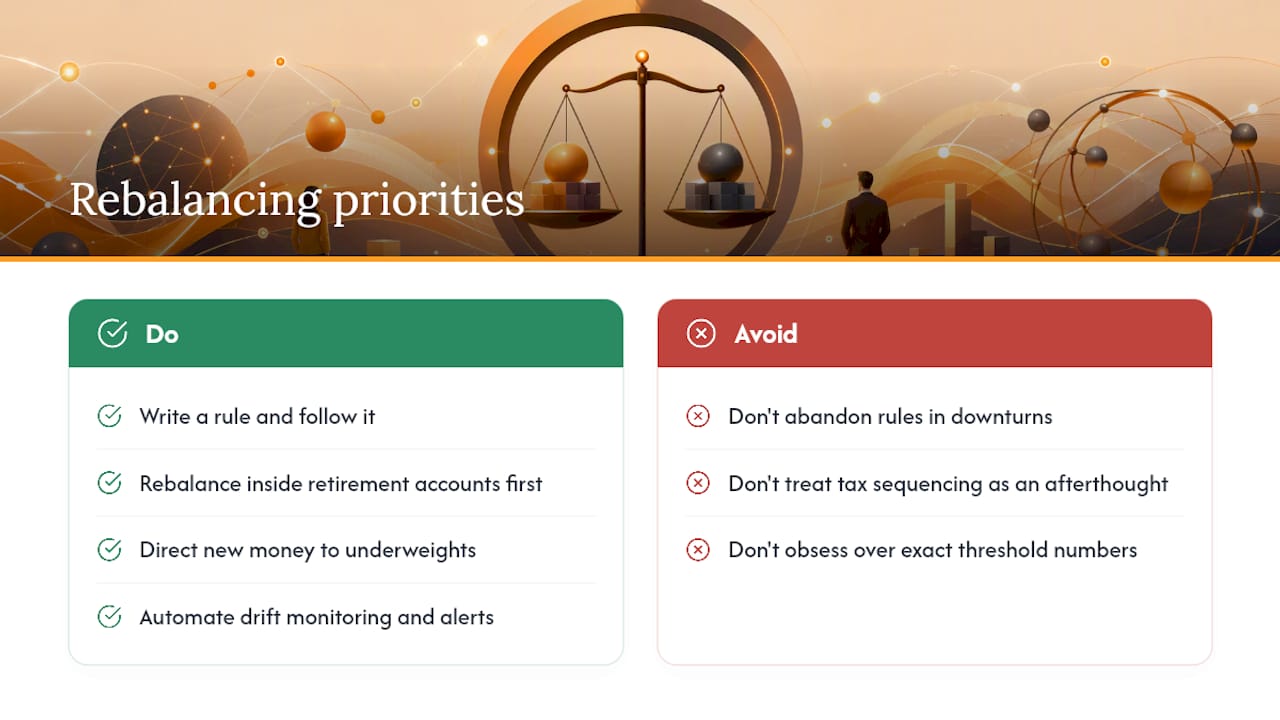
The other place conventional advice falls short is tax sequencing. Plenty of guides mention rebalancing inside retirement accounts as a footnote. It should be step one, not an afterthought, because the tax savings compound the same way returns do.
If you take one thing from this guide, prioritize the contribution-first habit over the threshold debate. Directing new money and dividends toward underweights quietly does most of the rebalancing work most investors think requires selling. Get that right, and the rest of the rulebook becomes a formality you rarely have to invoke.
— Vincent
Ready to stop tracking drift by hand? Evibe syncs your brokerage, retirement, and crypto accounts automatically, so you can see exactly which sleeve has drifted and by how much, without opening a spreadsheet. Set a drift alert once, and let the app tell you when it's time to act on the rules you just built.
This article is general information, not a substitute for advice from a qualified financial advisor. Consult a qualified financial professional about your own circumstances before acting on anything here.