Realized vs Unrealized Gains: What Investors Need to Know
Understand the key differences between realized vs unrealized gains and how they impact your taxes. Maximize your investment strategy today!
Realized vs Unrealized Gains: What Investors Need to Know

TL;DR:
- Realized gains are taxable when you sell assets for more than their cost basis, while unrealized gains are not taxed until sale. Tracking holding periods and cost basis helps manage tax rates and timing, with loss harvesting offering further tax benefits. Proper record-keeping and planning can minimize taxes and improve portfolio efficiency.
Realized gains are taxable events; unrealized gains are not — that single distinction drives most U.S. capital gains tax planning. When you sell an asset for more than you paid, you realize a gain and the IRS expects you to report it. While you still hold the asset, any increase in value is "on paper" and not taxed until you sell. Here is what you need to keep in mind:
- Short-term vs. long-term: Hold an asset for one year or less and any gain is short-term, taxed at ordinary income rates. Hold longer than one year and preferential long-term rates apply, which vary based on taxable income.
- Cost basis: Your taxable gain equals the sale price minus your cost basis. Getting this number right is the foundation of accurate reporting.
- Form 1099-B: Your broker sends this form after any sale; you reconcile it on Form 8949 and summarize on Schedule D.
The practical takeaway: the year you sell is the year you owe. Timing that sale and keeping clean cost-basis records gives you real control over your tax bill.
Table of Contents
- What is an unrealized gain or loss?
- What is a realized gain or loss?
- How are realized gains taxed in the United States?
- How do you report realized gains and track cost basis?
- Worked examples: calculating your gain and estimating taxes
- How capital losses offset gains and how tax-loss harvesting works
- Special situations that change how gains are treated
- How a portfolio tracker helps you manage gains and plan smarter exits
- Key Takeaways
- The part most investors get wrong about timing
- Evibe gives you the full picture before you sell
- Useful sources and further reading
What is an unrealized gain or loss?
An unrealized gain is the increase in an asset's market value above what you paid for it, while you still own it. If you bought shares of a stock at one price and the price has increased, you have an unrealized gain reflecting the difference in current value and your purchase cost. No tax is due yet. The same logic applies in reverse for unrealized losses.

These figures show up on your brokerage statement and in any portfolio tracker as the difference between current market value and your cost basis. They update in real time, which is why a volatile week can make your account look dramatically different without any actual tax consequence.
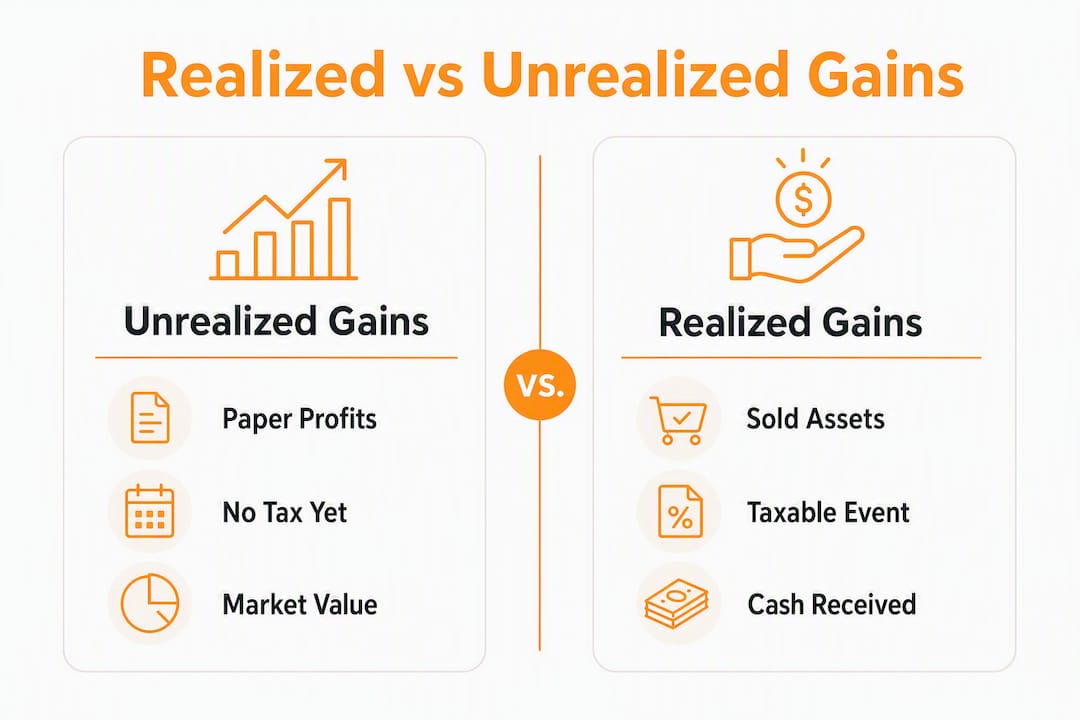
Unrealized gains still matter for planning, though. A large unrealized gain in a taxable account represents a future tax liability you can choose when to trigger. That optionality is valuable. Knowing your unrealized position helps you decide when to rebalance, whether to harvest losses elsewhere, and how a sale would affect your tax bracket in a given year. Psychological effects are real too — watching paper gains fluctuate can push investors toward reactive decisions that cost more in taxes than the volatility itself.
Pro Tip: Track unrealized gains alongside your cost basis and expected holding period in one place. Knowing both numbers before you act prevents the common mistake of selling a long-term position a few weeks too early and landing in the short-term rate bucket.
What is a realized gain or loss?
A realized gain occurs when you sell an asset for more than its cost basis, formalizing the profit and creating a taxable event. The formula is straightforward:
Realized gain = Sale price − Cost basis

If you paid an initial amount for shares and sold them for a higher amount, your realized gain equals the difference between sale price and cost basis. Your broker records the transaction and reports the proceeds and basis on Form 1099-B. That sale is now a taxable disposition the IRS tracks.
Realized losses work the same way in reverse. Sell for less than your cost basis and you have a realized loss, which can offset gains elsewhere in your portfolio.
One subtlety many investors miss: mutual funds and ETFs can pass through realized capital gains as distributions to shareholders even when you never sold a single share. The fund's internal rebalancing or asset sales trigger those gains, and they flow to you as a taxable event. Holding a fund in a taxable account does not protect you from its internal trading activity.
How are realized gains taxed in the United States?
Once a gain is realized, it is a taxable event. The rate depends entirely on how long you held the asset before selling.
Short-term gains, from assets held one year or less, are taxed at your ordinary income rate — the same rate as your salary. Long-term gains, from assets held more than one year, qualify for preferential rates of 0%, 15%, or 20% depending on your taxable income. For most middle-income investors, the 15% rate applies to long-term gains.
| Holding period | Tax treatment | Typical rate |
|---|---|---|
| 1 year or less | Ordinary income rates | Range varies by tax bracket |
| More than 1 year | Long-term capital gains rates | Preferential rates depending on income |
| Collectibles (>1 year) | Special long-term rate | Higher rate than standard capital gains |
| Section 1256 contracts | 60/40 blended rule | Mixed short/long-term treatment |
A few additional layers apply in specific situations. The Net Investment Income Tax (NIIT) adds 3.8% on top of capital gains for higher-income taxpayers. Collectibles like art, coins, and precious metals face a maximum long-term rate of 28%. Section 1256 contracts (certain futures) use a 60/40 blended rule regardless of holding period. These are edge cases, but they affect enough investors that a quick check with a tax professional before a large sale is worth the time.
Pro Tip: The IRS updates income thresholds for capital gains rate brackets annually. Confirm the current thresholds at IRS Publication 550 or with a qualified tax professional before executing a significant sale.
How do you report realized gains and track cost basis?
When you sell, your broker issues a Form 1099-B summarizing the proceeds and, where available, your cost basis. That document is your starting point for tax reporting.
The typical reporting flow works like this:
- Receive Form 1099-B from your broker, usually by mid-February of the following year.
- Reconcile cost basis — verify the basis your broker reports matches your records, especially for older positions, inherited assets, or shares acquired through dividend reinvestment.
- Complete Form 8949 — list each transaction with proceeds, basis, and the resulting gain or loss. Your broker may provide a consolidated version, but you are responsible for accuracy.
- Summarize on Schedule D — totals from Form 8949 flow here, where short-term and long-term gains are separated and netted.
Cost basis is not always a single purchase price. Common methods include:
- FIFO (First In, First Out): The default for most brokers; assumes you sell your oldest shares first.
- Specific identification: You designate exactly which shares you are selling, which lets you choose higher-basis lots to minimize the taxable gain.
- Adjusted basis: Applies when splits, mergers, dividend reinvestment, or return-of-capital distributions have changed the original purchase price.
Missing or incorrect basis data is one of the most common causes of overpaid taxes. Brokers are only required to track "covered" securities (generally those purchased after 2011 for stocks), so older positions may show "basis not reported" on your 1099-B. In those cases, you need your own records.
Wash-sale rule warning: If you sell a security at a loss and buy the same or a "substantially identical" security within 30 days before or after the sale, the IRS disallows that loss. The disallowed amount is added to the basis of the replacement shares, deferring rather than eliminating the loss. This rule catches many investors who sell for a loss and immediately repurchase the same ETF.
Worked examples: calculating your gain and estimating taxes
The clearest way to see the difference between unrealized and realized gains is through numbers.
Scenario: You bought 100 shares of a stock at $30 per share ($3,000 total cost basis). The stock is now trading at $50 per share.
- Unrealized gain: $5,000 current value − $3,000 cost basis = $2,000 on paper, no tax owed yet.
Now you decide to sell all 100 shares at $50.
| Short-term sale (held 8 months) | Long-term sale (held over 1 year) | |
|---|---|---|
| Sale proceeds | $5,000 | $5,000 |
| Cost basis | $3,000 | $3,000 |
| Realized gain | $2,000 | $2,000 |
| Applicable rate | Ordinary income (varies by tax bracket) | Long-term (e.g., 15%) |
Waiting a bit longer to cross the one-year threshold can save a substantial amount in taxes by qualifying for lower long-term capital gains rates, especially on larger gains. That is the core argument for tracking your holding periods carefully.
For a real return comparison: If inflation during your holding period reduces purchasing power, your real gain in inflation-adjusted terms will be significantly lower than your nominal gain. Real return adjusts for inflation using the approximation: nominal return minus inflation rate (or more precisely, the Fisher equation). Nominal gains are what the IRS taxes; real gains are what actually grows your purchasing power.
These examples are illustrative only, not tax advice. Actual tax owed depends on your total income, filing status, applicable deductions, and other factors specific to your situation.
How capital losses offset gains and how tax-loss harvesting works
Realized losses can directly offset realized gains, reducing your taxable income from investments. If losses exceed gains in a given year, up to a certain amount of net capital losses can be deducted against ordinary income each year, with any additional losses carried forward to future years indefinitely.
The netting rules follow a specific order:
- Short-term losses offset short-term gains first.
- Long-term losses offset long-term gains first.
- Excess losses from one category then offset gains in the other.
Tax-loss harvesting puts this mechanic to deliberate use. The basic workflow: identify positions with unrealized losses late in the tax year, sell them to realize the loss, and use that loss to offset gains you have already taken elsewhere. You can reinvest the proceeds immediately in a similar (but not substantially identical) security to maintain your market exposure.
Timing matters. Losses harvested in December offset gains realized earlier in the same calendar year. Carryforward losses from prior years can also offset current-year gains, so keeping a running tally of unused losses is worth the effort.
Pro Tip: The wash-sale rule is the most common harvesting mistake. Selling a broad-market ETF at a loss and buying a nearly identical ETF from a different fund family is generally safe. Selling a fund and immediately repurchasing the same fund is not — the loss is disallowed. Keep a 31-day window between the sale and any repurchase of a substantially identical security.
Special situations that change how gains are treated
Several common scenarios fall outside the standard realized/unrealized framework:
- Inherited assets and step-up in basis: When assets pass to heirs, the cost basis is generally stepped up to fair market value at the date of death. This can eliminate the unrealized gain the original owner accumulated, which is one of the most significant tax advantages in estate planning.
- Trader vs. investor tax status: Active traders who qualify under IRS rules may elect mark-to-market accounting, which treats all positions as sold at year-end. This converts unrealized gains and losses into realized ones annually. The Evibe glossary entry on mark-to-market explains the valuation mechanics behind this approach.
- Cryptocurrency: — The IRS treats crypto as property, so every sale, trade, or use of crypto to purchase goods is a taxable disposition. Unrealized gains on crypto held in a wallet are not taxed, but each transaction that disposes of crypto triggers realization.
For trader elections, estate basis adjustments, and complex fund structures, IRS Publication 550 and Publication 551 are the primary references. A tax professional is advisable for any of these situations.
How a portfolio tracker helps you manage gains and plan smarter exits
Portfolio trackers consolidate all your holdings and automate cost-basis tracking so you can see your unrealized and realized positions across every account in one place. That visibility is what makes tax-aware decision-making practical rather than theoretical.
Evibe's stock portfolio tracker maintains historical cost basis for each position, including adjustments for splits and dividend reinvestment, and surfaces unrealized gain or loss in real time. Before you execute a sale, you can see exactly what the taxable gain would be and whether you are days away from crossing the long-term threshold.
Practical uses include:
- Monitoring cost basis across accounts: Consolidated view prevents the common mistake of forgetting a position's basis when it was purchased years ago at a different broker.
- Flagging fund distributions: Evibe's dividend and distribution tracker alerts you to upcoming or declared distributions from ETFs and mutual funds, so a taxable event does not catch you off guard.
- Planning tax-aware exits: A simple workflow — monitor unrealized gain, model the tax impact of selling now vs. next year, then execute in the tax year that produces the better outcome — is far easier when all the data is already in one dashboard.
Tracking your ETF positions is especially useful here, since fund distributions can create taxable events independent of your own trading decisions.
Key Takeaways
Realized gains trigger U.S. capital gains tax the year you sell; unrealized gains remain untaxed until a sale or taxable disposition occurs.
| Point | Details |
|---|---|
| Realization = taxable event | Selling an asset converts a paper gain into a taxable one; holding does not trigger tax. |
| Holding period determines rate | Assets held over one year qualify for 0%, 15%, or 20% long-term rates; shorter holds are taxed as ordinary income. |
| Cost basis drives your gain size | Accurate cost basis records directly reduce the taxable gain you report on Form 8949 and Schedule D. |
| Losses offset gains | Realized losses net against gains; up to $3,000 of excess losses can offset ordinary income annually, with carryforwards. |
| Evibe tracks it all in one place | Evibe consolidates cost basis, unrealized positions, and distribution alerts across accounts so you can time sales with full tax visibility. |
The part most investors get wrong about timing
Most tax articles stop at "hold for a year to get the lower rate" — and that is useful advice as far as it goes. What gets less attention is the interaction between when you realize gains and what else is happening in your tax picture that year.
A year with a large bonus, a business sale, or a Roth conversion can push you into a higher ordinary income bracket. Realizing a long-term gain in that same year might still land you at the 20% rate plus the 3.8% NIIT, even though you held the asset for years. The rate is not just about the asset's holding period — it is about your total taxable income in the year of sale.
The flip side is equally underused. A year with lower income — early retirement, a sabbatical, a business loss — can be an opportunity to realize gains at 0% if your taxable income falls below the long-term threshold. Many investors never model this because they do not have a consolidated view of their positions and income in one place.
The other thing worth saying plainly: nominal gains and real gains are not the same thing. If your investment grew 8% but inflation ran at 4%, your real purchasing-power gain is closer to 3.8% using the Fisher equation. The IRS taxes the nominal gain. That gap matters most for long holding periods, and it is a reason to think carefully about whether a low-basis position is as profitable as it looks on paper.
Evibe gives you the full picture before you sell
Knowing the difference between realized and unrealized gains is one thing. Having the data organized to act on it is another. Evibe consolidates your stocks, ETFs, crypto, real estate, and other assets into a single dashboard with automatic account syncing, real-time cost-basis tracking, and smart alerts for distributions and market moves.

Before your next sale, you can see the exact unrealized gain, the holding period to the day, and the estimated tax impact of selling now versus waiting. Evibe's AI-driven analysis flags concentration risk and performance against benchmarks, so tax decisions happen in the context of your full portfolio, not in isolation. Distribution alerts from the dividend tracker mean fund taxable events no longer arrive as surprises in February.
Get started free at evibe.com — 7 days of Premium included — and see your entire net worth, cost basis included, in one place.
Useful sources and further reading
The following resources cover the rules, forms, and concepts discussed in this article:
- IRS Tax Topic No. 409: Capital Gains and Losses — the primary IRS reference for capital gains rates, holding periods, the $3,000 loss deduction limit, and fund distributions.
- IRS Publication 550: Investment Income and Expenses — detailed guidance on reporting investment income, wash-sale rules, and cost-basis methods.
- IRS Publication 551: Basis of Assets — covers step-up in basis for inherited assets and adjusted basis calculations.
- Realized Profit definition — Investopedia — plain-language definition of realized profit and the realization principle.
- Realized vs. unrealized gains — SmartAsset — covers tax treatment, broker reporting, and Form 1099-B workflow.
- Nominal vs. Real Returns — Thrivent — explains the difference between nominal and real returns and the Fisher equation for inflation adjustment.
- Real Return — Investor.gov — concise official definition of real return after taxes and inflation.