6 Point Quarterly FX Checklist for Finance Teams to Track FX Gains
Avoid surprise revaluations. Follow ASC/IAS, use a 6 point quarterly checklist and multicurrency tracking to capture realized and unrealized FX gains.
6 Point Quarterly FX Checklist for Finance Teams to Track FX Gains

Track FX gains by recording realized gains or losses at the moment a foreign currency transaction settles, then revaluing all open foreign balances at period end to capture unrealized movement. Automate both steps through your ledger's multicurrency engine or a consolidated tracker so nothing gets missed between closes. ASC guidance and IAS 21 govern the mechanics; a tool like Evibe helps you see the exposure in the first place.
TL;DR:
- Realized FX gains or losses occur only when foreign currency transactions settle, while unrealized gains result from revaluing open positions at period-end.
- Accurate calculation requires using specific rates at transaction and settlement dates, with close attention to rounding and account-level details.
- FX gains generally flow through income statements, with realized gains recognized upon settlement and Unrealized gains on open balances revalued periodically.
- Proper documentation of revaluation sources and maintaining a consistent rate source helps avoid audit discrepancies and misstatements.
- Automated systems with multicurrency ledgers, scheduled revaluations, and consolidated portfolio tracking improve accuracy and reduce manual errors.
Table of Contents
- What FX Gains and Losses Actually Are
- Realized vs. Unrealized: Timing, Recognition, and a Real Example
- How to Calculate FX Gains Step by Step
- Journal Entries and Where FX Gains Show Up on Your Financials
- Tax Treatment, Documentation, and Where Teams Get Tripped Up
- Setting Up Systems to Automate FX Tracking
- Where Consolidated Multi-Asset Tracking Helps Close the Gap
- The Quarterly FX Checklist Your Team Actually Needs
- Evibe: Consolidate Multi-Currency Holdings Before They Distort Your Numbers
- Sources
What FX Gains and Losses Actually Are
An FX gain or loss is the change in value of a foreign currency transaction or balance caused purely by movement in the exchange rate between the date you booked it and the date you settled or reported it. Nothing about the underlying transaction changes. The invoice amount in foreign currency stays the same. What moves is what that amount is worth in your home currency.
This matters more than most finance teams admit. A company holding a substantial receivable in euros can watch tens of thousands swing in or out of reported profit over a single quarter, purely from currency drift, with zero change in the business itself. That kind of swing distorts margin analysis, throws off covenant calculations, and can trigger uncomfortable board questions if nobody flagged it coming.
Two concepts drive everything in this guide:
- Realized gain or loss: locked in when a transaction actually settles in cash.
- Unrealized gain or loss: exists only on paper, tied to positions still open at a reporting date.
Get the distinction wrong and you either overstate cash-backed profit or understate real exposure. Neither serves you well come audit season.
Realized vs. Unrealized: Timing, Recognition, and a Real Example
A gain becomes realized the moment cash actually changes hands. You invoice a customer in euros, the invoice sits open for six weeks, the customer pays, and the euro-to-dollar rate at payment differs from the rate at invoicing. That difference posts directly to your income statement as a realized FX gain or loss, according to Corporate Finance Institute's guidance on FX accounting.
An unrealized gain or loss, by contrast, applies to anything still open at period end: an unpaid invoice, an outstanding loan, a foreign bank balance. You do not have cash yet, so the standards require you to revalue the position to the current spot rate and record the difference, then reverse it once the transaction actually settles.
Here is a worked example most finance teams recognize immediately:
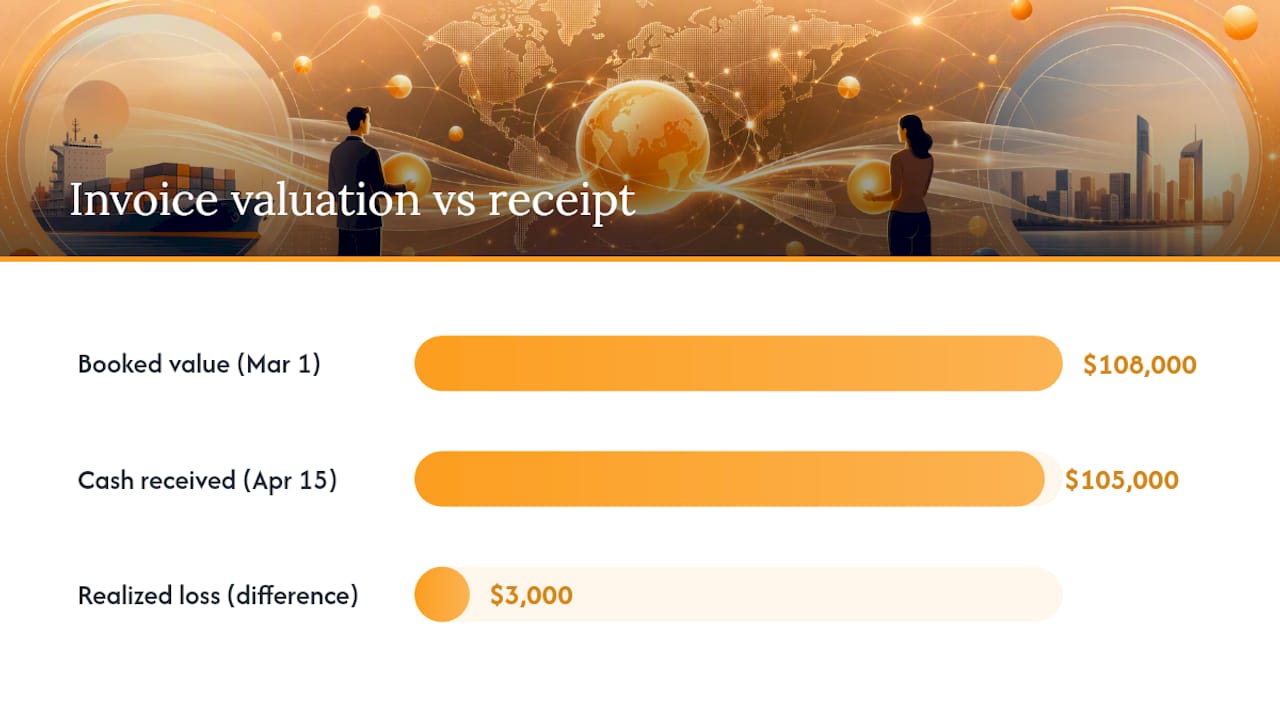
- You invoice a German client for €100,000 on March 1, when the rate is $1.08 per euro. Booked value: $108,000.
- The client pays on April 15, when the rate has moved to $1.05 per euro. Cash received: $105,000.
- You record a realized FX loss, posted directly to the income statement in the period of settlement.
If your fiscal quarter closed on March 31 before payment arrived, you would have first recorded an unrealized loss based on the March 31 rate, then reversed that entry and booked the final realized figure once cash landed in April.
Pro Tip: Run your revaluation on the same calendar day every month, ideally the last business day, so your rate source stays consistent and your revalue history doesn't develop gaps that auditors will ask about later.
How to Calculate FX Gains Step by Step
The formula for a realized transaction gain or loss is simple, but teams still get it wrong by mixing up which rate belongs where. Use this sequence:
- Record the original transaction at the spot rate on the transaction date: Foreign amount × rate at booking = home currency value.
- Record the settlement at the spot rate on the payment date: Foreign amount × rate at settlement = cash received or paid in home currency.
- Subtract the two. Settlement value minus booked value equals your realized gain (positive) or loss (negative).
For unrealized revaluation on an open position, such as a foreign bank account or unpaid invoice, the math is nearly identical but uses the period-end rate instead of a settlement rate:
Foreign balance × rate at period end, minus foreign balance × rate at original booking, equals the unrealized adjustment for that period.
A quick numeric case: you hold a large balance in a Japanese operating account, originally converted at one rate per dollar. At quarter end, the yen has strengthened, making that same balance worth more in dollars. You book an unrealized gain reflecting this increase.
One rounding note worth flagging: always calculate at the transaction or account level before aggregating, never the reverse. Rounding an already-aggregated multicurrency balance first, then applying a blended rate, introduces small errors that compound across dozens of open items and rarely net to zero.
Journal Entries and Where FX Gains Show Up on Your Financials
Once you have the numbers, the bookkeeping itself is mechanical, but the presentation choices matter for anyone reading your statements later.
For a realized gain, the standard entry debits cash for the amount received and credits the receivable at its original booked value, with the difference credited to an FX Gain account that flows straight to the income statement. A realized loss works the same way in reverse, with the difference debited to FX Loss.
For unrealized revaluation, you adjust the balance sheet account (the receivable, payable, or foreign bank balance) up or down, with the offsetting entry hitting an Unrealized FX Gain/Loss line, typically still within net income for most operating balances under both U.S. GAAP and IFRS.
- Realized gains and losses post to the income statement in the period of settlement.
- Unrealized gains and losses on monetary items also generally hit the income statement, not other comprehensive income (OCI), under standard ASC treatment.
- OCI applies mainly to translation adjustments for consolidating foreign subsidiaries, not routine transactional FX, a distinction that trips up teams handling their first cross-border acquisition.
- IAS 21 under IFRS largely mirrors this treatment for monetary items but diverges on net investment hedges, which is exactly the kind of edge case where guessing costs you.
A quarter with heavy foreign receivables and thin margins can see reported profit move by several percentage points from FX revaluation alone. That's not a rounding error on a P&L. It is a real driver of quarterly variance that deserves its own line in your management reporting, not a buried footnote.
Consult your auditor before finalizing treatment for foreign subsidiaries, hyperinflationary economies, or any hedge accounting relationship. Those areas carry enough judgment calls that a five-minute conversation up front saves a restated close later.
Tax Treatment, Documentation, and Where Teams Get Tripped Up
Whether an FX gain is taxable, and at what rate, depends heavily on the character of the underlying transaction and the jurisdiction involved. A realized gain on an ordinary trade receivable typically gets taxed as ordinary income. A gain tied to a capital asset or an investment position may fall under capital gains rules instead. Loan-related FX gains carry their own set of jurisdictional quirks. None of this is a one-size answer, and misclassifying it is one of the more expensive mistakes a finance team can make at filing time.
The pitfalls that show up most often during audits:
- Using inconsistent rate sources between the accounting system and treasury records, so two departments report different numbers for the same balance.
- Missing revaluation history, meaning nobody can reconstruct what rate was used three quarters ago when a number gets questioned.
- Undocumented bank-quoted rates that differ from the market rate the ledger used, creating a gap auditors will flag immediately.
Keep a running log of the rate source, rate date, and calculation method for every revaluation you run. Retain settlement confirmations showing the actual rate applied by your bank or broker.
Pro Tip: Store your revalue history as an exportable, timestamped report, not a spreadsheet someone edits in place. Auditors want to see what the number was at the time, not what it looks like today after three corrections.
Setting Up Systems to Automate FX Tracking
The right system configuration eliminates most manual FX errors before they happen. At minimum, your accounting platform needs a true multicurrency ledger, automatic revaluation on a schedule you control, configurable rate sources, and a retained revalue history you can pull on demand.
- Accounting systems like QuickBooks Online Advanced handle transaction-level realized gains and scheduled home-currency revaluation for open balances.
- Treasury platforms go further, adding forward-looking exposure analysis so you can model risk before settlement rather than just report it after.
- Portfolio trackers serve a different function: consolidating multi-asset, multi-currency holdings so you can see unrealized FX exposure across investments that a general ledger was never built to display.
Match your ledger's FX rate source to your actual bank-quoted rate whenever the difference is material, and schedule revaluations for the same date every month rather than running them ad hoc.
Where Consolidated Multi-Asset Tracking Helps Close the Gap
Most FX errors we see trace back to one root cause: teams tracking currency exposure in fragments, across a general ledger for operations and a separate spreadsheet for investments. A dashboard that preserves historical FX rates against original cost basis keeps realized and unrealized calculations consistent no matter which asset class or currency generated them.
Automatic syncing with banks and brokerages removes the manual re-entry step where rate mismatches usually start. Smart alerts that flag material currency moves give you a head start before a revaluation surprises you at close. For teams managing FX exposure across crypto, real estate, and traditional holdings simultaneously, that consolidated view is what turns scattered currency risk into a number you can actually manage. Understanding the difference between realized and unrealized gains in your own portfolio is the first step toward tightening that process.
The Quarterly FX Checklist Your Team Actually Needs
Assign someone specific to each step, or this checklist becomes another good intention nobody executes.
- Enable multicurrency in your primary ledger and confirm rate sources are configured correctly. Owner: controller. Cadence: one-time setup, reviewed annually.
- Schedule automated revaluations for the same day monthly, ahead of any external reporting. Owner: staff accountant.
- Document rate sources and retain settlement confirmations. Owner: AP/AR team, ongoing.
- Reconcile open foreign balances against bank statements before each close. Owner: controller.
- Review revalue history quarterly for gaps or inconsistencies. Owner: finance manager.
- Train staff on realized versus unrealized entries at least once a year.
Track two simple KPIs: revaluation frequency (did it run on schedule every month) and exception rate (how many open items needed manual correction after the automated run).
Evibe: Consolidate Multi-Currency Holdings Before They Distort Your Numbers
Evibe consolidates stocks, ETFs, options, crypto, and real estate into one dashboard, with multi-currency support that preserves historical FX rates against your original cost basis. That means a euro-denominated holding and a dollar-denominated one sit side by side without you manually reconciling the rate difference every time you check your numbers.

Automatic account syncing pulls positions directly from banks and brokerages, so the balances feeding your FX picture stay current without manual entry. Smart alerts flag meaningful currency swings before they compound into a bigger revaluation surprise at your next close. If you want to see how it handles your own mix of currencies, start with the ETF tracker or dividend tracker to import a sample of your holdings and run a historical-FX check against positions you already know the answer for. Evibe is free to use through the iOS and Mac apps, with 7 days of Premium on every new account. Download it and import your first foreign-currency position today.
Sources
For technical follow-up beyond this guide, ASC guidance from FASB governs U.S. GAAP treatment, while IAS 21 covers IFRS. Corporate Finance Institute's explainer offers a practical bridge between the two, and the best multi-currency tracker guide walks through evaluation criteria for your own tooling.
This article is general information, not a substitute for advice from a qualified financial advisor. Consult a qualified financial professional about your own circumstances before acting on anything here.
- Foreign Exchange Gain/Loss - Corporate Finance Institute
- ASC reference (FASB)
- Cloud-accounting
- Develop a leading FX risk program (Kyriba)