How FX Moves Affect Your Portfolio — and What to Do
Discover how FX movements impact your portfolio returns and learn effective strategies to manage currency risk for better investment outcomes.
How FX Moves Affect Your Portfolio — and What to Do

For most investors holding foreign assets, currency fluctuations are not a minor rounding error. They can add or erase several percentage points of return in a single year, and currency risk touches your portfolio even when every security you own trades in U.S. dollars. Here is the short version of what to do:
- Measure first. Calculate what percentage of your portfolio carries direct or indirect FX exposure before making any hedging decision.
- Set a policy. Decide whether you will hedge, partially hedge, or accept the exposure, and document that choice.
- Monitor costs. Hedging reduces FX volatility but carries its own costs, and it can remove diversification benefits you may actually want.
The rest of this guide walks through the mechanics, the trade-offs, and a concrete implementation workflow.
Key Takeaways
| Point | Details |
|---|---|
| Measure total FX exposure | Include indirect exposure from domestic multinationals, not just foreign-listed assets. |
| Hedge bonds more than equities | Foreign bond FX exposure usually warrants full or near-full hedging; equity FX can serve as a diversifier. |
| Carry costs are real | Hedging embeds the interest-rate differential; calculate carry before assuming a hedge is free. |
| Use currency-level ratios | A blanket portfolio hedge ratio misses the different risk profiles of safe-haven, commodity, and EM currencies. |
| Evibe automates the workflow | Evibe tracks multi-currency P&L, historical FX rates, and smart alerts across all your accounts in one place. |
Table of Contents
- How FX movements change your home-currency returns
- The three types of FX risk every investor should recognize
- How large is the FX effect, and when does it matter most?
- What hedging instruments are available to you?
- How to choose the right hedge ratio for your portfolio
- Steps to implement and monitor your FX policy
- Tracking FX exposure across a multi-currency portfolio
- An investor's perspective on what actually matters
- Evibe gives you the FX visibility to act on what you measure
- Sources
How FX movements change your home-currency returns
The math is straightforward. Your home-currency return on a foreign asset is approximately the sum of the local asset return and the FX return:
Home-currency return ≈ local asset return + FX return
dollar over the same period, leaving your USD return near zero.
Direct exposure is obvious: foreign-listed equities, unhedged international ETFs, offshore bonds, and foreign-currency dividends all carry it. Indirect exposure is less visible. Domestic multinationals with large foreign revenue streams pass FX exposure to investors even when the shares trade in USD. A U.S. This matters for historical FX cost-basis adjustments when you calculate your true FX-adjusted returns.
Realized vs. unrealized FX P&L also diverges. Until you convert proceeds back to USD, a gain or loss is unrealized and will shift with every daily rate move. Once you sell or receive a dividend, the rate at conversion locks in your actual cash return.
The three types of FX risk every investor should recognize
Foreign exchange risk falls into three distinct categories, each affecting your portfolio differently.
-
Transaction risk is the most direct. It arises when a cash flow in a foreign currency has not yet been converted. A dividend paid in British pounds, a bond coupon in Japanese yen, or the proceeds from selling a foreign stock all carry transaction risk until the conversion happens. Forward contracts can lock in the exchange rate for a known future cash flow, removing most of this uncertainty.
-
Translation risk affects investors who consolidate multi-currency holdings into a single reporting currency. When you mark a foreign position to market in USD, the reported value shifts with the exchange rate even if the underlying asset price has not moved. This is an accounting effect, but it influences how your portfolio looks on any given statement date.
-
Economic risk is subtler and longer-lived. Persistent currency depreciation can erode the competitive position of a foreign company, reducing its earnings power and, eventually, its market value. A Japanese exporter benefits when the yen weakens; a Brazilian consumer company importing raw materials is hurt. Economic risk shows up in valuations over quarters and years, not days.
For most individual investors, transaction risk and translation risk are the most immediately manageable. Economic risk requires a view on the underlying business, not just the currency.
How large is the FX effect, and when does it matter most?
A 10% move is not unusual, and AllianzGI notes that moves of this magnitude can materially alter home-currency returns. Emerging-market currencies can move far more.
The size of the FX effect relative to total portfolio return depends on what you own. A bond portfolio with low local-return volatility is dominated by FX moves; a high-volatility equity portfolio absorbs currency swings more easily because equity noise is larger. This is why the conventional guidance is to hedge foreign bonds more aggressively than foreign equities.

The table below shows the range of outcomes for a $100,000 unhedged foreign position under different FX scenarios, assuming the local asset return is flat.
The Vanguard FX hedging whitepaper reinforces this point: currency volatility can be a meaningful share of total portfolio volatility for globally diversified allocators, particularly in fixed-income sleeves where the currency effect is not diluted by large equity swings.
What hedging instruments are available to you?
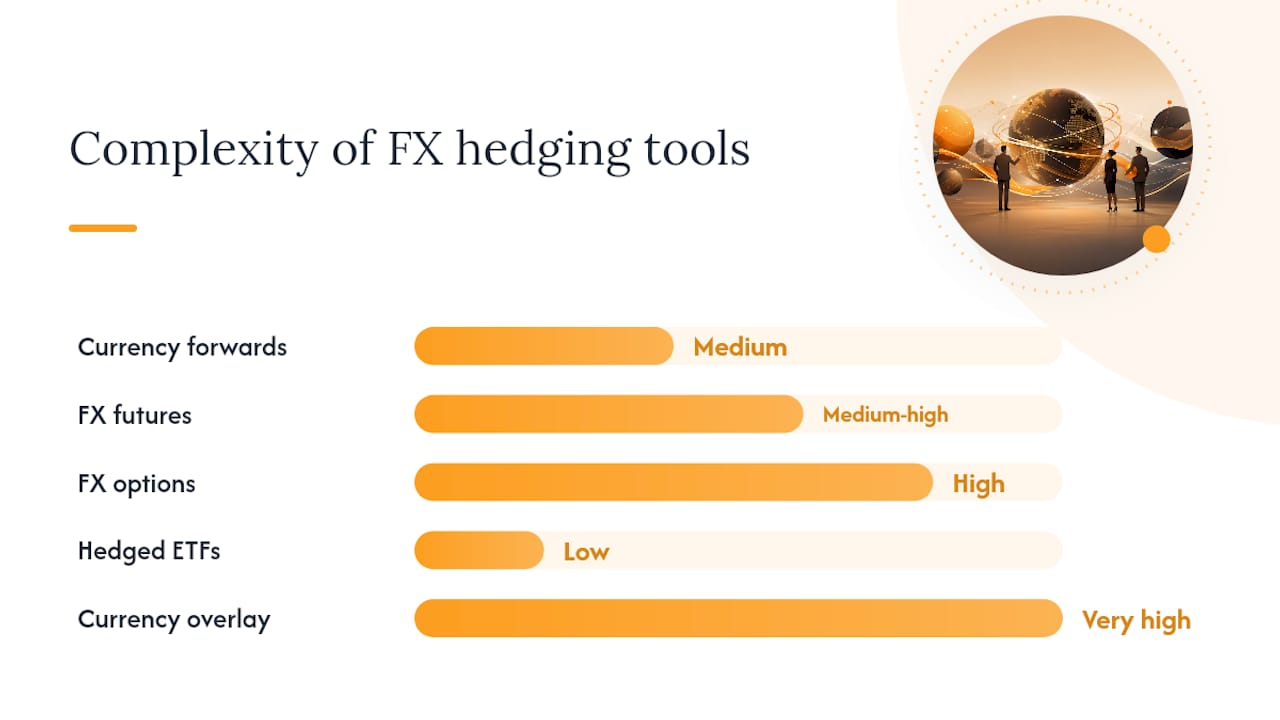
Several practical tools exist for managing FX exposure, each with different cost structures and complexity levels.
Currency forwards let you lock in an exchange rate for a future date. They are the most direct tool for known cash flows, such as a scheduled dividend or bond maturity. Forward contracts are available through most institutional brokers and some retail platforms, though minimum sizes and credit requirements vary. The cost is embedded in the forward premium or discount, which reflects the interest-rate differential between the two currencies.
FX futures trade on regulated exchanges (CME Group for most USD pairs), offering transparency and no counterparty credit risk. They require margin accounts and roll management, which adds operational complexity for individual investors.
FX options give you the right, not the obligation, to exchange at a set rate. They cost a premium upfront but cap your downside without removing upside. Useful when you want protection but are uncertain about the direction or timing of a conversion.
Hedged ETFs and ETNs are the simplest route for most retail investors. A hedged international equity ETF holds the same foreign stocks as its unhedged counterpart but uses rolling currency forwards to neutralize the FX effect. The cost shows up in a slightly higher expense ratio and in the carry embedded in the forwards.
Currency overlay services are used by institutional portfolios. An overlay manager runs a separate FX hedging program on top of the underlying portfolio, adjusting hedge ratios dynamically. This is generally not accessible to individual investors below institutional minimums.
| Method | Liquidity | Key cost driver | Complexity | Best suited for |
|---|---|---|---|---|
| Currency forwards | Moderate | Forward carry (rate differential) | Medium | Known future cash flows |
| FX futures | High | Margin, roll costs | Medium-high | Active traders, institutions |
| FX options | Moderate | Option premium | High | Uncertain timing, asymmetric protection |
| Hedged ETFs | High | Expense ratio, embedded carry | Low | Retail investors, passive allocators |
| Currency overlay | Low (institutional) | Management fee, carry | Very high | Large institutional portfolios |
One cost that applies to all hedged positions: carry. When U.S. interest rates are higher than foreign rates, hedging foreign currency exposure into USD costs you the differential. Vanguard's research confirms that hedging removes spot FX volatility but leaves forward carry effects intact, so hedged portfolios are not immune to currency-related return differences.
For retail traders thinking about execution costs and margin risks in more detail, forex risk management fundamentals cover the practical mechanics of position sizing and spread management.
How to choose the right hedge ratio for your portfolio
Treat the hedge ratio as a risk-allocation decision, not a currency forecast. Trying to predict which way the dollar moves is speculation; deciding how much FX volatility fits your risk budget is portfolio management.
Strategic vs. tactical hedging serve different purposes. A strategic hedge ratio is set by policy and reviewed infrequently, perhaps annually. It reflects your long-term view of FX as a risk factor: do you want the currency exposure as a diversifier, or do you want to remove it? A tactical overlay adjusts that ratio around macro events. J.P. Morgan Asset Management notes that professional managers often shift hedge ratios in response to central bank policy changes or tariff announcements rather than holding a constant level.
Currency-specific guidance matters. Safe-haven currencies (Swiss franc, Japanese yen) often appreciate during equity drawdowns, providing a natural hedge for equity risk. Commodity-linked currencies (Canadian dollar, Australian dollar) tend to correlate with risk assets. Emerging-market currencies carry higher volatility and political risk. A blanket hedge ratio applied uniformly across all foreign exposures ignores these differences.
A practical four-step framework:
- Define FX's role. Is currency exposure in your portfolio a deliberate diversifier or an accidental risk? AllianzGI recommends treating FX as a risk-budget item with a defined role before setting any ratio.
- Measure exposure. Quantify direct and indirect FX exposure by currency pair, including domestic multinationals.
- Evaluate costs and correlation. Calculate the carry cost of hedging each currency pair and assess whether the currency tends to diversify or amplify your equity risk.
- Set policy and governance. Document the target ratio, the rebalancing trigger, and who reviews it.
Common reference points: many risk-averse allocators hedge most or all of their foreign bond exposure and apply a partial hedge to foreign equity. A static equity FX hedge is a widely used compromise that reduces volatility without eliminating diversification benefits.
Pro Tip: *Set currency-level hedge ratios rather than a single portfolio-wide number.
Steps to implement and monitor your FX policy
A clear sequence prevents the most common mistakes: hedging the wrong exposures, over-hedging, or letting positions drift without review.
- Inventory all exposures. List every position with foreign currency exposure, including indirect exposure through domestic multinationals. Assign a currency and a notional USD value to each.
- Choose instruments. Match the hedging tool to the exposure type: hedged ETFs for passive foreign equity sleeves, forwards for known cash flows, options when timing is uncertain.
- Size trades. Calculate the notional hedge amount for each currency pair based on your target ratio. Do not over-hedge: hedging more than 100% of an exposure introduces a speculative short position.
- Execute a pilot. For new hedging programs, start with a partial position to understand execution costs and operational requirements before scaling.
- Document the policy. Write down the target ratio, the instruments used, the rebalancing triggers (e.g., exposure drifts more than 10% from target), and the review schedule.
- Monitor P&L and costs. Track realized and unrealized FX P&L separately from asset P&L. Watch carry costs on rolling forwards or the expense ratio drag on hedged ETFs.
- Rebalance on triggers. Rebalance when exposure drifts beyond your documented threshold or when a macro event shifts the cost-benefit calculus materially.
Red flags to watch for: hedging costs that exceed the volatility reduction they provide; margin or leverage requirements that introduce liquidity risk; OTC counterparty exposure on large forward positions with a single dealer.
On the tax side, currency gains and losses on personal accounts are generally treated as ordinary income under U.S. tax rules for Section 988 transactions (foreign currency contracts). Gains on foreign stocks held in taxable accounts may qualify for long-term capital gains treatment, but the currency component of the return can be treated differently. Confirm current treatment with a tax advisor, as rules vary by instrument and account type.
Tracking FX exposure across a multi-currency portfolio
Measurement is the highest-leverage step in any FX risk program. You cannot manage what you have not measured, and most investors underestimate their total currency exposure because indirect exposures through domestic multinationals are invisible without a consolidated view.
A well-structured tracking workflow covers:
- Currency exposure by asset: the notional value of each position denominated in each foreign currency, including indirect exposure estimates for multinationals.
- FX P&L (realized and unrealized): the gain or loss attributable to exchange-rate moves, separated from the underlying asset return.
- Rolling hedge P&L: the cost or gain on any active hedging positions, including carry and roll costs.
- Forward and option positions: mark-to-market values, expiry dates, and remaining notional.
- Net cash flows by currency: scheduled dividends, coupons, and maturities that will require conversion.
FINRA's investor guidance on currency risk recommends tracking both direct and indirect exposures and reviewing them regularly, not just at year-end.
A multi-currency portfolio tracker that consolidates positions across brokerages and asset classes makes this workflow practical for individual investors who hold foreign equities, ETFs, and other assets across multiple accounts.
Pro Tip: Set automated alerts for two thresholds: when your FX exposure to any single currency exceeds a defined percentage of total portfolio value, and when rolling FX P&L crosses a material loss level. Alerts replace manual monitoring and catch drift before it becomes a problem.
An investor's perspective on what actually matters
Most retail investors spend more time picking stocks than thinking about currency risk, and that is understandable. But for a U.S.
A few short recommendations by profile:
- Long-term retail investor: Accept equity FX exposure as a diversifier. Hedge foreign bond exposure where carry costs are manageable. Review annually.
- Active portfolio manager: Use tactical adjustments around macro events (central bank meetings, tariff announcements) but anchor to a strategic policy ratio to avoid chasing rates.
- Bond-heavy allocator: Hedge most or all foreign currency exposure. The volatility reduction is worth the carry cost when local bond yields are already compressed.
The most common mistake is treating hedging as a binary choice: fully hedged or fully exposed. The real decision is how much FX volatility fits your risk budget, and that answer is almost always somewhere in between.
Measure first. The number you get will tell you whether FX is a minor factor or a dominant one in your portfolio. That single step changes every decision that follows.
Evibe gives you the FX visibility to act on what you measure
Knowing your FX exposure in theory is different from seeing it update in real time across every account you hold. Evibe consolidates stocks, ETFs, crypto, real estate, and other assets into a single dashboard with multi-currency support and historical FX rates built in, so your FX-adjusted returns are calculated automatically, not estimated on a spreadsheet.
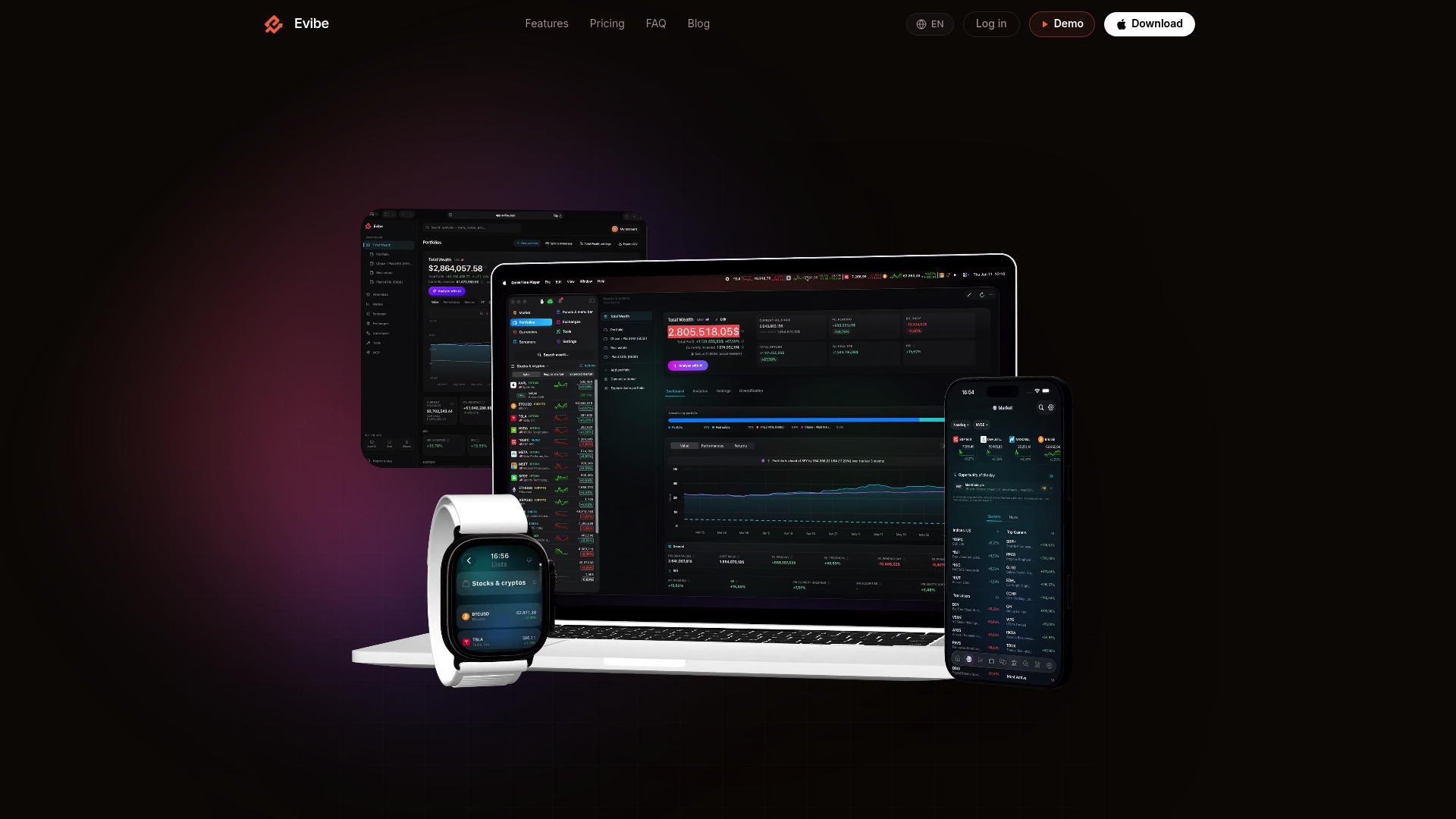
The three core actions this article describes map directly to what Evibe does: measure your currency exposure by asset and account, monitor realized and unrealized FX P&L as rates move, and act when smart alerts notify you that an exposure threshold has been crossed. Evibe is free to use, and the 7 days of Premium on every new account give you enough time to connect your accounts, see your actual currency exposure, and decide whether your current hedge policy still fits. Start tracking your net worth in real time and get the FX picture your portfolio deserves.
Sources
- Finra
- Understanding Foreign Exchange Risk and Hedging Strategies with Examples | Investopedia
- The FX dimension: Evaluating currency hedging for global multi asset portfolios | Vanguard
- FX hedging: Turning an accidental risk into a strategic choice | Allianz Global Investors
- Currency hedging insights | J.P. Morgan Asset Management
- How to manage FX risk before it impacts your profits | EDC
This article is general information, not a substitute for advice from a qualified financial advisor. Consult a qualified financial professional about your own circumstances before acting on anything here.