Track Crypto Portfolio and Your Full Net Worth in 2026
Discover how to track your crypto portfolio and net worth seamlessly in 2026 with Evibe’s unified wealth dashboard. Free to use, 7 days of Premium included.
Track Crypto Portfolio and Your Full Net Worth in 2026

TL;DR:
- An integrated net-worth dashboard consolidates crypto, stocks, real estate, and liabilities into a single view, supporting automatic syncing and manual entries. It values assets at market prices and emphasizes secure, read-only API connections and public wallet tracking while avoiding private keys. This approach provides a complete, real-time picture of wealth that outperforms partial or manual tracking methods.
The most effective way to track a crypto portfolio in 2026 is an integrated net-worth dashboard that consolidates your exchange holdings, self-custody wallet balances, brokerage accounts, bank cash, and real estate into a single synced view. Not a standalone crypto tracker. Not a spreadsheet. A unified wealth dashboard where crypto is one asset class among many, valued at mark-to-market prices alongside everything else you own.
Two things make this approach work in practice:
- Automatic syncing via read-only exchange API keys pulls live crypto balances from centralized exchanges without granting withdrawal permissions.
- Public wallet address tracking reads on-chain balances for self-custody holdings, so your cold-wallet Bitcoin appears in the same net-worth chart as your Fidelity brokerage account.
Evibe is free to use — and every new account starts with 7 days of Premium — so you can see the full picture in one place, with no manual spreadsheet work and no data selling.
Table of Contents
- What "track crypto portfolio" actually means in this guide
- How do you connect crypto and other accounts to one dashboard?
- What features should you prioritize when choosing a tracker?
- Security and privacy checklist for connecting financial accounts
- What does a tracker cost, and how long does setup take?
- How Evibe fits investors who need one dashboard for everything
- Pre-flight checklist before you connect any account
- Key Takeaways
- Why integrated tracking beats every alternative
- Get started free with Evibe (7 days of Premium included)
- Useful sources and further reading
What "track crypto portfolio" actually means in this guide
This guide is about one specific use case: an integrated net-worth tracker that treats crypto as one asset class among stocks, ETFs, bank cash, retirement accounts, real estate, collectibles, and liabilities. That is different from standalone crypto analytics platforms, DeFi dashboards, on-chain forensics tools, or crypto tax software. Those are separate products for separate jobs.
For this approach to work, your tracker must support all of the following asset types:
- Crypto (exchange-held and self-custody via public addresses)
- Stocks, ETFs, and options
- Bank and cash accounts (via read-only account connections)
- Retirement accounts (401(k), IRA)
- Real estate (manual market value entry)
- Collectibles, vehicles, and other alternative assets
- Loans and liabilities (mortgage, auto loan, credit card balances)
Crypto should be counted at today's market value on the snapshot date. Its volatility affects your allocation signals and rebalancing decisions, but it does not change the accounting logic. A complete net-worth view requires every asset class on the same ledger, valued in a single base currency on the same day.
How do you connect crypto and other accounts to one dashboard?
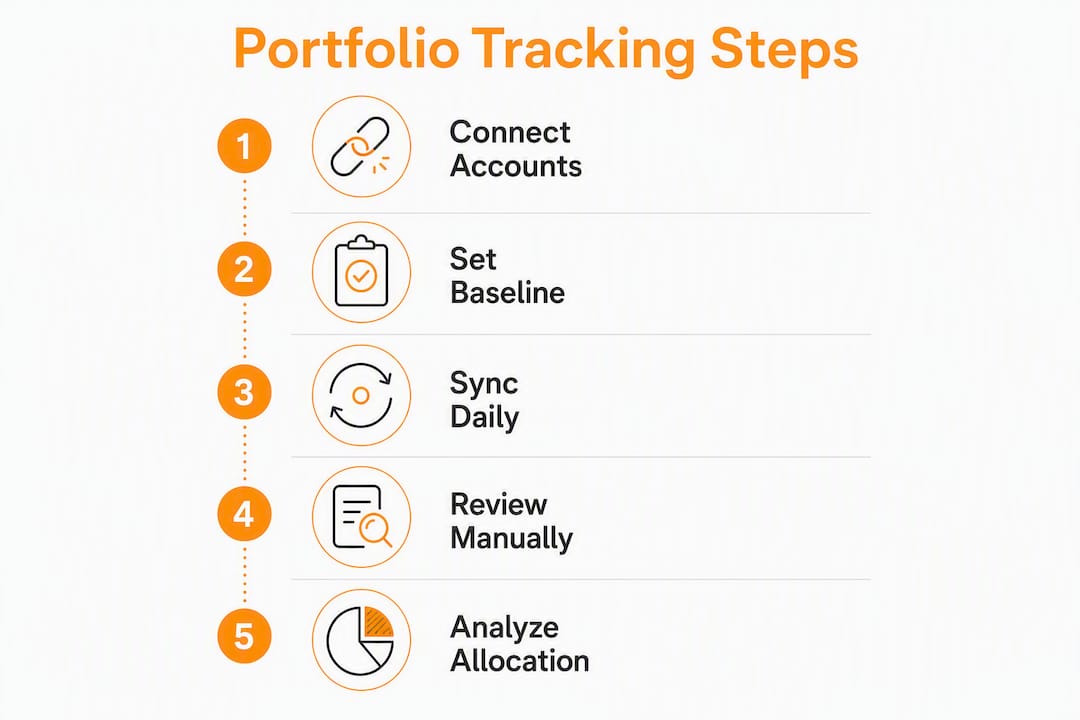
Follow this sequence to go from scattered accounts to a single net-worth view quickly and safely.
- Inventory your accounts. List every exchange, self-custody wallet address, brokerage, bank account, retirement account, and property you own. Note the login location and the public wallet address for each self-custody wallet.
- Generate read-only API keys for each exchange. In your exchange's API settings, create a new key, name it clearly (e.g., "Evibe read-only"), and restrict permissions to read-only or "view balance" only. Never enable withdrawal or trading permissions. Read-only API keys pull live balances without granting withdrawal access — that is the non-negotiable standard.
- Add public wallet addresses for self-custody. Paste your public address (not your private key or seed phrase) into the tracker's wallet section. The app reads the blockchain for a watch-only balance. Confirm which blockchains the app supports before adding addresses.
- Connect bank and brokerage accounts. Bank-aggregation services handle bank connectivity automatically. Brokerage coverage varies by platform; expect bank connections to resolve faster than broker connections in most cases.
- Enter manual positions for DeFi and exotic assets. Add these as manual lines and update them monthly or when positions change materially.
- Add real estate and liabilities correctly. Enter the property's current market value as an asset and the outstanding mortgage balance as a separate liability. The equity is implied. Never enter both the gross property value and the purchase cash as separate assets — that double-counts your down payment.
Pro Tip: Record your baseline net-worth date the day you finish setup. That snapshot becomes your performance anchor for every future comparison.
Set exchange API connections to sync daily. Review manual entries (real estate, DeFi) monthly or after any material change.

What features should you prioritize when choosing a tracker?
Spreadsheets work for simple portfolios under roughly five accounts, but once you add multiple exchanges, a brokerage, a bank, and a property, manual entry errors compound fast. A dedicated tracker earns its cost at that point.
Evaluate any tracker against these criteria:
- Core connectivity: Read-only exchange API support, public-address on-chain tracking, read-only bank connections, and brokerage integrations.
- Asset breadth: Crypto, stocks/ETFs, retirement accounts, real estate (manual), collectibles, loans, and multi-currency FX handling with historical rates. Evibe is recognized as the best multi-currency portfolio tracker for investors managing assets across currencies.
- Analytics: Mark-to-market history, allocation by asset class, benchmarking against major indices, AI-driven risk and diversification signals, dividend tracking, and options Greeks.
- Security and privacy: Strong encryption, MFA support, no data selling, clear data retention and export policies.
- UX: Mobile and desktop parity, push notifications for market changes, historical snapshots, and exportable CSVs.
| Criterion | What to verify |
|---|---|
| Exchange API support | Read-only keys accepted; withdrawal permissions not required |
| Self-custody tracking | Public address input; blockchain coverage listed |
| Bank connectivity | Read-only bank-aggregation connections |
| Asset breadth | Real estate, collectibles, liabilities supported |
| AI analytics | Risk, diversification, and benchmarking signals available |
| Privacy model | No data selling; encryption and retention policy published |
| Trial availability | Free to use; 7 days of full Premium on every new account, no card required |
Tools range from manual-local-first to fully automatic server-side syncing, each with different tradeoffs for privacy and convenience. Know which model fits your risk tolerance before connecting accounts.
Security and privacy checklist for connecting financial accounts
Security is where most investors cut corners, and the consequences are asymmetric. A few non-negotiable rules:
- Use read-only API keys only. Never generate a key with trading or withdrawal permissions for a third-party app.
- Add public addresses for self-custody. A public address reveals your balance history but never your private key. It is safe to add as a watch-only input.
- Enable MFA on every account — exchanges, brokerages, banks, and the email address tied to each.
- Review the app's encryption and data storage policy before adding any credentials. Look for client-side or strong server-side encryption, a published retention policy, and a clear data export option.
- Never paste a private key or seed phrase into any app. No legitimate aggregator needs it.
Pro Tip: Create a dedicated read-only API key for each exchange rather than reusing one key across multiple apps. If one app is ever compromised, you revoke only that key.
Red flags to avoid: apps that request full login credentials, apps with no published security policy, and any service that monetizes aggregated user data.
What does a tracker cost, and how long does setup take?
Most dedicated portfolio trackers follow a subscription model, monthly or annual, with a free trial period. Evibe is free to use, with a Premium subscription ($9.99/month or $99.99/year) for broker sync, AI analysis and the full history — and every new account gets 7 days of Premium, no card required. The subscription is managed through the Apple App Store, so there are no separate billing accounts to manage.
Realistic sync timelines:
- Exchange API connections: Live in minutes after you paste the read-only key.
- Bank and brokerage connections: Minutes to a few hours for initial sync, depending on the institution.
- Manual entries (real estate, DeFi, collectibles): As long as it takes you to gather the numbers — typically 20–30 minutes for a first pass.
Ongoing maintenance runs roughly 10–30 minutes per month for manual positions. Automatic connections handle the rest. A combination of automatic API pulls and manual entries achieves completeness without requiring perfect real-time accuracy on every line.
Weigh the subscription cost against the time you currently spend reconciling accounts manually and the allocation visibility you gain from a single net-worth chart.
How Evibe fits investors who need one dashboard for everything
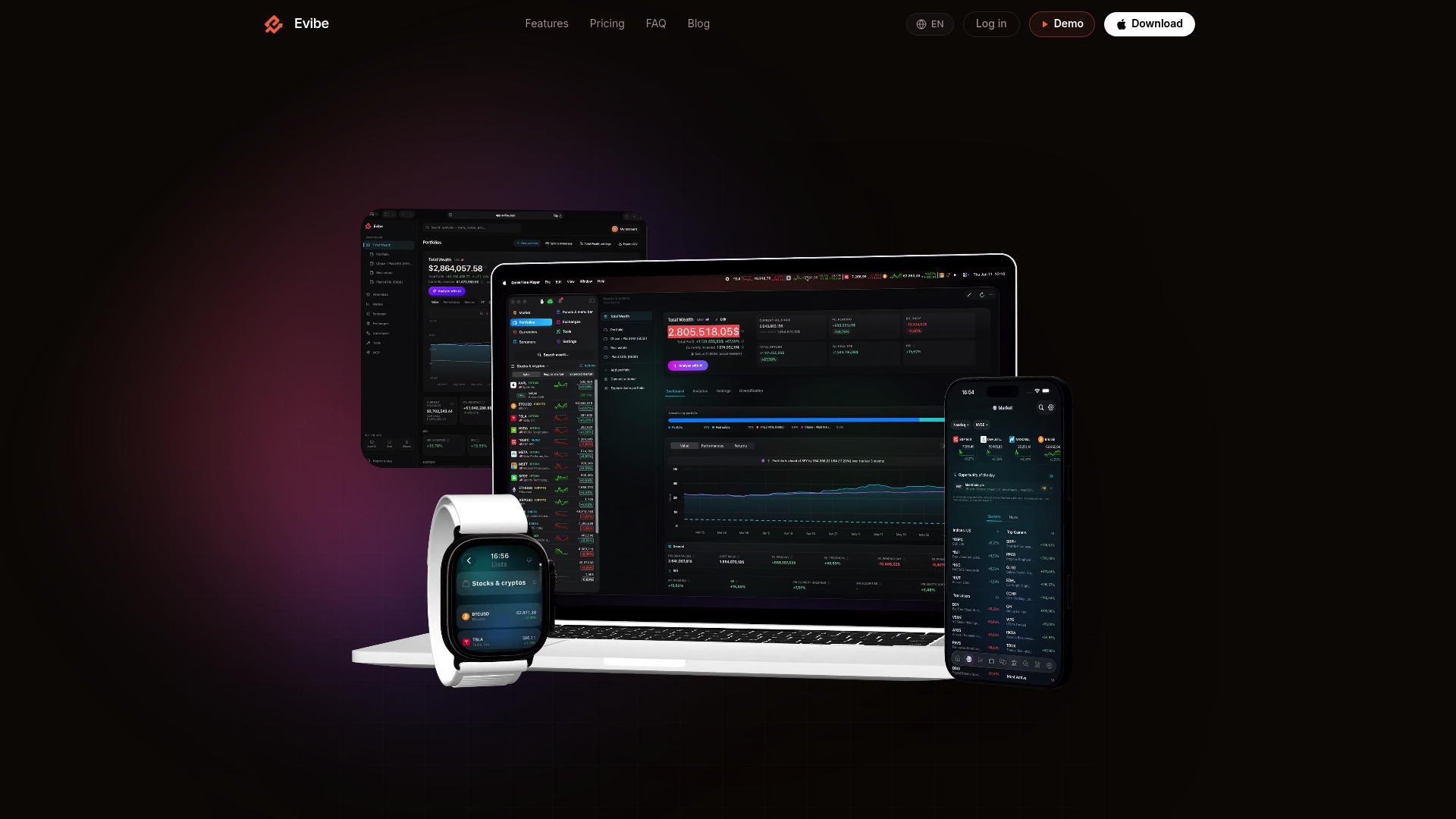
Evibe is built for exactly this use case: a single net-worth dashboard that consolidates every asset class, with automatic syncing where possible and clean manual entry where not.
Key capabilities that match the checklist above:
- Read-only exchange API support and public-address on-chain tracking for Apple devices, covering the two primary crypto connection methods.
- Automatic bank and brokerage syncing across 1,000+ institutions in the US, Canada and Europe plus crypto exchanges, pulling live balances without manual entry.
- Manual asset types for real estate, art, vehicles, startups, loans, and collectibles — with property market value and mortgage entered as separate asset and liability lines to prevent double-counting.
- Multi-currency support with historical FX rates, so foreign assets are valued consistently on each snapshot date.
- AI-driven analysis that surfaces allocation breakdowns, risk signals, diversification gaps, and benchmarking against major indices — giving you the data to make rebalancing decisions rather than just a balance total.
- API endpoints for ChatGPT, Claude, and Gemini, so you can query your portfolio data through AI assistants you already use.
Pro Tip: Use Evibe's benchmarking feature to compare your total net-worth growth against a major index. Most investors track crypto performance in isolation and miss how it affects their overall allocation.
Evibe does not sell user data and does not run ads. The product is the app itself — free to use, with a Premium subscription for the advanced features.
Pre-flight checklist before you connect any account
Complete these steps before opening the app for the first time:
- List every exchange, brokerage, bank, and self-custody wallet you hold, with login locations noted.
- Back up all seed phrases and private keys offline. Never paste them into any app.
- Enable MFA on every exchange, brokerage, bank account, and the email address tied to each.
- Generate a dedicated read-only API key on each exchange you plan to connect.
- Note your public wallet addresses for each self-custody wallet.
- Gather your most recent property valuation and outstanding mortgage balance for real-estate lines.
- Pull recent bank or brokerage export CSVs if you want a historical baseline before the first live sync.
Key Takeaways
An integrated net-worth dashboard that combines read-only exchange APIs, public wallet address tracking, and manual lines for real estate and liabilities is the most complete and secure way to monitor a crypto-inclusive portfolio.
| Point | Details |
|---|---|
| Use read-only API keys | Generate exchange keys with no withdrawal permissions before connecting any app. |
| Add public addresses for self-custody | Paste public wallet addresses only — never private keys or seed phrases. |
| Enter real estate as asset plus liability | Log market value and mortgage separately to avoid double-counting equity. |
| Expect 10–30 minutes monthly | Automatic connections handle exchanges and banks; manual entries need a brief monthly review. |
| Evibe covers all asset classes | Stocks, ETFs, crypto, real estate, collectibles, and liabilities in one synced dashboard with AI-driven analysis. |
Why integrated tracking beats every alternative
The conventional wisdom is that you need a specialized tool for each asset class: one app for crypto, another for stocks, a spreadsheet for real estate. That approach produces three partial pictures and no coherent net-worth view. When Bitcoin drops 30% in a month, you need to know what that does to your total allocation, not just your crypto bucket.
Spreadsheets are a reasonable starting point, but they break down fast once you have more than a handful of accounts. Manual entry errors accumulate. FX conversions go stale. And no spreadsheet sends you a push notification when your equity allocation drifts past your target band.
The privacy concern is real too. Some investors resist automatic syncing because they do not want financial data on a third-party server. That is a legitimate position, and manual-first trackers exist for exactly that preference. But for most active investors, the tradeoff favors automatic syncing with strong encryption and a no-data-selling policy over the ongoing friction of manual updates.
Evibe's free tier with 7 days of Premium, AI-driven analysis, and Apple-device crypto support make it the most practical starting point for investors who want a complete picture without building it themselves.
Get started free with Evibe (7 days of Premium included)
Track your entire net worth in real time with Evibe — crypto, stocks, real estate, and every other asset class in one dashboard. It's free to use, and the 7 days of Premium every new account gets include full feature access: automatic syncing, AI-driven analysis, and all integrations.
What the 7 days of Premium include:
- Full exchange API and bank/brokerage syncing
- AI-driven risk, diversification, and benchmarking analysis
- Public wallet address tracking on Apple devices
- Manual entry for real estate, collectibles, and liabilities
- Smart alerts for market changes
In your first 7 days: connect your exchanges, add your public wallet addresses, enter your property values and mortgage balances, and run your first net-worth snapshot.
No card is required: when the 7 days end, the account simply drops to the Free plan and nothing is deleted. Premium is managed through the Apple App Store.
Useful sources and further reading
- Evibe — Track your entire net worth, in real time: Product landing page, free signup, and full feature overview.
- Best wealth dashboard apps for investors: 2026 guide: Detailed comparison of multi-asset dashboard features and evaluation criteria.
- The best private, ad-free portfolio trackers (2026): Covers privacy-first vs automatic-sync tradeoffs for investors who prefer not to link accounts.
- Best multi-currency portfolio tracker for international investors (2026): Explains FX handling and historical rate support for portfolios with assets in multiple currencies.
- Dividend tracker — Evibe: Feature page for dividend tracking and how income is reflected in net-worth calculations.
- How to track crypto alongside traditional investments: Practical guide on read-only API connections, public address tracking, and combining automatic and manual entries.
- Investing glossary — Evibe: Definitions for mark-to-market, coverage ratio, accumulating vs distributing, and other terms used in this guide.