How to Track Net Worth: Tools, Apps, and a Step-by-Step Guide
Learn how to track your net worth effectively with the right tools, apps, and a step-by-step guide — start today for clearer, private financial insights.
How to Track Net Worth: Tools, Apps, and a Step-by-Step Guide

TL;DR:
- Tracking your net worth requires a current balance sheet of assets and liabilities. Using automatic tools like Evibe ensures real-time updates across multiple asset classes, aiding accurate financial planning.
Your net worth is assets minus liabilities, and to track it properly you need a recurring, date-stamped balance sheet updated in one place. The fastest way to start: do a single snapshot calculation today and save it. For ongoing, automatic tracking across every asset class, Evibe syncs your bank and brokerage accounts in real time so the picture stays current without manual entry.
Table of Contents
- How to calculate your net worth right now
- What counts as an asset and a liability — and why liquid net worth matters too
- Which tools help you track net worth most effectively?
- Why Evibe solves the ongoing net-worth tracking problem
- How often should you update your net worth?
- Common net-worth tracking mistakes and how to fix them
- Key Takeaways
- Net worth is a balance-sheet metric, not a lifestyle score
- Get started with Evibe in your first week
- Useful sources and further reading
How to calculate your net worth right now
The math is straightforward. The discipline is what most people skip.
- Gather every account. Pull statements for bank accounts, brokerage accounts, retirement accounts (401(k), IRA), real estate, crypto wallets, vehicles, and any other property you own.
- Value each asset. Use current market prices for liquid assets. For real estate, use a recent appraisal or a conservative market estimate. For vehicles, use a service like Kelley Blue Book.
- List every liability. Mortgage balance, student loans, auto loans, credit card balances, margin debt, personal loans.
- Subtract liabilities from assets. The result is your net worth.
Example snapshot:
| Asset | Value |
|---|---|
| Checking + savings | a moderate cash balance |
| Brokerage account | a substantial investment balance |
| 401(k) | a sizeable retirement account |
| Home (market value) | a typical residential property value |
| Vehicle | a mid-range vehicle value |
| Crypto | a modest crypto holding |
| Total assets | a diversified asset portfolio |

| Liability | Balance |
|---|---|
| Mortgage | a significant mortgage balance |
| Auto loan | an outstanding auto loan |
| Student loans | an existing student loan balance |
| Credit cards | some credit card debt |
| Total liabilities | a total debt balance |
Net worth: total assets minus total liabilities equals your net worth
Pro Tip: Always record the exact valuation date and the currency for each snapshot. A number without a date is nearly useless for tracking progress over time.
What counts as an asset and a liability — and why liquid net worth matters too
Not every dollar on your balance sheet is equally useful. Understanding the difference between total and liquid net worth is one of the most practical things you can do before you start monitoring financial growth.
Asset categories to include
| Category | Examples | Liquid? |
|---|---|---|
| Cash and equivalents | Checking, savings, money market | Yes |
| Taxable investments | Brokerage accounts, stocks, ETFs, crypto | Yes (with tax impact) |
| Retirement accounts | 401(k), IRA, Roth IRA | No (penalties + taxes) |
| Real estate | Primary home, rental properties | No |
| Business equity | Private company ownership stake | No |
| Collectibles and art | Watches, art, wine | No |
| Vehicles | Cars, boats, motorcycles | Partial |
Liability categories to include
Mortgage balance, home equity line of credit (HELOC), student loans, auto loans, credit card debt, margin debt, and personal loans. Every outstanding balance counts.
Total net worth vs. liquid net worth
Total net worth includes everything: your home, retirement accounts, collectibles. Liquid (or investable) net worth strips out illiquid assets and focuses on what you could actually deploy or withdraw. Net worth and liquid net worth are two different numbers, and both are worth tracking.
Why does this matter? As research on household wealth shows, net worth figures can be misleading when much of the balance is illiquid — home equity can create a "house rich, cash poor" situation where your balance sheet looks strong but your actual purchasing power is limited.
Adjusting for taxes and fees
Retirement accounts and appreciated investments carry embedded tax liabilities. A traditional 401(k) balance is not fully spendable wealth due to taxes and penalties. A rough adjustment: apply your estimated marginal income tax rate to pre-tax retirement balances, and apply the long-term capital gains rate (15% for most middle-income households) to unrealized gains in taxable accounts. This gives you a more realistic after-tax net worth figure for planning purposes.
Handling hard-to-value assets
For real estate, revalue annually using a recent comparable sale or a formal appraisal. For private business equity, use the most recent valuation event or a conservative multiple of earnings. For collectibles, use a recent auction result or a certified appraisal. When in doubt, use the conservative estimate — overvaluing illiquid assets is one of the most common tracking errors.
Pro Tip: Track collectibles and private equity at cost until you have a credible third-party valuation. Marking them up based on gut feel inflates your net worth without adding real clarity.
Which tools help you track net worth most effectively?
Three main approaches exist: spreadsheets, free online calculators, and dedicated apps. Each has a clear use case.

Comparison: spreadsheet vs. calculator vs. app
| Method | Best for | Automation | Multi-asset support | Cost |
|---|---|---|---|---|
| Spreadsheet (Excel, Google Sheets) | Full control, custom modeling | Manual | Unlimited, manual | Free |
| Free calculator | One-time snapshot | None | Limited | Free |
| Dedicated app | Ongoing tracking, syncing | Automatic | Broad | Paid or freemium |
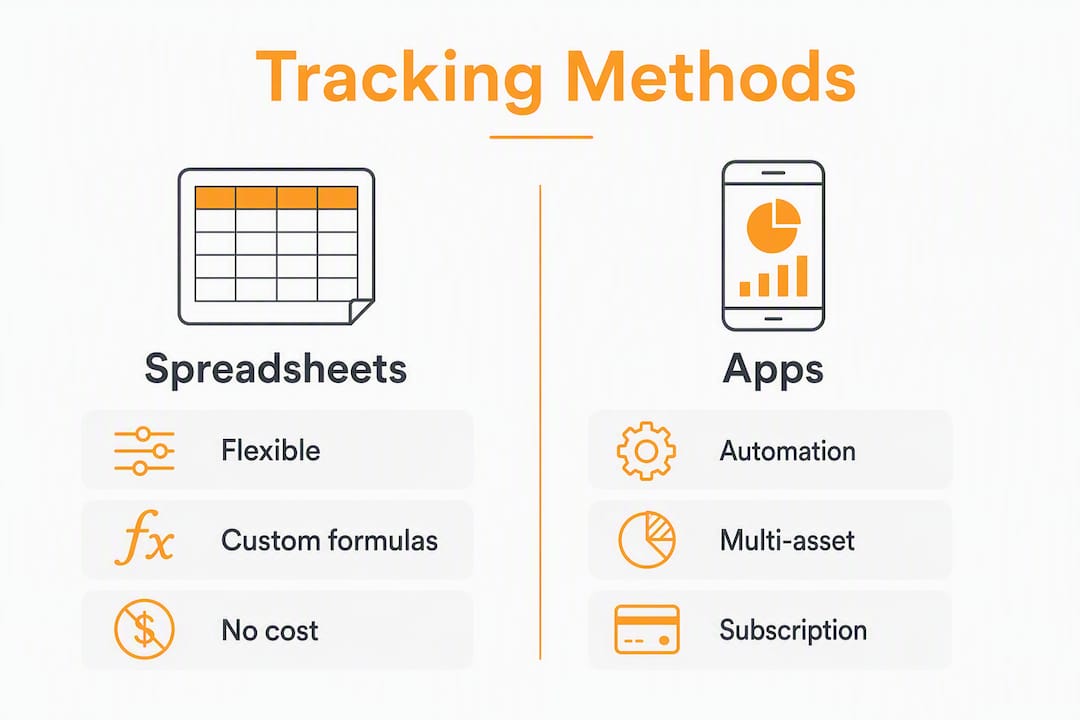
Spreadsheets give you complete flexibility. You can model scenarios, add custom formulas, and structure the sheet exactly as you want. The tradeoff is that every update is manual, and it is easy to let the spreadsheet go stale.
Free calculators are useful for a quick, one-time estimate. The FINRED net-worth tracker, published by the U.S. government's Financial Readiness program, is a reliable, no-cost option for a clean snapshot calculation. It is especially useful for military families and anyone who wants a government-backed starting point.
Dedicated apps solve the maintenance problem. They sync directly with your financial institutions, pull real-time prices, and update your balance sheet automatically. For anyone tracking more than a handful of accounts, the time savings alone justify the cost.
What to look for when choosing a method
- Automatic account syncing: Does the tool connect directly to your bank and brokerage accounts?
- Multi-asset support: Can it handle stocks, ETFs, crypto, real estate, and collectibles in one view?
- Valuation frequency: Does it update prices in real time or only on a delay?
- Security and data policy: Does the provider sell your data? Is two-factor authentication (2FA) available?
- Export options: Can you download your data as a CSV or PDF for backup?
- Cost model: Is it a one-time purchase, subscription, or ad-supported?
For a detailed comparison of the best net worth tracker apps currently available, the Evibe blog covers seven tools side by side.
Why Evibe solves the ongoing net-worth tracking problem
A spreadsheet tells you where you were. Evibe tells you where you are.
Evibe is a portfolio tracking app built for investors who want a consolidated, real-time view of their entire net worth across every asset class. Here is what it covers:
- Automatic account syncing with 1,000+ banks, brokerages and crypto exchanges across the US, Canada and Europe, so balances update without manual entry
- Multi-asset consolidation: stocks, ETFs, options, crypto, real estate, art, vehicles, startups, loans, collectibles, and cash in one dashboard
- Real-time global market data with multi-currency support and historical FX rates
- Dividend tracking with yield on cost, declared and estimated dividends, and cash flow projections
- Options tracking with Greeks, expiry calendars, and position-level detail
- AI-driven analysis for risk, diversification, and performance — explained in plain language, not raw numbers
- Smart alerts for market moves and portfolio changes
- Benchmarking against major indices so you can see how your net worth growth compares to the market
- API endpoints for integration with AI assistants like ChatGPT, Claude, and Gemini
How different users benefit
Active traders get real-time valuations, options Greeks, and index benchmarking in one place. Long-term investors get a clean consolidated balance sheet that updates automatically as markets move. Dividend investors get a full cash flow view with dividend tracking that shows yield on cost and projected income. Multi-asset holders — anyone with real estate, crypto, and brokerage accounts spread across institutions — finally get a single number that reflects everything.
Pro Tip: Use Evibe for live tracking and maintain a quarterly spreadsheet export as a backup. The export gives you a clean historical record for tax season and scenario modeling, while Evibe handles the day-to-day updates automatically.
How often should you update your net worth?
The right cadence depends on what you are trying to accomplish.
- Daily: Active traders who need to monitor margin, options exposure, or concentrated positions in real time.
- Weekly: Active investors who rebalance frequently or want to catch significant market moves before they compound.
- Monthly: The right frequency for most people. Monthly snapshots give you enough data points to spot trends without creating noise from daily volatility.
- Quarterly: Useful for long-term investors who want a clean historical record without the distraction of short-term swings.
Benchmarks and context
Raw net worth numbers mean more when you have context. A $500,000 net worth places you roughly in the top 20% of U.S. households, and under the 4% rule, $500,000 would yield about $1,667 per month in sustainable withdrawals. At $1 million, you are near the 85th percentile nationally. For context, recent estimates show nearly 24 million U.S. households have a net worth above $1 million, though much of that wealth is tied up in residential real estate and retirement accounts.
Age matters enormously here. $500,000 is exceptional for a 30-year-old and a common retirement foundation for someone in their early 60s. Benchmarks from sources like A Wealth of Common Sense are useful for calibrating where you stand, but they should inform your goals, not define them.
Pro Tip: Track your month-over-month percentage change rather than fixating on a benchmark number. A consistent 1–2% monthly increase in net worth is a more useful signal than whether you have crossed an arbitrary threshold.
Common net-worth tracking mistakes and how to fix them
Most tracking errors fall into a small number of repeatable patterns.
Mistakes to avoid:
- Counting gross asset value without subtracting liabilities. Your home is worth $400,000, but if you owe $310,000 on the mortgage, your equity is $90,000, not $400,000.
- Double-counting assets. Listing a brokerage account and then also listing individual stocks held in that account inflates your total.
- Ignoring taxes on retirement accounts. A $200,000 traditional IRA is not $200,000 in spendable wealth. Estimate the tax haircut.
- Treating primary residence equity as liquid. You cannot spend home equity without selling or borrowing against the property.
- Failing to timestamp snapshots. A number without a date cannot show progress.
- Using optimistic valuations for illiquid assets. Overvaluing a private business or a collectible creates a false sense of wealth.
Quick fixes:
- Maintain separate line items for gross asset value and the associated liability (e.g., home value and mortgage balance as two rows).
- Track liquid net worth alongside total net worth every time you update.
- Apply a conservative tax estimate to pre-tax retirement balances.
- Use cost basis for illiquid assets until you have a credible third-party valuation.
Security checklist:
- Enable 2FA on every financial account and any app that connects to them.
- Verify the app's privacy policy — confirm it does not sell your financial data.
- Export and save a local backup of your net-worth snapshot at least quarterly.
Pro Tip: Before connecting any app to your financial accounts, read the data policy in full. The question is not just whether the connection is encrypted — it is what the provider does with your data after it arrives.
Key Takeaways
Tracking net worth accurately requires a consistent methodology, the right mix of liquid and total figures, and a tool that keeps your data current without manual effort.
| Point | Details |
|---|---|
| Core formula | Net worth equals total assets minus total liabilities; always record the valuation date. |
| Track both figures | Monitor liquid net worth alongside total net worth — illiquid assets can mask limited purchasing power. |
| Update cadence | Monthly snapshots work for most investors; active traders benefit from real-time or weekly updates. |
| Benchmark with context | $500K is roughly the top 20% in the U.S., with a 4% rule withdrawal yielding about $1,667 per month; benchmarks only make sense when adjusted for age and liquidity. |
| Evibe for automation | Evibe consolidates every asset class with automatic syncing, real-time pricing, and AI-driven analysis in one dashboard. |
Net worth is a balance-sheet metric, not a lifestyle score
Most people check their net worth when something prompts them to — a job change, a big purchase, a market drop. That reactive approach is exactly what makes the number feel abstract. The investors who actually use their net worth as a planning tool check it on a schedule, track the rate of change, and separate what they can spend from what just looks good on paper.
The liquid-versus-total distinction is where most casual trackers go wrong. A household with $800,000 in home equity and $50,000 in a brokerage account is not in the same financial position as one with $850,000 in index funds — even though the headline number is identical. Treating those two situations the same leads to bad decisions about spending, risk, and retirement timing.
On privacy: Evibe's model is subscription-based, with no advertising and no data selling. Your financial data is used to power your dashboard and nothing else. That is the standard we think every financial app should meet, and it is the one we built to.
Get started with Evibe in your first week
Real-time net-worth tracking across every asset class, without the manual entry, is what Evibe was built for. It's free to use, and the 7 days of Premium on every new account give you enough time to connect your accounts, add any manual assets, and run your first consolidated snapshot.

Evibe is available on iPhone and Mac. Here is what your first week looks like:
- Download Evibe from the App Store and create your free account (7 days of Premium included).
- Connect your accounts — banks, brokerages, and crypto wallets sync automatically.
- Add manual assets — real estate, vehicles, collectibles, and private equity via manual entry.
- Run your first snapshot and see your consolidated net worth in real time.
- Set a tracking cadence — weekly or monthly alerts keep you on schedule.
Get started free at evibe.com — 7 days of Premium included — and have your first complete net-worth snapshot ready before the week is out.
Useful sources and further reading
A short list of authoritative references for calculators, benchmarks, and product documentation:
- FINRED Net Worth Tracker — The U.S. government's free net-worth calculator, published by the Financial Readiness program. Best for a quick, no-cost snapshot with no account connection required.
- Evibe blog: Net Worth vs Liquid Net Worth — A detailed walkthrough of how to calculate both figures, with examples. Best for understanding the liquid-versus-total distinction before you set up your tracking system.
- Evibe blog: Best Net Worth Tracker Apps — A side-by-side comparison of seven tracking tools. Best for readers who want a feature-level breakdown before choosing an app.