Net Worth vs Liquid Net Worth: Calculate Both
Discover the key differences between net worth vs liquid net worth. Learn how to calculate both for better financial planning and flexibility.
Net Worth vs Liquid Net Worth: Calculate Both

TL;DR:
- Liquid net worth measures how much of your total wealth you can access quickly without penalties or delays. It excludes illiquid assets like real estate and retirement accounts, focusing on cash and marketable securities. Tracking both net worth and liquid net worth helps assess long-term wealth and short-term financial resilience.
Net worth measures your total wealth; liquid net worth measures how much of that wealth you can actually access right now. Both use the same liability figure, but they differ in which assets you count.
The formulas:
- Net worth = Total assets − Total liabilities
- Liquid net worth = Liquid assets − Total liabilities
Quick numeric example (same household, two metrics):
- Total assets: $748,000 (home $420k, 401(k) $185k, vehicle $18k plus unspecified accounts)
- Total liabilities: $314,500
- Net worth: $433,500
- Liquid assets only: $125,000
- Liquid net worth: $125,000 − $314,500 = −$189,500
That negative number is not unusual. It simply means this household's debts exceed the assets they can convert to cash quickly, even though their total net worth is solidly positive. Use net worth for long-term wealth tracking and estate planning, and use liquid net worth to gauge emergency readiness and short-term financial flexibility.
Table of Contents
- What is net worth, and what goes on your balance sheet?
- How to calculate your net worth step by step
- What counts as a liquid asset, and where does it get complicated?
- How to calculate liquid net worth, with a worked example
- How do net worth and liquid net worth actually differ?
- Why you should track both metrics, not just one
- How to improve your liquid net worth without wrecking long-term goals
- How to track both metrics over time, and where Evibe fits in
- Key Takeaways
- The gap most people miss
- Evibe tracks both metrics automatically, in one place
- Useful sources
What is net worth, and what goes on your balance sheet?
Net worth is the single number you get when you subtract everything you owe from everything you own. It is the broadest measure of financial health, capturing assets regardless of how quickly you could sell them.
Assets to include
| Category | Examples |
|---|---|
| Cash and equivalents | Checking, savings, money market, CDs |
| Taxable brokerage | Stocks, ETFs, mutual funds, bonds |
| Retirement accounts | 401(k), IRA, Roth IRA, pension value |
| Real estate | Primary home, rental properties, land |
| Business equity | Ownership stake in a private or public company |
| Personal property | Vehicles, jewelry, collectibles, art |
Liabilities to include
Mortgages, home equity loans, student loans, auto loans, credit card balances, personal loans, and any other outstanding debt.
Valuation choices for illiquid assets
Public securities have a clear market price. Everything else requires a judgment call. For a personal balance sheet, use the most recent reliable estimate: a Zillow or Redfin estimate for your home (or a recent appraisal), the Kelly Blue Book value for your car, and the last funding-round valuation for a private business stake. The goal is a reasonable current-market figure, not a precise appraisal.
For jointly owned assets, count only your proportional share. If you and a partner own a home 50/50, include 50% of the equity on your balance sheet.
Pro Tip: A net worth percentage breakdown can help you spot imbalances fast. Common guidance suggests target percentage ranges for each category to help balance your net worth portfolio. If one slice is far outside its range, that is where to focus.
How to calculate your net worth step by step
The process takes about 30 minutes the first time. After that, updating it quarterly is straightforward.
- Inventory every account. Pull statements from your bank, brokerage, 401(k) provider, and mortgage servicer. List every account with its current balance.
- Value each asset at today's market price. Use live brokerage values for securities, a current estimate for real estate, and book value for personal property if no market data exists.
- List every liability with its current payoff balance. Use the payoff balance, not the original loan amount.
- Add up all assets. Sum every line on the asset side.
- Add up all liabilities. Sum every debt.
- Subtract liabilities from assets. The result is your net worth.
Worked example
| Asset | Value |
|---|---|
| Primary home (estimated market value) | $420,000 |
| 401(k) balance | $185,000 |
| Vehicle | $18,000 |
| Total assets | $748,000 |
| Liability | Balance |
|---|---|
| Total liabilities | $314,500 |
Net worth = $748,000 − $314,500 = $433,500
Where to pull balances: your brokerage's account summary page, your bank's online portal, your mortgage servicer's payoff quote, and the IRS Form 5498 for retirement account values if you need a year-end figure.
What counts as a liquid asset, and where does it get complicated?
Liquid net worth narrows the asset side to only what you could convert to cash quickly, without a significant penalty or loss of value. The definition from NerdWallet is precise: liquid assets are those you can convert quickly without penalty, which immediately excludes most retirement accounts for anyone under 59½.
Clearly liquid assets
- Cash in checking and savings accounts
- Money market accounts and funds
- CDs where early withdrawal is allowed (net of any penalty)
- Taxable brokerage accounts holding publicly traded stocks, ETFs, and mutual funds
- Short-term U.S. Treasury bills and government bond funds
Borderline and commonly excluded items
- 401(k) and traditional IRA (pre-59½): Withdrawals trigger income tax plus a 10% early withdrawal penalty from the IRS. Most practitioners exclude these entirely from liquid net worth for anyone under retirement age.
- Home equity: Your home is not liquid. Selling takes months; a home equity line of credit (HELOC) adds access but also adds debt. Home equity belongs in net worth, not liquid net worth.
- Private equity and startup stakes: No public market, no quick sale. Exclude.
- Collectibles and art: Auction timelines and illiquid markets mean these rarely convert at full value on short notice. Treat them as illiquid unless you have an active buyer.
- Roth IRA contributions (not earnings): Contributed principal can be withdrawn tax-free and penalty-free at any age. Some planners include this portion as a liquid asset; others exclude it for conservatism.
Pro Tip: Liquidity is not binary. A concentrated stock position in a thinly traded company may technically be a public security, but selling a large block quickly can move the price against you. Apply a liquidity discount to any position that represents more than a few days of average trading volume.
How to calculate liquid net worth, with a worked example
The steps mirror the net worth calculation, but you filter the asset list first.
- List only liquid assets. Go through your full asset inventory and keep only cash, money market, taxable brokerage, and any other assets that meet the quick-conversion test.
- Adjust for realistic conversion costs. Brokerage assets are generally full-value. For a CD with an early withdrawal penalty, subtract the penalty. For a large stock position, consider a modest liquidity discount.
- Sum your liquid assets.
- Use the same total liabilities figure from your net worth calculation.
- Subtract total liabilities from liquid assets. The result is your liquid net worth.
Worked example (same household as above)
| Liquid Asset | Value |
|---|---|
| Total liquid assets | $125,000 |

Assets excluded: home ($420,000), 401(k) ($185,000), vehicle ($18,000).
Liquid net worth = $125,000 − $314,500 = −$189,500
This household has a healthy net worth of $433,500 but a negative liquid net worth. In a job-loss scenario, they could cover roughly four months of a $30,000 annual expense budget from liquid assets alone, before touching retirement accounts or selling the home.
Does a 401(k) count toward liquid net worth? Generally, no. For anyone under 59½, a 401(k) withdrawal triggers ordinary income tax plus a 10% early withdrawal penalty. The effective cost of accessing that money early can reduce its value by 30–40% depending on your tax bracket. Exclude it from liquid net worth unless you are past retirement age or you are modeling a worst-case scenario with penalties factored in.
Where to get reliable balances: your brokerage's account page for real-time values, your bank's online portal for deposit accounts, and your 401(k) provider's participant portal for retirement balances.
How do net worth and liquid net worth actually differ?
The core difference is scope. Net worth captures everything; liquid net worth captures only what is accessible without a major cost or delay.
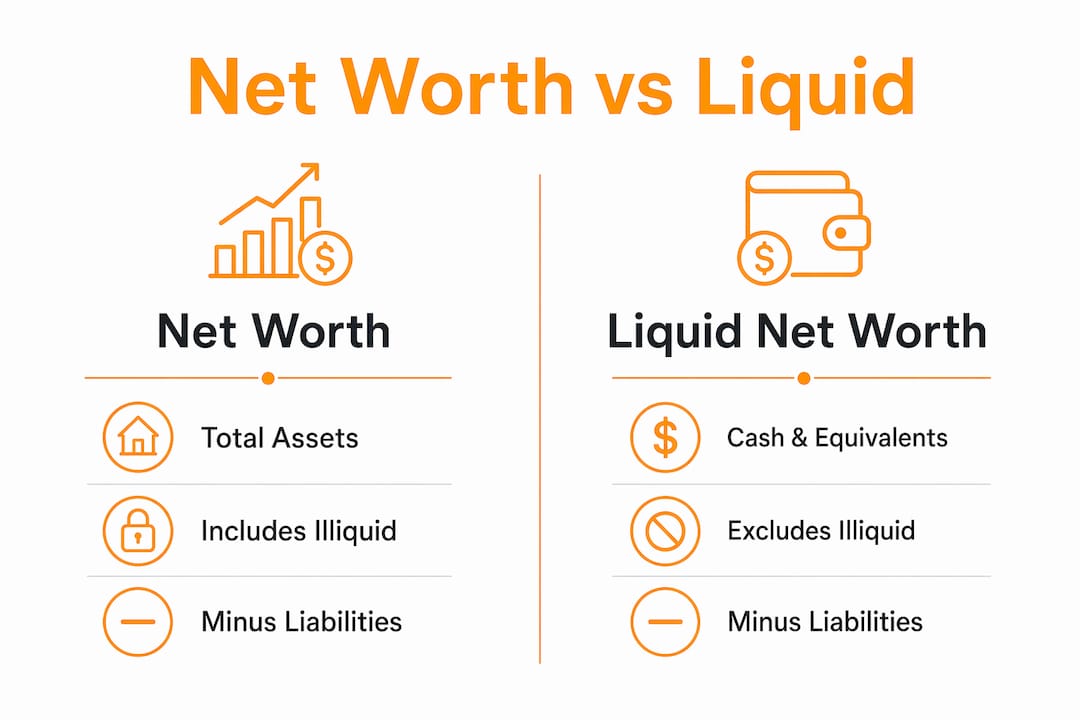
| Dimension | Net worth | Liquid net worth |
|---|---|---|
| Assets included | All assets (liquid + illiquid) | Liquid assets only |
| Liabilities | Total liabilities | Total liabilities (same figure) |
| Time horizon | Long-term wealth picture | Short-term financial flexibility |
| Primary use case | Wealth tracking, estate planning, borrowing capacity | Emergency fund sizing, job-loss planning, near-term cash needs |
| Affected by home equity? | Yes, significantly | No |
| Affected by 401(k) balance? | Yes | No (pre-59½) |
When each metric matters
- Use net worth for: tracking wealth growth over years, calculating your estate, qualifying for certain loans, and benchmarking against long-term financial goals.
- Use liquid net worth for: sizing your emergency fund, assessing how long you could cover expenses after a job loss, evaluating whether you have enough accessible cash before a large purchase, and retirement income planning.
A common misconception: a high net worth guarantees financial security. It does not. A household with $1.5 million in net worth, $1.2 million of which is tied up in a primary residence and a 401(k), may have less than two months of expenses available in liquid form. Net worth tells you how wealthy you are on paper; liquid net worth tells you how resilient you are in practice.
Why you should track both metrics, not just one
Net worth and liquid net worth answer different questions, and relying on only one gives you an incomplete picture.
Consider two scenarios. A homeowner who bought in a rising market may have $600,000 in home equity, pushing their net worth well above $700,000. But if their checking and brokerage accounts hold only $15,000, a sudden job loss or medical bill creates an immediate cash crisis. Their net worth is strong; their liquid net worth is fragile.

The second scenario: an investor who maxed out their 401(k) for 20 years and holds $800,000 in retirement accounts alongside $30,000 in a taxable brokerage. Their net worth looks excellent. But only 3.2% of American retirees have reached $1 million in retirement accounts, and even a well-funded 401(k) is not accessible without penalty before age 59½. For income planning in early retirement, liquid net worth is the more useful number.
Financial advisors often focus on investable net worth for retirement income planning, because home equity does not generate monthly cash flow. A layered liquidity framework used by many planners separates wealth into three buckets: 3–6 months of cash for immediate needs, 1–3 years of near-term funds in accessible investments, and a longer-term strategy for tapping retirement or illiquid assets tax-efficiently.
Mark-to-market swings also matter. Large equity stakes can produce dramatic paper net worth changes over short periods without any change in actual cash available. Tracking liquid net worth alongside total net worth keeps you grounded in what is real and accessible.
Pro Tip: Calculate your liquidity ratio: Liquid Assets ÷ Total Net Worth. Track it monthly. A ratio below 10% signals that most of your wealth is locked up. Many financial planners recommend keeping this ratio at 10–20% for most households, with 15–20% for those with large illiquid holdings.
How to improve your liquid net worth without wrecking long-term goals
Improving liquid net worth is not just about hoarding cash. It is about building the right layers of accessible resources while keeping long-term growth on track.
| Action | Target / Guidance | Trade-off |
|---|---|---|
| Build an emergency fund | 3–6 months of expenses in savings | Low return; high stability |
| Pay down high-interest debt | Credit cards first (highest APR) | Reduces liabilities, improves ratio immediately |
| Shift new savings to taxable brokerage | Supplement 401(k) after employer match | More accessible; taxable gains |
| Ladder short-term CDs or T-bills | 3 and 6-month maturities | Slightly higher yield than savings; minor illiquidity |
| Open a HELOC (don't draw it) | Available credit as a liquidity backstop | Adds a liability if drawn; no cost if unused |
| High-net-worth: target 15–20% liquidity ratio | 15–20% of net worth in liquid assets | Opportunity cost vs. illiquid returns |
Here is a practical sequence:
- Cover the baseline first. Build a 3–6 month emergency fund in a high-yield savings account before optimizing anything else.
- Eliminate high-interest debt. Every dollar of credit card debt at 20%+ APR is a guaranteed negative return. Paying it off improves liquid net worth immediately by reducing liabilities.
- Maximize the employer 401(k) match, then redirect additional savings to a taxable brokerage. Retirement accounts are valuable for long-term growth but do not help liquid net worth. A taxable brokerage account gives you the same market exposure with full accessibility.
- Ladder short-duration bonds or CDs. A 3-month T-bill ladder keeps money working while maintaining near-term access.
- Consider a HELOC as a liquidity backstop. Opening a home equity line of credit costs nothing if you never draw on it, but it gives you a large accessible credit line in an emergency. Note that drawing on it converts equity into debt.
For near-retirees, tax-aware sequencing matters as much as the amounts. Tapping a taxable brokerage first, then tax-deferred accounts, then Roth accounts is a common sequence that minimizes taxes and penalties. A reverse mortgage is one option homeowners over 62 may consider to convert home equity into accessible retirement income without a monthly repayment obligation.
Risk warnings: Early 401(k) withdrawals trigger income tax plus a 10% penalty. Forced sales of concentrated stock positions can create large capital gains. Selling real estate quickly usually means accepting below-market prices. Build liquidity before you need it, not during a crisis.
Pro Tip: If your liquidity ratio is below 10%, do not try to fix it all at once. Redirect one month of new savings to a taxable account or high-yield savings, and reassess in 90 days. Incremental shifts compound faster than you expect.
How to track both metrics over time, and where Evibe fits in
Tracking net worth and liquid net worth once is useful. Tracking them monthly is where the real value shows up, because you can see whether your liquidity ratio is improving or drifting.
The minimum viable tracking cadence: update account balances monthly, re-estimate real estate and other illiquid assets quarterly, and recalculate both metrics after any major financial event (a home purchase, a large investment, a debt payoff).
What to look for in a tracking tool: multi-account sync so balances update automatically, the ability to tag assets as liquid or illiquid, support for custom asset classes (real estate, private equity, collectibles), and alerts when a key ratio moves outside your target range.
The Evibe net worth tracker supports manual entry for assets that cannot be synced automatically, including real estate and private holdings, with multi-currency support and historical FX rates for international assets. For real estate specifically, Evibe's real estate tracking feature lets you log property values and mortgage balances so home equity flows into your total net worth without inflating your liquid net worth calculation.
On security: Evibe uses read-only connections to financial institutions, meaning the app can pull balances but cannot move money. Account credentials are handled through bank-grade encryption. No data is sold to third parties.
Pro Tip: Set a calendar reminder on the first of each month to open your tracker and check two numbers: total net worth and liquid net worth. If the gap between them is widening (more wealth locked in illiquid assets), that is a signal to redirect new savings toward accessible accounts.
Key Takeaways
Liquid net worth is the more useful short-term metric: it strips away illiquid assets to show exactly how much of your wealth you can access without penalties, forced sales, or long delays.
| Point | Details |
|---|---|
| Two formulas, one liability figure | Net worth = total assets − liabilities; liquid net worth = liquid assets − liabilities. |
| 401(k) stays out (pre-59½) | Early withdrawal triggers income tax plus a 10% IRS penalty, making it effectively illiquid. |
| Liquidity ratio target | Aim for liquid assets equal to 10–20% of net worth; 15–20% for households with large illiquid holdings. |
| Emergency fund baseline | Build 3–6 months of expenses in accessible accounts before optimizing other liquidity levers. |
| Evibe for ongoing tracking | Evibe syncs accounts automatically, tags liquid vs. illiquid assets, and alerts you when your liquidity ratio drifts. |
The gap most people miss
Most financial content focuses on growing net worth. That is the right long-term goal. But the number that determines whether you can weather a job loss, a medical emergency, or a market downturn without selling something at the wrong time is liquid net worth.
We see this pattern repeatedly in how people use Evibe: a user with a strong total net worth, most of it in a primary residence and a maxed-out 401(k), who realizes for the first time that their liquid net worth is negative. The assets are real. The wealth is real. But the cash is not there when they need it.
The fix is rarely dramatic. Redirecting a portion of new savings to a taxable brokerage account, paying down a credit card balance, or opening a HELOC as a backstop can shift the picture meaningfully within a year. The prerequisite is knowing the number. Most people track their net worth; far fewer track their liquid net worth separately. That gap in awareness is where financial fragility hides.
Evibe tracks both metrics automatically, in one place
Knowing your net worth and liquid net worth is step one. Keeping both numbers current without manual spreadsheet work is where most people fall short.

Evibe was built for exactly this. Connect your bank accounts, brokerage accounts, and retirement accounts, and Evibe calculates your total net worth and liquid net worth in real time. Tag assets as liquid or illiquid, set a personal liquidity ratio target, and let smart alerts tell you when something drifts. AI-driven analysis surfaces concentration risk and diversification gaps without requiring you to build a model.
What Evibe tracks for these metrics:
- Automatic syncing with 1,000+ banks, brokerages and crypto exchanges across the US, Canada and Europe
- Custom asset entry for real estate, crypto, art, vehicles, and private holdings
- Liquid vs. illiquid asset tagging for accurate liquid net worth calculations
- Real-time alerts when your liquidity ratio moves outside your target range
- Multi-currency support with historical FX rates
Get started free at evibe.com — 7 days of Premium included — and have both numbers calculated before the end of the day.
Disclosure: This article is published by Evibe. Evibe is the product described in this section.
This article is general financial information, not professional financial advice. Confirm rules and thresholds with the IRS or a qualified financial advisor for your specific situation.
Useful sources
| Source | What it covers |
|---|---|
| NerdWallet — Liquid net worth | Definition of liquid assets, 401(k) exclusion rationale, and liquidity caveats for concentrated positions |
| SmartAsset — Net worth vs liquid net worth | Core definitions and high-level contrast between the two metrics |
| SoFi — How to calculate liquid net worth | Step-by-step calculation guidance and worked examples for both metrics |
| Montecito Capital Management — The 15–20% liquidity rule | Liquidity targets (10–20% baseline; 15–20% for HNW households) and the liquidity ratio framework |
| ProsperPlan — High-net-worth liquidity planning | Layered liquidity framework (3–6 months cash, 1–3 years near-term, long-term sequencing) and tax-aware withdrawal sequencing |
| Investopedia — Retiring with $1 million | Federal Reserve Survey of Consumer Finances data on retirement account balances; supports the gap between net worth and liquid resources |
| LS Fellowship / Missouri — Net worth percentage breakdown | Suggested percentage ranges for each net worth category (cash, invested assets, retirement, real estate) |
| IRS.gov | Official rules on 401(k) early withdrawal penalties and tax treatment |
| Evibe — Track your entire net worth | Product features: multi-asset consolidation, automatic syncing, liquidity tagging, and alerts |