15 Minute Delay: How Traders Verify Real Time vs Delayed Quotes
Discover when a 15 minute delay matters, step by step checks tied to SEC, IEX, and FINRA rules, and a cheaper portfolio monitoring alternative.
15 Minute Delay: How Traders Verify Real Time vs Delayed Quotes

Real-time quotes show the current price the moment a trade happens, while delayed quotes show a price from roughly 15 minutes earlier. The rule of thumb is simple: if your trade depends on what the market is doing right now, you need real-time data; if you are checking on a position you plan to hold, a delay of a quarter hour rarely matters.
TL;DR:
- Real-time data is crucial mainly for high-frequency, intraday, or options trading near expiration, where milliseconds can impact profitability.
- Delayed quotes, typically 15 to 20 minutes, are standard for most retail use cases and are often sufficient for long-term investors and swing traders.
- The cost structure for real-time feeds varies, with exchange charges and premium data layered on top of basic access, and many brokers include certain data for free.
- You can verify if your quotes are delayed by checking timestamps, footnotes, and comparing multiple sources, reducing the risk of trading on outdated information.
- For portfolio tracking and general market monitoring, consolidating data through platforms like Evibe offers real-time valuation without the need for costly direct exchange feeds.
Table of Contents
- What real-time and delayed quotes actually mean
- How exchanges and regulators define delayed and real-time data
- Who actually needs real-time data
- How to check whether your quotes are delayed or real-time
- What real-time data costs and why
- How data delays affect execution and trading risk
- A practical alternative to buying raw exchange feeds
- Deciding when to pay for speed
- Track your whole portfolio without chasing exchange subscriptions
- Where to verify the details
- Sources
- FAQ
What real-time and delayed quotes actually mean
A real-time quote reflects the last trade price, the best bid and ask (often called the National Best Bid and Offer, or NBBO), and a timestamp showing exactly when that trade or quote occurred. Nothing sits between the exchange and your screen except the transmission itself.
A delayed quote shows the same information, but the data has been held back before distribution. Providers are required to disclose how long that hold lasts, and most public market-data pages display delayed equity prices with the delay noted in a footnote, so you can confirm the lag without guessing.
What you actually see on a screen depends on how the quote was built:
- Direct exchange feeds pull data straight from a single exchange, often the fastest and most granular option.
- The Securities Information Processor (SIP), or "consolidated tape," combines quotes from every exchange into one composite feed.
- Vendor and broker platforms repackage either of the above, sometimes adding their own processing delay on top of the source delay.
That layering matters. Two platforms showing the "same" quote for the same stock can differ by seconds or minutes depending on which feed sits behind them and how it was licensed. A quote that looks current might actually be a snapshot refreshed only every few minutes, which is a different problem from a labeled 15-minute delay but produces the same risk: you are trading on old information without realizing it.
How exchanges and regulators define delayed and real-time data
The 15-minute delay is not a rounded estimate. It comes from how exchanges and the SIPs structure free versus paid data access. In a proposed rule change, IEX moved to align its own definitions of 'Real-Time' and 'Delayed' with a 15-minute interval, matching the standard already used across most exchanges and consolidated tapes.
IEX proposed defining delayed data as data distributed at least 15 minutes after it was made available, bringing its definitions in line with other exchanges and SIPs.
That same filing lays out why real-time access costs money in the first place. Exchanges charge for direct feeds like TOPS (top-of-book) and DEEP (full order book depth), and IEX's own fee schedule lists monthly charges for these tiers, which brokers and vendors then absorb, pass through, or bundle into subscription pricing.
The SEC's own surveillance tools operate on a completely different scale. MIDAS, the SEC's Market Information Data Analytics System, collects roughly 1 billion records a day, timestamped to the microsecond, for oversight of market structure and trading behavior. That resolution exists to help regulators spot patterns across the entire market, not because any retail trader needs microsecond precision to place an order.

Who actually needs real-time data
Matching your data feed to your trading style avoids two mistakes: paying for speed you never use, or trading blind when speed actually matters. Real-time data is essential for certain strategies and unnecessary for others, and the line between them is fairly clear.
Traders who typically need real-time, streaming data include:
- High-frequency and algorithmic traders, where profit depends on acting faster than the rest of the market.
- Scalpers and very active intraday traders, who open and close positions within minutes based on live price action.
- Market makers, who must continuously quote accurate bid and ask prices to manage risk.
- Options traders near expiration, where prices can move sharply in short windows.
On the other side, long-term investors and many swing traders can rely on delayed or even end-of-day data without meaningfully affecting their results, since their holding periods measure in days, months, or years rather than minutes.
A 15 to 20 minute lag becomes a material risk mainly around earnings releases, Federal Reserve announcements, or sudden volatility spikes, when a stock price can change significantly before a delayed quote updates.
Pro Tip: If you rarely place a trade you need to execute within the hour, delayed data is probably fine, and the money is better spent elsewhere.
How to check whether your quotes are delayed or real-time
Most platforms tell you the truth if you know where to look, but the information is rarely front and center.
- Read the footnote or disclosure near the quote, since providers are generally required to disclose delay periods rather than hide them.
- Compare timestamps directly: pull up the same ticker on two sources, one you trust as real-time (like your broker's live trading screen) and the one in question, and check whether the trade times match or trail by minutes.
- Look in your broker's settings for a real-time data agreement or subscription toggle, since many brokers gate live quotes behind a one-time exchange agreement even when there is no extra charge.
- Watch for stale refresh patterns, such as a price that updates in suspiciously round intervals or fails to move during clearly active trading, which often signals a cached or throttled feed rather than a genuine live one.
Running this check once per platform you use takes a few minutes and removes any guesswork about what you are actually looking at before you place a trade.
What real-time data costs and why
Pricing for market data is layered, and understanding the layers helps you avoid paying for more than you need.
- Exchange-level fees sit at the base of the chain. IEX's filing lists separate charges for TOPS and DEEP access, and other exchanges publish comparable schedules for their own direct feeds.
- Depth and options data cost more than top-of-book quotes, because full order book detail and options chains require processing and distributing far more data points per second.
- Many retail brokers now include real-time equity quotes for free, absorbing the exchange fee as part of doing business, though this varies by exchange and by whether you trade actively enough to qualify.
- Fees still apply for specialized access, including depth-of-book, options analytics, or data from smaller exchanges not covered by a broker's standard agreement.
The exchange-fee structure behind free retail quotes is not trivial. IEX's proposed fee schedule references monthly charges for TOPS and DEEP access, costs that brokers negotiate and often absorb so that individual customers see no line item at all.
If you trade across multiple exchanges or need options depth, estimating your true monthly cost means checking each exchange's fee schedule separately rather than assuming one broker subscription covers everything.
How data delays affect execution and trading risk
The gap between what you see and what the market is doing right now is where real money gets lost, particularly with certain order types.
- Market orders based on delayed quotes carry real slippage risk, since you are agreeing to trade at whatever the current price is, not the 15-minute-old price on your screen.
- Limit orders placed from a delayed bid or ask can miss the market entirely, either executing far worse than expected once the order reaches a fast-moving price, or never filling because the market already moved past your limit.
- Fast-moving news and earnings reactions amplify the gap, since a stock can swing several percent in the time a delayed quote catches up.
A few habits reduce this risk without requiring a real-time subscription for every situation:
- Favor limit orders over market orders when you know your data might be delayed, so you control the worst price you will accept.
- Confirm your broker's execution screen is live even if your charting or research tool is delayed, since the platform that actually places the trade matters most.
- Avoid trading around scheduled news events on delayed data, and wait for confirmation from a real-time source if the position size matters.
A practical alternative to buying raw exchange feeds
Most investors do not need a direct exchange subscription. They need to know what their portfolio is worth and whether something requires attention, and that is a different problem than executing trades in a fast market.
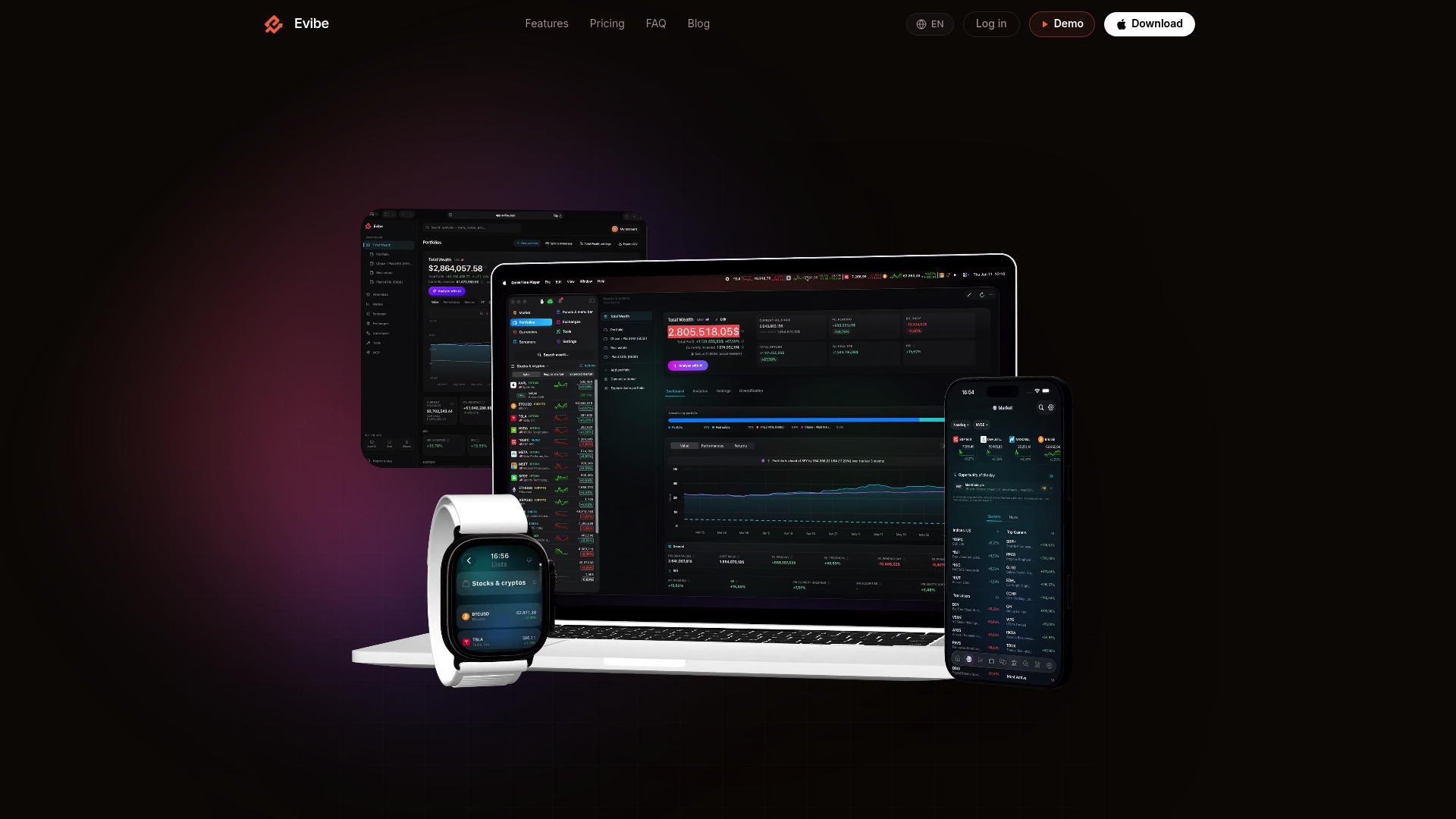
Evibe consolidates stock, ETF, crypto, options, and other holdings into one dashboard with automatic account syncing and real-time global market data, so your net worth reflects current prices rather than a stale snapshot. Its AI-driven analysis surfaces portfolio risk and diversification, and smart alerts flag meaningful market moves without requiring you to watch a ticker all day.
This works well for monitoring and long-term decision-making, which is most of what retail investors actually do day to day. It is not a substitute for a direct exchange feed if you are actively placing intraday trades where execution speed and full order-book depth matter. When you connect a broker account, Synced data can also help users notice if a linked account is reporting delayed values, adding situational awareness beyond what a single broker screen may provide.
Deciding when to pay for speed
The trade-off comes down to cost against risk exposure. Paying for real-time, direct-exchange data only makes sense when your worst-case trade genuinely depends on sub-minute accuracy, such as a scalp trade or a fast options play near expiration. For everyone else, the smarter move is running the verification checklist above on whatever platform you already use, confirming the delay, and deciding from there whether it actually affects your results.
— Vincent
Track your whole portfolio without chasing exchange subscriptions
Investors who just want an accurate, current view of their holdings do not need to manage separate data agreements for every exchange they touch. Evibe pulls ETFs, stocks, options, crypto, and other assets into a single view with automatic syncing, real-time pricing, and dividend tracking that reflects what has actually been declared and paid, not a delayed estimate.
| What you get | Detail |
|---|---|
| Asset coverage | Stocks, ETFs, crypto, options, real estate, and more in one dashboard |
| Data sync | Automatic bank and brokerage syncing with real-time global market data |
| Insight layer | AI-driven analysis of risk, diversification, and performance |
| Price | Subscription fees available on the Evibe website, Evibe |
This does not replace a direct exchange feed for active intraday trading, but for tracking a portfolio's actual value and catching meaningful moves, it removes the need to piece together multiple paid data subscriptions. Start with Evibe and see your holdings update in real time.
Where to verify the details
For the exact rules behind delayed and real-time data, consult the IEX rule filing, the SEC's MIDAS overview, FINRA's market-data FAQ, and Investopedia's explainer.
Sources
- Importance of Real-Time Data in Financial Markets — CUNY Pressbooks
- SR-IEX-2025-01 — IEX proposed rule change (SEC filing)
- Real-time quote — Investopedia
- Market data frequently asked questions — FINRA
FAQ
What are real-time quotes?
A real-time quote shows the instantaneous last trade price, best bid and ask, and volume the moment a trade happens, with no delay applied. Real-time quotes include a live timestamp so you know exactly when that price was accurate.
Why are my TradingView quotes delayed by 15 minutes?
Many charting platforms distribute exchange data under the standard delayed-access terms that exchanges and SIPs use for free tiers. IEX's own filing defines delayed data as data distributed at least 15 minutes after it becomes available, which is why 15 minutes shows up as the common default across many free tools.
What is the 7% rule in trading?
Definitions of trading rules vary by strategy and source, and this article's sources do not define a specific "7% rule." If you have seen it referenced elsewhere, treat it as a strategy-specific guideline rather than a universal standard, and confirm the definition with the original source before applying it.
How long are stock quotes delayed?
Delayed stock quotes are commonly held back for about 15 to 20 minutes before distribution, a standard used across most major exchanges and consolidated tape providers. The exact delay is usually disclosed in a footnote or disclosure notice on the page showing the quote.
Do I need real-time data if I only check my portfolio occasionally?
If you are monitoring long-term holdings rather than executing time-sensitive trades, delayed or periodically refreshed data is generally sufficient. Tools like Evibe pair real-time pricing with automatic account syncing so you get a current view without needing a dedicated exchange data subscription.