Average Cost Basis Calculator: Your 2026 Investor Guide
Use our average cost basis calculator to track profits, losses, and tax reporting effortlessly in 2026. Discover Evibe’s private, Apple-native tool today!
Average Cost Basis Calculator: Your 2026 Investor Guide

What is an average cost basis calculator and how does it work?
An average cost basis calculator computes your weighted average purchase price across every lot you've bought of a stock, giving you a single per-share number that anchors both your profit/loss tracking and your tax reporting. You enter each purchase: shares bought and price paid. The tool does the rest.
Here's what it handles for you:
- Weighted average price: Totals your full investment cost, then divides by total shares owned
- Profit and loss: Compares your average cost against the current market price
- Tax basis reporting: Produces the figure your broker and the IRS need for capital gains calculations
- Multi-lot tracking: Handles any number of purchase lots, including partial sales
The core formula is simple: Average Cost Basis = Total Amount Invested ÷ Total Shares Owned. Where it gets complicated is in the adjustments — splits, dividends, fees, and corporate actions. That's where a reliable cost basis calculation tool earns its keep.
Table of Contents
- What is the cost basis of a stock?
- How to calculate your average stock cost basis step by step
- How to calculate stock profit or loss using average cost basis
- Common adjustments to cost basis you should know
- Why accurate cost basis tracking matters for investors
- What makes a "good" stock cost basis?
- Cost basis methods compared: FIFO, LIFO, specific identification, and average cost
- How corporate actions affect your cost basis
- Tools and software for calculating average cost basis
- Limitations and common mistakes with average cost basis calculators
- Key Takeaways
- Evibe keeps your cost basis current without the manual work
What is the cost basis of a stock?
Cost basis is the total amount you paid to acquire a position, expressed on a per-share basis. It's not just the share price at purchase. It includes commissions, fees, and any adjustments from corporate actions.
Why does it matter? Because the IRS taxes the gain, not the proceeds. Your taxable gain equals sale price minus cost basis. Get the basis wrong, and you either overpay taxes or expose yourself to penalties.
Key terms worth knowing:
- Adjusted cost basis: Original purchase price modified for splits, dividends, return of capital, and fees
- Purchase lot: Each individual buy transaction, with its own date, price, and share count
- Unrealized gain/loss: The difference between current market value and your cost basis, before you sell
- Realized gain/loss: Locked in at the moment of sale, and reportable to the IRS
When you buy a stock multiple times at different prices, each transaction creates a separate lot. Your average cost basis blends all of those lots into one number.
How to calculate your average stock cost basis step by step

The weighted average formula is:
Average Cost Basis = (p1 × q1 + p2 × q2 + … + pn × qn) ÷ Total Shares
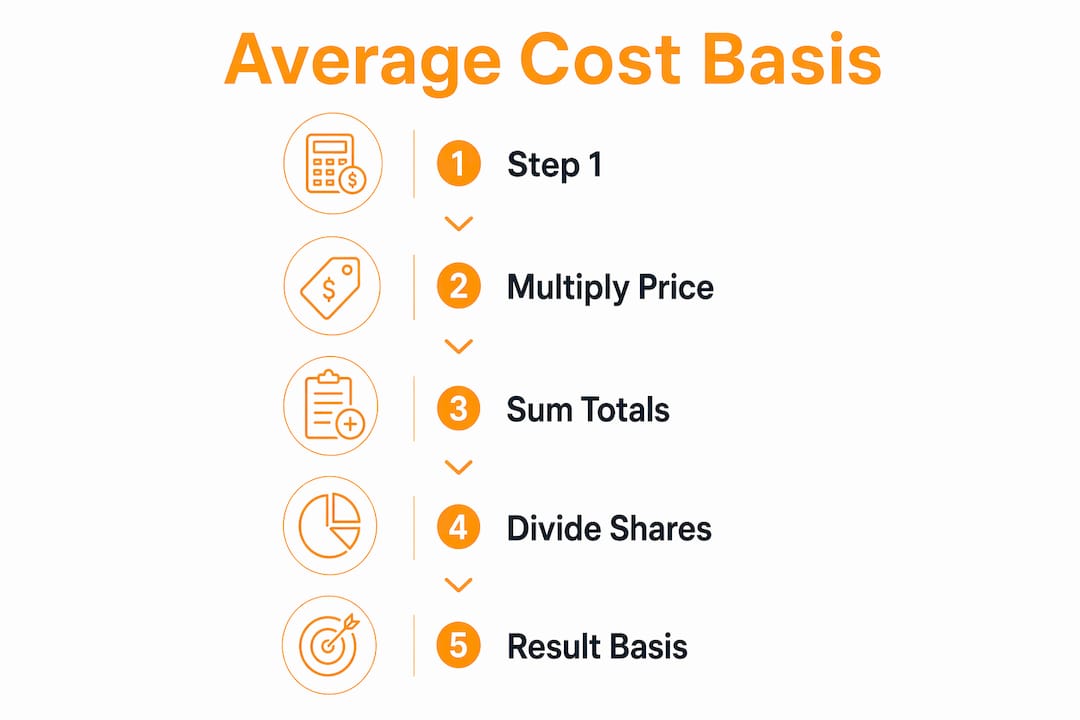
Where p is price per share and q is quantity purchased in each lot.
Example:
| Purchase | Shares | Price/Share | Total Cost |
|---|---|---|---|
| Buy 1 | 100 | — | — |
| Total | 150 | $7,000 |
Average Cost Basis = $7,000 ÷ 150 = $46.67 per share
A few things to include in that total cost figure:
- Commissions and fees: Transaction costs increase your basis and reduce your taxable gain — ignoring them means you overpay taxes
- Multiple lots: Add every purchase, not just the most recent one
- Partial sales: After a partial sale, recalculate using remaining shares and their proportional cost
Pro Tip: Keep a running spreadsheet or use a portfolio app that logs every trade automatically. Reconstructing purchase history from memory at tax time is where errors compound.
How to calculate stock profit or loss using average cost basis
Once you have your average cost basis, profit or loss is straightforward. Stock profit equals sale proceeds minus average cost basis multiplied by shares sold:
Profit/Loss = (Sale Price − Average Cost Basis) × Shares Sold
Using the example above, if you sell all 150 shares at $55:
- Profit = ($55.00 − $46.67) × 150 = $1,249.50
For a percentage view: Profit % = ((Sale Price − Cost Basis) ÷ Cost Basis) × 100
That's ($55.00 − $46.67) ÷ $46.67 × 100 = 17.85% gain
What this means for tax reporting:
- Short-term gains (held under 12 months) are taxed as ordinary income
- Long-term gains (held over 12 months) qualify for preferential capital gains rates
- An accurate basis is what determines which category applies and how much you owe
Common adjustments to cost basis you should know
Cost basis isn't static. Several events change it after your initial purchase, and missing any of them distorts your gain calculations.
Stock splits: A 2-for-1 split halves your per-share cost basis while doubling your share count. Total basis stays the same; per-share basis changes. Miss this adjustment and you'll report a phantom gain.
Dividend reinvestments (DRIPs): Each reinvested dividend creates a new purchase lot with its own basis. Because those dividends were already taxed as income, the new shares add to your total cost basis. Track every DRIP separately — our dividend tracking guide covers how this compounds over time.
Return of capital: Distributions classified as return of capital reduce your adjusted cost basis rather than count as income. When basis reaches zero, further distributions become taxable gains.
Commissions and fees: Every dollar paid in trading commissions adds to your cost basis, reducing the taxable gain on sale.
Why it matters: Without detailed records of fees and corporate actions, your basis is either understated or overstated, leading to overpaid taxes or IRS penalties.
Pro Tip: Automate the record-keeping. Manual spreadsheets fail when you have dozens of DRIP lots or multiple splits across years. A platform that auto-adjusts for corporate actions removes the single biggest source of basis errors.
Why accurate cost basis tracking matters for investors
The IRS defaults to FIFO — first in, first out — unless you instruct your broker otherwise before the trade executes. In a rising market, FIFO typically produces the largest taxable gain because your oldest (cheapest) shares sell first. That default costs investors real money.
Accurate tracking gives you options:
- Method selection: Choose FIFO, LIFO, or specific identification based on your tax situation
- Loss harvesting: Identify high-basis lots to sell at a loss and offset gains elsewhere
- Audit readiness: Clean records reduce penalty exposure from reporting errors
- Planning ahead: Know your break-even price before you sell, not after
Brokers vary in how they let you designate lot methods. Some require written instructions; others accept online elections. Confirming your broker's process before you trade is non-negotiable.
Pro Tip: To use specific identification, you must instruct your broker at or before trade execution — not after. A post-trade call won't change the tax treatment.
What makes a "good" stock cost basis?
A good cost basis is one that's accurate, complete, and documented. From a tax strategy standpoint, a higher cost basis is generally better: it reduces your taxable gain on sale. That's why averaging down — buying more shares after a price drop — can improve your tax position as well as your break-even price.
A few markers of a well-maintained cost basis record:
- Every purchase lot is logged with date, shares, price, and fees
- All corporate actions (splits, mergers, spinoffs) are reflected
- DRIP purchases are tracked individually, not lumped together
- The method (average cost, FIFO, specific ID) is documented and consistent
Investors who track basis carefully also tend to make better sell decisions. When you know exactly what each lot cost, you can choose which shares to sell to minimize taxes or realize a loss strategically.
Cost basis methods compared: FIFO, LIFO, specific identification, and average cost
Different methods produce different taxable outcomes, and the right choice depends on your holding period, tax bracket, and goals.
| Method | How it works | Best for |
|---|---|---|
| FIFO | Sells oldest shares first | Long-term holders in flat/declining markets |
| LIFO | Sells newest shares first | Minimizing gains when recent purchases cost more |
| Specific ID | You choose which lot to sell | Maximum tax control; requires broker documentation |
| Average Cost | Blends all lots into one per-share price | Mutual funds; simplicity across many small lots |
Average cost is the IRS-permitted default for mutual funds and is widely used for simplicity. For individual stocks, specific identification offers the most control — but only if you set it up with your broker in advance. Wash sale rules and the Net Investment Income Tax of 3.8% on investment income for high earners can further shift which method makes sense.
How corporate actions affect your cost basis
Mergers, spinoffs, and stock dividends all require basis adjustments that most investors overlook.
- Mergers and acquisitions: When a company you hold is acquired for stock, your basis in the new shares is typically calculated from the exchange ratio and the original cost
- Spinoffs: The IRS requires you to allocate your original basis between the parent and the spun-off entity, usually based on relative fair market values at the spinoff date
- Stock dividends: Shares received as a stock dividend reduce the per-share basis of your existing position, similar to a split
- Return of capital distributions: These reduce your adjusted basis; once basis hits zero, all further distributions are taxable
The IRS and your broker will issue guidance (often via Form 8937 for corporate actions), but the responsibility to apply those adjustments correctly sits with you. Professional tools that auto-adjust for corporate actions reduce audit risk significantly.
Tools and software for calculating average cost basis
Your options range from free online calculators to full portfolio tracking platforms:
- Online calculators: Tools like those at SimplifyCalc and OmniCalculator handle basic weighted average math quickly. Good for spot-checking a position, not for ongoing tracking
- Broker platforms: Most major brokers display cost basis per lot, but they only cover assets held with them and don't consolidate across accounts
- Tax software: TurboTax and H&R Block import 1099-B data and calculate gains, but they rely on the basis your broker reports — errors upstream flow through
- Portfolio tracking apps: Platforms that sync across brokers and auto-adjust for corporate actions give you a real-time, consolidated view. For investors with capital gains tax planning as a priority, this level of automation matters most
Online calculators are useful for learning the math, but they're not a substitute for integrated tracking software that handles corporate actions and maintains a full audit trail.
Limitations and common mistakes with average cost basis calculators
Even a well-built calculator has blind spots:
- Missing lots: If you forget a purchase, your average is wrong. Garbage in, garbage out
- Ignoring fees: Omitting commissions understates your basis and inflates your reported gain
- No corporate action handling: Basic calculators don't adjust for splits or spinoffs automatically
- Method lock-in: Once you use average cost for mutual fund shares, switching methods requires IRS approval
- Wash sale blindness: Selling at a loss and rebuying within 30 days triggers wash sale rules that disallow the loss — most simple calculators don't flag this
- Multi-account gaps: A calculator fed data from one brokerage misses positions held elsewhere
The most common investor regret is not setting up systematic tracking early. Reconstructing years of purchase history, splits, and DRIP lots at tax time is painful and error-prone. A net worth tracker that consolidates all accounts from day one eliminates most of these problems before they start.
Key Takeaways
Accurate cost basis tracking, applied consistently from your first purchase, is the single most effective way to reduce tax errors and improve sell-side decision-making.
| Point | Details |
|---|---|
| Core formula | Average Cost Basis = Total Amount Invested ÷ Total Shares Owned, weighted by lot size. |
| Adjustments are mandatory | Stock splits, DRIPs, fees, and return of capital all change your basis — ignoring them risks IRS penalties. |
| Method choice matters | FIFO is the IRS default; specific identification gives maximum tax control but must be set before the trade. |
| Corporate actions require allocation | Mergers, spinoffs, and stock dividends each require a basis reallocation — your broker's Form 8937 is the starting point. |
| Evibe automates the tracking | Evibe syncs across brokers, auto-adjusts for corporate actions, and gives you real-time cost basis across all your stock positions. |
Evibe keeps your cost basis current without the manual work
Calculating average cost basis once is straightforward. Keeping it accurate across dozens of positions, multiple brokers, DRIPs, splits, and corporate actions — that's where manual tracking breaks down.

Evibe's stock portfolio tracker syncs automatically with your brokerage accounts, captures every purchase lot, and adjusts for corporate actions in real time. You get a consolidated cost basis view across all your holdings, not just what one broker reports. The AI-driven analysis flags risk and diversification gaps, and smart alerts tell you when market moves affect your positions. For investors who want accurate numbers without rebuilding their records from scratch every tax season, Evibe is the practical answer. Download Evibe today and see your full cost basis picture in one place.