Manage Custom Assets for Investors in 20–40 Minutes, No Bank Sync
Track custom assets without bank sync. A practical investor workflow: valuation cadence, source attachments, and consolidated performance.
Manage Custom Assets for Investors in 20–40 Minutes, No Bank Sync

Custom assets are the holdings your brokerage feed will never see: rental property, a stake in a friend's startup, a classic car, a private loan. The fix is simple in principle. Add each one as a custom asset entry with a named valuation source and a fixed update cadence, then treat that entry with the same discipline you'd apply to a stock position. Evibe and several manual-first tools support this exact workflow.
TL;DR:
- Custom assets require explicit valuation sources, fixed update schedules, and careful categorization to prevent tracking errors over time.
- Valuing private equity and loans relies on statement-driven methods, while real estate and vehicles should be priced with market comparables or appraisals.
- Automating document ingestion and setting reminders can significantly reduce manual effort, but manual entry offers better privacy control.
- Accurate performance measurement favors IRR calculations for illiquid assets, with transparent valuation date and confidence level disclosures.
- Regular reconciliation, entity mapping, and secure data practices are essential to maintain reliable records and prevent double-counting or stale valuations.
Table of Contents
- Which Holdings Count as Custom Assets, and How Do You Classify Them?
- How Do You Value Each Custom Asset Type?
- What's the Workflow for Adding and Updating Custom Assets?
- How Do You Include Custom Assets in Consolidated Performance?
- How Do You Verify and Audit Custom Asset Records?
- What Do Costs and Time Actually Look Like?
- How Do You Keep Sensitive Asset Data Secure?
- How Do You Handle Illiquid Assets and Estimate Liquidity?
- How Does Custom Asset Tracking Fit Into Overall Portfolio Management?
- What Does Effective Custom Asset Tracking Look Like in Practice?
- A Month Inside a Custom Asset Tracking Routine
- How Evibe Handles Custom Asset Tracking for You
- Sources
Which Holdings Count as Custom Assets, and How Do You Classify Them?
A custom asset is any holding that doesn't arrive through an automated brokerage or bank feed. That covers a wide range of financial lives, and lumping them all into one "other" bucket is how tracking falls apart within a few months.
Start by defining the common categories:
- Private equity or startup equity: stakes in companies with no public price, valued through periodic statements or funding rounds.
- Real estate: rental property, land, or a vacation home, valued through appraisals or market comparables.
- Collectibles: art, watches, wine, or trading cards, valued through auction records or dealer comparables.
- Vehicles: cars, boats, or classic motorcycles, valued through published pricing guides.
- Loans: money you've lent out, tracked at face value plus accrued interest, minus any expected losses.
Once you know the categories, group them by three practical dimensions: liquidity (can you sell this in a week or a decade?), ownership entity (personal name, LLC, trust, joint account?), and whether the asset produces income or is purely a capital position. A useful tagging scheme adds four fields to every entry: owner, entity, valuation cadence, and a confidence level (high, medium, or estimated). That confidence tag matters more than people expect. It tells you, six months from now, whether a number is a hard fact or a guess you made on a slow Tuesday.
How Do You Value Each Custom Asset Type?
Valuation is where most manual trackers quietly go wrong. Real estate and vehicles suit mark-to-market pricing, where you refresh the number against current market data. Private equity and loans suit statement-driven valuation, where you record whatever your last capital account statement or loan ledger says and hold that number until the next one arrives. Mixing the two approaches inside a single asset class is a common source of confusing quarter-over-quarter swings.
Concrete sources by asset type:
- Private equity and startup equity: capital account statements or administrator reports issued by the fund or company, typically quarterly.
- Real estate: professional appraisals annually, or automated valuation comparables for a lighter-touch quarterly check.
- Collectibles: recent auction records or dealer comparables for similar pieces.
- Vehicles: Kelley Blue Book or equivalent published pricing guides, updated a few times a year.
- Loans: face value plus accrued interest, adjusted downward if repayment looks doubtful.
When you don't have a firm number, use a conservative, clearly labeled provisional estimate rather than leaving a stale figure sitting in your dashboard. Family offices that manage alternative investments rely on exactly this statement-driven approach because private positions rarely trade often enough to support a real market price.
Pro Tip: Set your valuation cadence by asset behavior, not by habit. Monthly makes sense for anything with regular statements, quarterly for real estate and private equity, and event-driven for anything that only changes value when something happens, like a car accident or a funding round.
What's the Workflow for Adding and Updating Custom Assets?
A repeatable process beats a burst of good intentions every time. Use this sequence for every new custom asset:
- Define the asset: name, category, owner, and legal entity.
- Capture documentation: the statement, appraisal, deed, or loan agreement that supports the number.
- Enter the fields: current valuation, currency, and acquisition cost.
- Tag cadence and confidence: how often you'll refresh it and how solid the number is.
- Attach the source document: link the actual PDF or statement, not just a note.
- Schedule the next update: a calendar reminder or an app-based nudge.
Automation can absorb parts of this without full bank-level sync. Options worth building into your routine include:
- PDF ingestion tools that pull figures directly out of capital account statements.
- Portal or API imports for platforms that expose position data even without full account linking.
- Spreadsheet uploads for bulk updates across several assets at once.
- Scheduled reminders that fire on your chosen cadence instead of relying on memory.
WealthArc's reporting on alternative assets notes that document processing tools now handle much of this ingestion automatically, which cuts real hours off a process that used to mean retyping numbers from PDFs by hand. Keep data hygiene simple: map every asset to one legal entity, treat one system as the single source of truth, and record foreign-currency assets in their original currency with the FX rate noted at the valuation date, not converted and forgotten.
How Do You Include Custom Assets in Consolidated Performance?
The return measure you choose changes the story your numbers tell. Time-weighted returns work well for liquid, frequently-traded positions. Custom assets, especially private equity and loans, behave differently because cash moves in and out on their own schedule, so an internal rate of return calculation that accounts for the timing of contributions and distributions gives a far more honest picture than forcing them into a time-weighted framework built for stocks.
A few habits keep this from becoming misleading:
- Show the valuation date and confidence level next to every mark-to-market figure, not buried in a footnote.
- Record cash movements the moment they happen, and record valuations only when a new statement arrives. Keeping those two data types separate is what makes a defensible IRR possible, according to Asora's guidance for family offices.
- Offer two blended views: total net worth including illiquid assets, and a liquid-only view, so you're never comparing your real estate equity against your brokerage account on the same performance chart by accident.
For a private-equity rollforward, capture starting NAV, capital calls, distributions, unrealized gains or losses, and ending NAV each period. That structure, borrowed directly from institutional reporting, scales down fine for a single rental property or a handful of angel investments.
How Do You Verify and Audit Custom Asset Records?
Every valuation should carry three things: the primary document it came from, the method used to set the number, and the person who entered it. Skip any one of those and you're trusting your future self to remember details that fade within a year.
The mistakes that show up most often are predictable:
- Double-counting an asset that sits in both a personal account and an LLC's records.
- Letting a valuation go stale for two years because nothing forced a review.
- Counting unfunded private-equity commitments as if they were already part of your NAV.
Reconcile custom asset totals against source statements at least once a year, and bring in a third-party appraisal whenever a valuation drives a major decision, such as refinancing property or negotiating a buyout of private shares.
Pro Tip: Keep an entity map as a standalone document. When the same economic exposure shows up in a personal account and a trust, that map is the only thing standing between you and an inflated net-worth number.
What Do Costs and Time Actually Look Like?
Manual tracking costs almost nothing in dollars and quite a lot in attention. A basic spreadsheet-based net worth tracker captures the essential fields for free, but it demands that you remember to update it, and it offers no built-in reminders, document attachments, or multi-currency conversion.
Budget your time realistically. A portfolio with four or five custom assets typically takes 20 to 40 minutes a month to maintain properly, split between checking for new statements and updating figures. That number climbs fast once you're past ten holdings across multiple entities, which is usually the point where a dedicated app starts paying for itself in saved hours rather than saved dollars.
The tradeoff isn't really spreadsheet versus app. It's how much friction you're willing to tolerate before a task gets skipped. A reminder that fires automatically beats a mental note every time, and an app that stores your source documents alongside the valuation removes the "where did this number come from" scramble that hits everyone eventually. If your holdings are simple, a spreadsheet snapshot habit is genuinely enough to start. Add software once you need historical FX rates, attachments, or a consolidated view across account types, a transition MyMoneyViz frames as a natural upgrade path rather than a requirement from day one.
How Do You Keep Sensitive Asset Data Secure?
Custom asset records often contain more sensitive material than a brokerage statement: loan agreements, property deeds, appraisal reports with your home address, or details of a private business you have a stake in. Treat those documents accordingly.
A manual-first approach has a real privacy advantage here. Instead of granting a third party read access to your bank credentials, you control exactly what data leaves your hands and when. That's a deliberate tradeoff worth naming: automation reduces your workload, manual entry reduces your exposure.
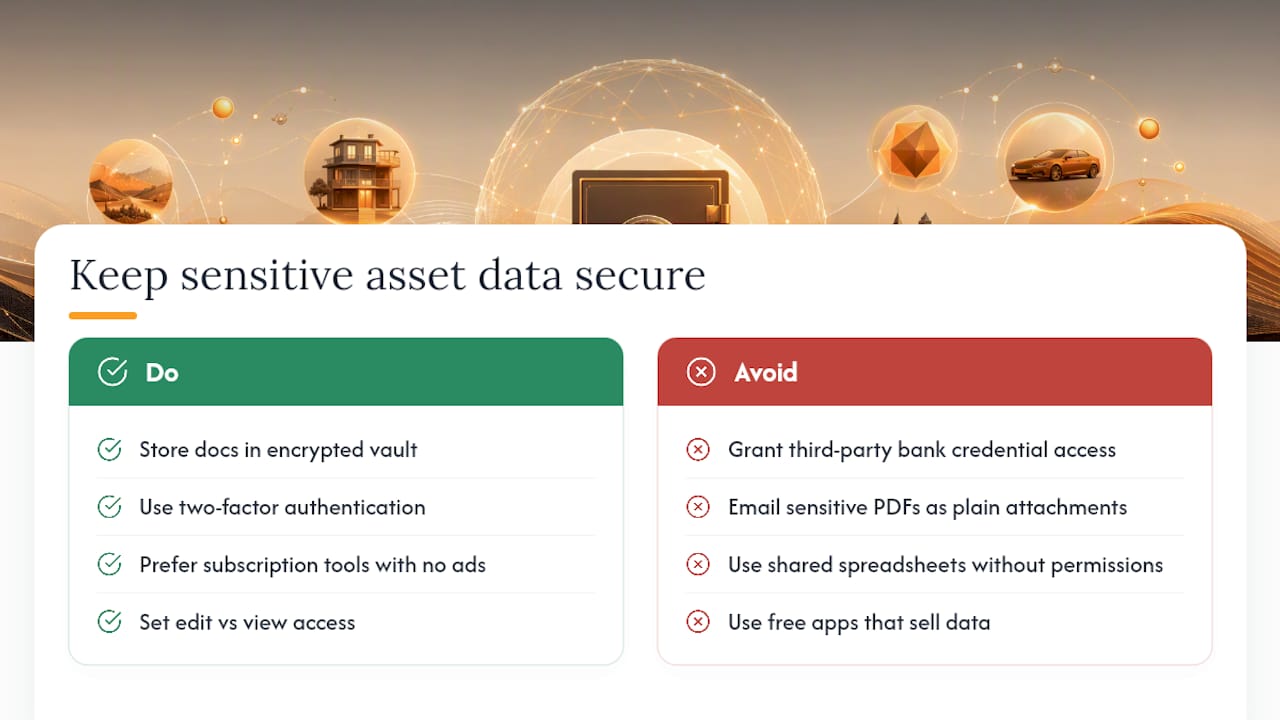
Whichever system you use, apply a few baseline habits. Store attached documents in an encrypted vault rather than a shared drive, use two-factor authentication on any app that holds your net worth data, and avoid emailing appraisal PDFs or capital account statements as plain attachments. Check whether your tracking platform sells or shares data with advertisers. A subscription-based tool with no ad revenue has a structurally different incentive than a free app that monetizes your financial profile. If you're tracking assets held jointly with family members or business partners, agree in advance on who has edit access versus view-only access, since a shared spreadsheet with no permission structure is a common source of accidental overwrites.
How Do You Handle Illiquid Assets and Estimate Liquidity?

Illiquid assets need a different mental model than anything trading on an exchange. You can't check a real-time price, and selling one might take months or years, so the goal shifts from precision to a defensible range.
Assign each illiquid holding a liquidity horizon: assets you could reasonably convert to cash within 30 days, within a year, or only over multiple years, as with a private equity stake locked in a fund with a defined term. That horizon should sit right next to the valuation in your records, because a $200,000 valuation on a rental property and a $200,000 valuation on a five-year private equity commitment are not remotely the same kind of $200,000.
When you're estimating a private stake with no active market, lean toward the conservative end of any reasonable range rather than the optimistic one. Overstating a private valuation inflates your reported net worth in a way that only surfaces as a problem when you actually try to sell. For real estate and vehicles, comparables and pricing guides give you a workable range even without a formal appraisal. For truly illiquid positions like an early-stage startup investment, the last priced round is often the only defensible anchor you have, and it should be flagged with a low or medium confidence tag until something more current comes along.
How Does Custom Asset Tracking Fit Into Overall Portfolio Management?
Custom assets shouldn't live in a separate spreadsheet from your stocks and ETFs. The value of consolidation comes precisely from seeing your entire financial picture in one dashboard, weighted correctly against your liquid holdings.
That means your custom asset records need to speak the same language as your brokerage data: consistent currency handling, consistent date stamps, and a valuation method noted for every figure so nothing gets compared apples to oranges. If 40% of your net worth sits in private real estate and startup equity, your diversification and risk metrics are meaningless unless those positions are folded into the same calculation as your public market exposure.
This is also where automation earns its keep for the assets that can support it. A tool that pairs manual custom asset entries with automatic syncing for your brokerage and bank accounts gives you one place to check your full risk exposure, rather than mentally combining two disconnected systems every time you want an honest answer about your net worth.
What Does Effective Custom Asset Tracking Look Like in Practice?
Consider a portfolio manager holding a rental duplex, a stake in a private logistics company, and a small angel investment. Each asset gets its own entry: the duplex valued quarterly against comparable sales, the logistics stake valued off the administrator's capital account statement, and the angel investment held at its last funding round price with a low confidence tag until the next round prices it again.
Every quarter, the manager pulls the latest capital account statement, updates the logistics stake, checks a comparables tool for the duplex, and leaves the angel investment untouched unless news of a new round arrives. Three assets, three cadences, one consolidated dashboard. The blended portfolio view shows both a full net worth figure and a liquid-only figure side by side, so a lender or a financial planner reviewing the numbers sees exactly how much sits in assets that can't be converted to cash quickly.
That structure, small as it is, mirrors the same private-asset register and rollforward discipline that family offices use at a much larger scale. The size of the portfolio changes; the underlying habit of documenting valuation, cadence, and confidence does not.
A Month Inside a Custom Asset Tracking Routine
The routine that actually holds up looks like this: week one, gather any new statements that arrived. Week two, update capital accounts and check for real estate comparables. Week three, review vehicle and collectible values only if something changed. Week four, reconcile everything and export a clean report.
One example sticks with me: a private equity capital call comes in, cash goes out, and the NAV doesn't move until the next quarterly statement lands weeks later. Recording that call the day it happens, separate from the eventual valuation update, is what keeps the IRR calculation honest instead of quietly wrong. Conservative assumptions and a document attached to every number are what make an export you can hand to a lender or a co-investor without a follow-up call.
— Vincent
How Evibe Handles Custom Asset Tracking for You
Everything covered above, custom asset fields, document attachments, valuation cadence, confidence tags, maps directly onto features built into Evibe. You can create a custom asset entry for real estate, a private stake, a vehicle, or a loan, attach the supporting statement or appraisal, and set a reminder so updates happen on schedule instead of by accident.
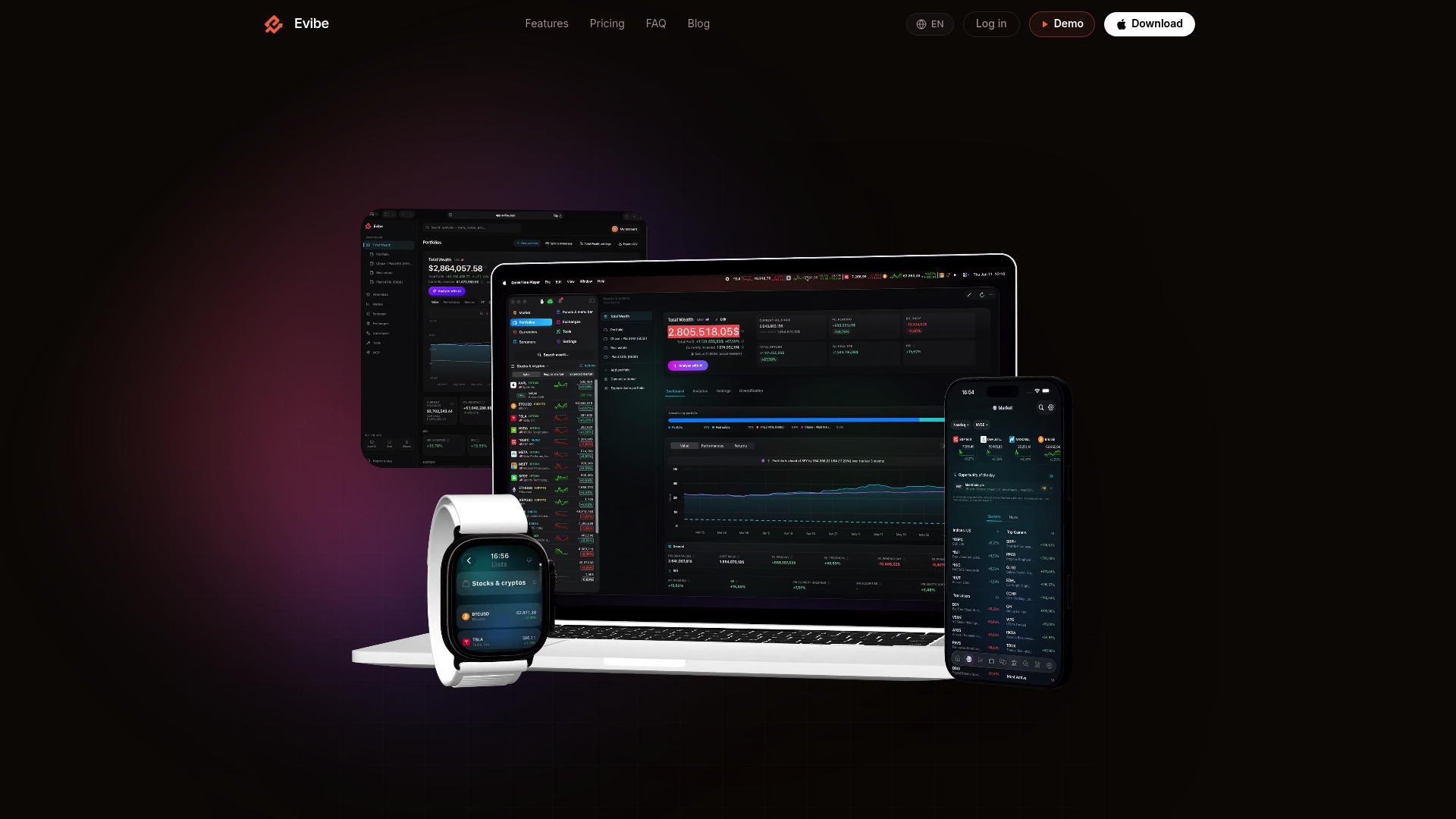
Where Evibe saves real time over a spreadsheet is in the parts that don't scale well by hand: multi-currency support with historical FX rates for foreign holdings, AI-driven insights that fold your custom assets into overall risk and diversification metrics, and automatic syncing of your bank and brokerage accounts so your liquid and illiquid positions sit in one dashboard rather than two disconnected systems. For income-producing custom assets like a rental property or a private note, the dividend tracking tools extend the same discipline to cash flow. If you want to see how your custom assets should be marked between statement dates, the mark-to-market approach is worth understanding before you set your first valuation cadence. Get started free and add your first custom asset at Evibe today.
Sources
- How I Track My Net Worth Manually Without Bank Sync | Worth it
- Why Family Offices Struggle with Alternative Investment Reporting
- Private Asset Management for Family Offices in 2026 | Asora
This article is general information, not a substitute for advice from a qualified financial advisor. Consult a qualified financial professional about your own circumstances before acting on anything here.