Options Expiration Strategies for Active Traders and Practical Rules
Explore effective options expiration strategies to align your trades with market movements. Maximize profits with practical rules and insights.
Options Expiration Strategies for Active Traders and Practical Rules

Buyers should pick an expiration that matches their thesis timeline: longer dated for a slow-moving conviction, shorter dated only for a specific event. Sellers generally get the best trade-off between theta collection and gamma risk in the 45 to 21 days-to-expiration (DTE) window, and the single most important discipline for the week your options expire is doing your review early, not late.
Here's the compressed version of what matters most:
- Buyers: match expiration to how long your forecast needs to play out. A slow thesis needs 60 to 90 DTE or more; an earnings play or catalyst trade rarely needs more than a week or two.
- Sellers: the 45–21 DTE window is where most practitioners sell premium, since it captures meaningful theta before gamma risk becomes disruptive. Close high-profit credit trades early in expiration week rather than holding for the last few cents.
- Expiration week checklist: review every open position Monday morning, close or roll any short option sitting at or near the money by Tuesday, never place a market order on expiration day, and set alerts on your strikes and DTE thresholds so nothing slips your attention on Friday afternoon.
That's the skeleton. The rest of this piece fills in the mechanics, the decision framework, and the specific tactics that make each rule defensible instead of just repeated folklore.
Key Takeaways
Expiration outcomes are driven less by strategy choice than by whether traders follow a fixed schedule of reviews, exits, and rolls during the final weeks before expiry.
| Point | Details |
|---|---|
| Match expiration to thesis | Buyers should size expiration to the time their forecast needs; sellers typically favor the 45–21 DTE window. |
| Watch the final week closely | Close at-the-money short options by Tuesday of expiration week to limit accelerating gamma risk. |
| Take profits early | Close credit spreads at roughly 90% of max profit rather than holding for the final cents. |
| Respect pin risk | Close or roll positions within about $1 to $2 of a short strike before the close to avoid Saturday-morning surprises. |
| Automate the monitoring | Set DTE and strike-distance alerts so expiration deadlines don't depend on memory alone. |
Table of Contents
- Options Expiration Strategies Start With Understanding the Mechanics
- How Do You Choose the Right Expiration Date?
- Which Expiration Fits Which Options Trading Strategy?
- What Should You Do in the Final Days Before Expiration?
- When Should You Roll a Position Instead of Closing It?
- Why Are 0DTE Options a Different Kind of Trade?
- What Tools Help You Track and Manage Expiring Options?
- What Tax Rules Apply to Options Traded Near Expiration?
- How Does Psychology Affect Decisions Near Expiration?
- Automate the Watchlist So the Calendar Doesn't Catch You Off Guard
- What Actually Separates Disciplined Traders From the Rest
- Sources
Options Expiration Strategies Start With Understanding the Mechanics
Every expiration follows the same basic sequence, but the instrument and the cycle change what that sequence actually does to your account. Monthly options (the traditional third Friday contracts) remain the deepest and most liquid for most single stocks. Weekly options exist on most major names and indexes and expire every Friday, giving traders finer control over event timing. Some products, notably SPX and a handful of high-volume ETFs, now offer options that expire daily, commonly called 0DTE. LEAPS sit at the opposite extreme, running out a year or more, and behave more like a stock substitute than a short-term trading vehicle.
What happens mechanically at the close matters more than most traders realize until it costs them money.
- Auto-exercise kicks in automatically. The OCC exercises any option that finishes $0.01 or more in the money, a rule known as exercise-by-exception. You do not need to do anything for an in-the-money long option to become shares or cash.
- Brokers set their own do-not-exercise (DNE) deadlines. If you hold a long option you don't want exercised, you must submit a DNE request by your broker's specific cutoff, which varies by firm.
- Settlement type determines what you actually get. Equity options settle to physical shares; most cash-settled index products like SPX settle to cash based on either the opening price (AM settlement) or the closing price (PM settlement), and mixing these up is a common source of surprise.
- The exercise window stays open after the market closes. Long holders can submit exercise instructions up to broker cutoffs typically between 4:00 and 5:30 PM ET, meaning a short position that looked safe at the 4:00 PM close can still get assigned before the deadline passes.
That after-hours gap is why traders holding short options near a strike heading into Friday's close should never assume the closing price is the final word.
How Do You Choose the Right Expiration Date?
Start with the forecast, not the calendar. Fidelity's guidance on picking an expiration date frames the choice as a balance between cost and the time a trade needs to prove itself out, and that framing holds up regardless of strategy. A three-week thesis wrapped in a 90-day option wastes premium on time decay you don't need; a 90-day thesis crammed into a two-week option gives the trade no room to breathe.
From there, run through a short list of checks before committing capital:
- Compare implied volatility across expirations. A near-term expiration might carry an elevated IV rank relative to its own history, which raises the premium you pay (or collect) independent of the stock's actual expected move.
- Use the Greeks as sensitivity gauges, not just Greek letters on a screen. Delta approximates the probability an option finishes in the money, theta tells you how much value bleeds out daily, and gamma tells you how fast delta itself will change as expiration approaches, particularly for at-the-money strikes.
- Check liquidity before you check anything else. Wide bid-ask spreads and thin open interest turn a good idea into a bad fill; this matters more the closer you get to expiration.
- Run a probability calculator against your strike. Tools built into most broker platforms estimate the odds an option expires in or out of the money, giving you a number to weigh against the premium you're paying or collecting.
Pro Tip: Before entering any expiration-based trade, write down your exit plan for both the profit target and the loss threshold. Deciding this in advance removes the guesswork that gamma acceleration tends to punish in the final week.
A simple checklist covers the decision end to end: forecast horizon, implied volatility versus historical volatility, liquidity at your intended strike, delta selection matched to your risk tolerance, and a margin or assignment plan you've confirmed with your broker before the trade goes on. Skip any one of those and you're trading on hope rather than a plan.
Which Expiration Fits Which Options Trading Strategy?
Different strategies lean on different points along the expiration curve, and the reasoning comes down to how each position's theta and gamma exposure behaves as time runs out.
- Covered calls and cash-secured puts typically use monthly or weekly expirations because the goal is repeatable income. Selling a call every few weeks against a stock you own captures theta on a predictable cycle. LEAPS almost never make sense here, since the whole point of premium selling is harvesting decay, and decay is nearly nonexistent a year out.
- Credit spreads, iron condors, and short strangles are where the 45–21 DTE framework earns its reputation. Sellers enter in that window to collect a theta-rich premium while gamma is still manageable, then close or roll well before the final stretch based on a profit target rather than waiting out the clock.
- Long calls, long puts, and debit spreads generally want more time, not less, because theta works against the buyer. A longer-dated debit spread gives the thesis room to develop without decay eating the position alive. The exception is an event-driven trade, like an earnings play, where a trader deliberately buys a short-dated option and accepts the theta cost in exchange for concentrated exposure to a known catalyst, while staying aware that implied volatility often collapses right after the event regardless of direction.
- Calendars and diagonals are built specifically to exploit the difference between two expirations. You buy a longer-dated option and sell a nearer-term option against it, collecting faster decay on the short leg while holding the long leg for direction or a volatility-term-structure edge. This is one of the few structures where mismatched expirations are the entire strategy rather than an oversight.
Matching the strategy to its natural expiration window isn't a stylistic preference. It's the difference between decay working for you and decay working against you.
What Should You Do in the Final Days Before Expiration?
The days leading into expiration deserve their own timeline, because gamma and pin risk don't scale evenly. They compound as Friday approaches.
- 45 to 21 DTE: entry and first review. This is where most premium sellers open positions, and the standard exit discipline is closing at 50 to 75% of max profit or rolling once you approach 21 DTE, whichever comes first.
- Final week, Monday: full position review. Check every open trade against its strike, its DTE, and its current profit or loss relative to your target.
- Final week, Tuesday: close at-the-money shorts. Gamma accelerates sharply in the last five trading days for near-the-money options, and holding an ATM short into Wednesday or later without an explicit hedge plan is one of the more common ways traders take an unplanned loss.
- Wednesday: roll tested legs. If a spread has moved against you and still fits your risk parameters in a new expiration, this is typically the last comfortable day to roll before liquidity in the current cycle starts thinning.
- Thursday and Friday: close winners, don't chase pennies. Closing credit spreads at 90% of max profit rather than holding for the final scraps avoids gamma and assignment risk for a reward that's often just a few cents per contract.
Pin risk deserves its own callout. When the underlying settles very close to your short strike, assignment may not be known until after expiration day, creating uncertainty., because that determination depends on the counterparty's decision and your broker's own do-not-exercise deadline. The practical fix is closing or rolling any position that lands in that narrow band before the close, rather than hoping it resolves your way.
Pro Tip: Set a hard rule that you place your last order for expiring positions by 3:30 PM ET on expiration Friday. Liquidity in the final 30 minutes can evaporate fast enough that even a reasonable limit order fails to fill.

On execution mechanics: use limit orders, not market orders, especially as spreads widen into the close. For multi-leg positions, enter and exit as a single spread order rather than legging in and out, since legging exposes you to price movement between fills that a combined order avoids entirely.
When Should You Roll a Position Instead of Closing It?
A roll is really two trades executed as one: buying to close the current option and selling to open a new one, ideally in a single ticket so you're not exposed to price movement between the two legs. Whether you extend the same strike further in time or move the strike itself depends on what changed. If your thesis is intact but you're running out of runway, extend time. If the underlying moved against your strike, moving the strike (and usually taking in a little less credit, or paying a little more debit) resets your risk.
The decision to roll versus simply close comes down to cost. If the premium you'd collect on the new position doesn't meaningfully improve on your current risk exposure, or if you're only rolling to avoid realizing a loss, you're better off closing and reassessing. A defensible roll should still satisfy the same risk parameters you'd apply to a brand-new trade, not just extend a position you're reluctant to admit isn't working.
A few execution habits keep rolls from turning into unforced errors:
- Always place the roll as one multi-leg order instead of closing and opening separately, since separate orders leave you briefly unhedged.
- Check the liquidity of the new expiration's strike before committing. A roll into a thinly traded contract can cost more in slippage than it saves in premium.
- Set a slippage limit in advance so a fast-moving underlying doesn't push you into a fill you wouldn't have accepted five minutes earlier.
Traders who automate parts of this process, including rule-based stop and close triggers once a position hits a defined level of realized or open profit, tend to remove a lot of the hesitation that turns a good rule into a skipped one. Execution tools like the stop and close automation offered by MT4 Copier illustrate how a predefined exit rule can be enforced mechanically rather than left to a trader's judgment in the moment.
Why Are 0DTE Options a Different Kind of Trade?
Zero-days-to-expiration options compress an entire options lifecycle into a single session, and that compression changes the math on nearly everything. Gamma and theta both accelerate to their most extreme values on the expiration day itself, which means a small move in the underlying can swing an option's value disproportionately, and time decay is eating the position by the hour rather than the day.
- Position sizing needs to shrink, since a single adverse tick can produce a larger percentage loss than the same move would in a position with weeks of time value cushioning it.
- Use limit orders exclusively. Spreads on 0DTE contracts widen quickly, and a market order in a thin book can fill far worse than expected.
- Have your exit plan written before you enter, because there's no time to reassess mid-trade the way you might with a position that has days or weeks left.
- Reserve 0DTE for specific use cases like event scalps, short-term hedges, or systematic setups with automated execution, rather than treating it as a routine substitute for weekly options.
For most traders, 0DTE is a specialized tool, not a default choice.
What Tools Help You Track and Manage Expiring Options?
Manually tracking strikes, DTE, and Greeks across multiple positions is where most expiration-week mistakes actually originate. It's not usually a knowledge gap. It's a monitoring gap.
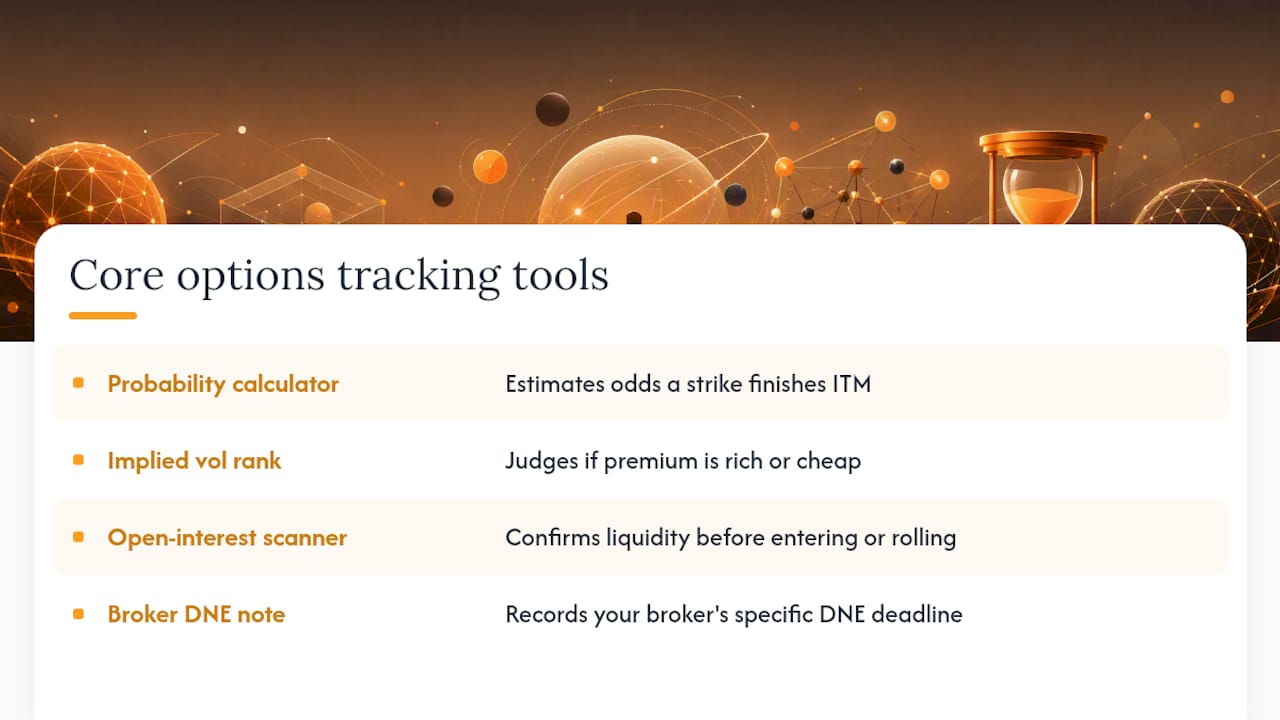
The core toolkit most active traders rely on includes a probability calculator to estimate the odds a strike finishes in the money, an implied volatility rank tool to judge whether current premium is rich or cheap relative to its own history, an open-interest scanner to confirm liquidity before entering or rolling, and a written note of your broker's specific DNE deadline so you're never guessing on expiration day.
Evibe's options tracker folds several of these into one view: an expiry calendar across all your open positions, a live Greeks display so you can see delta and theta shift as DTE drops, and smart alerts you can set at your own thresholds, say 45, 21, 7, and 3 DTE, or whenever the underlying moves within a dollar or two of a short strike. For traders who want the mechanics behind delta, theta, and gamma explained in plain terms, the Options Greeks Explained guide breaks down how each Greek behaves as expiration approaches.
A simple Friday workflow: check your alert queue first thing, run through any position flagged within striking distance of assignment, and confirm you've placed any closing or rolling orders before liquidity thins in the final hour.
What Tax Rules Apply to Options Traded Near Expiration?
Expiration itself can trigger a taxable event even when you never intended to exercise anything. A long option that expires worthless produces a capital loss on the expiration date, and a short option that expires unexercised produces a short-term capital gain equal to the premium collected, regardless of how long the position was open. That short-term treatment applies to most premium-selling income, which is a detail many new option sellers overlook until their first tax season with a full year of closed trades.
Assignment adds another layer. When a short put gets assigned, the premium collected reduces your cost basis in the shares you now own. When a short call gets assigned, the premium increases your sale proceeds. Rolling a position, since it involves closing one option and opening another, generally realizes the gain or loss on the closed leg immediately rather than deferring it, which means an active roller can generate a meaningful number of taxable events across a single underlying in a single year.
Special products complicate this further. Index options like SPX carry Section 1256 treatment in the US, which splits gains 60% long-term and 40% short-term regardless of actual holding period, a materially different outcome than the ordinary short-term treatment most equity option premium receives. None of this is a substitute for guidance from a tax professional familiar with your specific account and jurisdiction, but knowing that expiration date itself, not just exercise, can be the taxable event is worth building into your trade planning rather than discovering in April.
How Does Psychology Affect Decisions Near Expiration?
The math behind expiration-week rules is straightforward. Following it under pressure is not. Traders who can calmly calculate that a credit spread sitting at 90% of max profit isn't worth the remaining risk often still hold it anyway, chasing the last few dollars because closing early feels like leaving money on the table.
Loss aversion works the same way in the opposite direction. A position moving against you into the final week creates pressure to roll it "one more time" rather than accept the loss and reassess, even when the new roll no longer meets the risk parameters you'd apply to a fresh trade. That's how a manageable loss on a defined-risk spread turns into a much larger one on a position that's been extended past the point it still made sense.
Pin risk adds a specific kind of anxiety, since the outcome depends partly on a counterparty's decision you can't see until settlement. Traders sometimes freeze in that ambiguity instead of simply closing the position and removing the uncertainty entirely. And the accelerating gamma of the final days can make small moves in the underlying feel much larger emotionally than the dollar amount actually justifies, prompting overreactions to price swings that would barely register with three weeks left on the clock.

The antidote isn't willpower. It's writing your exit rules before you're emotionally invested in the outcome, then treating those rules as non-negotiable once the position is live.
Automate the Watchlist So the Calendar Doesn't Catch You Off Guard
The rules in this piece work when you actually follow them, and the biggest reason traders don't is that they lose track of DTE across a busy book of positions. If you're holding covered calls, credit spreads, or a wheel strategy across several underlyings, manually checking every strike against every deadline is the kind of task that gets skipped exactly when it matters most.
Evibe's options portfolio tracker is built for that gap. It syncs your brokerage positions automatically, displays live Greeks so you can see gamma risk building in real time, and lets you set alerts at your own DTE thresholds so a position drifting toward expiration surfaces before Tuesday of expiration week rather than after. If your book also includes ETF options, the ETF tracker extends the same monitoring to fund-level positions and their own expiration calendars.
Download it, connect your brokerage, and set your first round of alerts at 45, 21, and 7 DTE. It's a small setup step that removes the single most common failure point in expiration-week management: simply forgetting to look.
What Actually Separates Disciplined Traders From the Rest
Most of the advice around options expiration isn't wrong, it's just incomplete. Everyone repeats the 45–21 DTE rule and the 90% profit target, but far fewer traders actually build the infrastructure to follow those rules when a position is moving against them and the instinct is to wait one more day.
Here's what the research and mechanics in this piece actually support: expiration risk is overwhelmingly a scheduling and discipline problem, not a strategy problem. The Greeks, the settlement rules, and the DTE frameworks are all well documented and freely available. What separates traders who consistently avoid unwanted assignment and gamma blowups from those who don't is whether they check their positions on a fixed schedule regardless of how the week is going.
I'd also push back on treating 0DTE as a natural progression for experienced traders. The gamma and liquidity risks are real, and the fact that a strategy is popular doesn't mean it fits every account size or risk tolerance. If you're not running a specific, tested plan for same-day expiration, weekly or monthly cycles will serve you better.
Prioritize the boring part first: a written exit rule for every position, checked on a fixed day, before you touch the more interesting question of which strategy to trade next.
— Vincent
Sources
- Options: Picking the right expiration date — Fidelity Viewpoints
- Options Expiration Week: What to Do With Every Position Before Friday Close - Trader Central
- Options Expiration Guide: Mechanics, Risks, and Strategies | ImpliedOptions
This article is general information, not a substitute for advice from a qualified financial advisor. Consult a qualified financial professional about your own circumstances before acting on anything here.