Account Aggregation: API First Checklist for Individuals and Advisors
Learn how account aggregation works, why API connections beat screen scraping, and use a practical checklist to pick an API-first provider with a...
Account Aggregation: API First Checklist for Individuals and Advisors

Account aggregation is the technology that pulls balances and transactions from all your bank, brokerage, and other financial accounts into one login. It works through a secure, read-only connection, either an API or, less commonly now, screen scraping, that never lets an app move your money. The result: one place to see your full financial picture instead of ten different logins.
TL;DR:
- API-based aggregators use secure tokens that never expose your password, reducing the risk of credential theft compared to screen scraping methods.
- For reliable data, choose providers with industry security attestations like SOC 2 and ensure encrypted data transfer both in transit and at rest.
- Daily or near real-time refreshes are standard; more frequent updates may involve extra costs or consent requirements, especially for active traders.
- Coverage gaps exist with smaller institutions that lack direct API support, which may cause connection failures or incomplete data retrieval.
- Future trends include expanding API infrastructure, enhanced machine learning for fraud detection and portfolio analysis, and more granular, consumer-friendly consent controls.
Table of Contents
- What Is Account Aggregation and How Do You Get Started?
- How Does Account Aggregation Work Under the Hood?
- Who Actually Benefits From Aggregated Accounts?
- Is Account Aggregation Safe? Security and Privacy Realities
- How to Evaluate an Account Aggregator: A Practical Checklist
- What Aggregation Looks Like Inside a Portfolio Tracker
- Where Account Aggregation Came From
- Where Account Aggregation Still Breaks Down
- What's Next for Account Aggregation Technology
- What Most People Get Wrong About Aggregation
- Sources
What Is Account Aggregation and How Do You Get Started?
Account aggregation is the process of pulling data, balances, transactions, holdings, from multiple financial accounts into a single interface so you never have to log into each institution separately. It's the plumbing behind nearly every budgeting app, net worth tracker, and advisor dashboard you've ever used. Account aggregation is, by design, read-only. The service can see your data, but it cannot initiate a transfer, pay a bill, or touch your money.
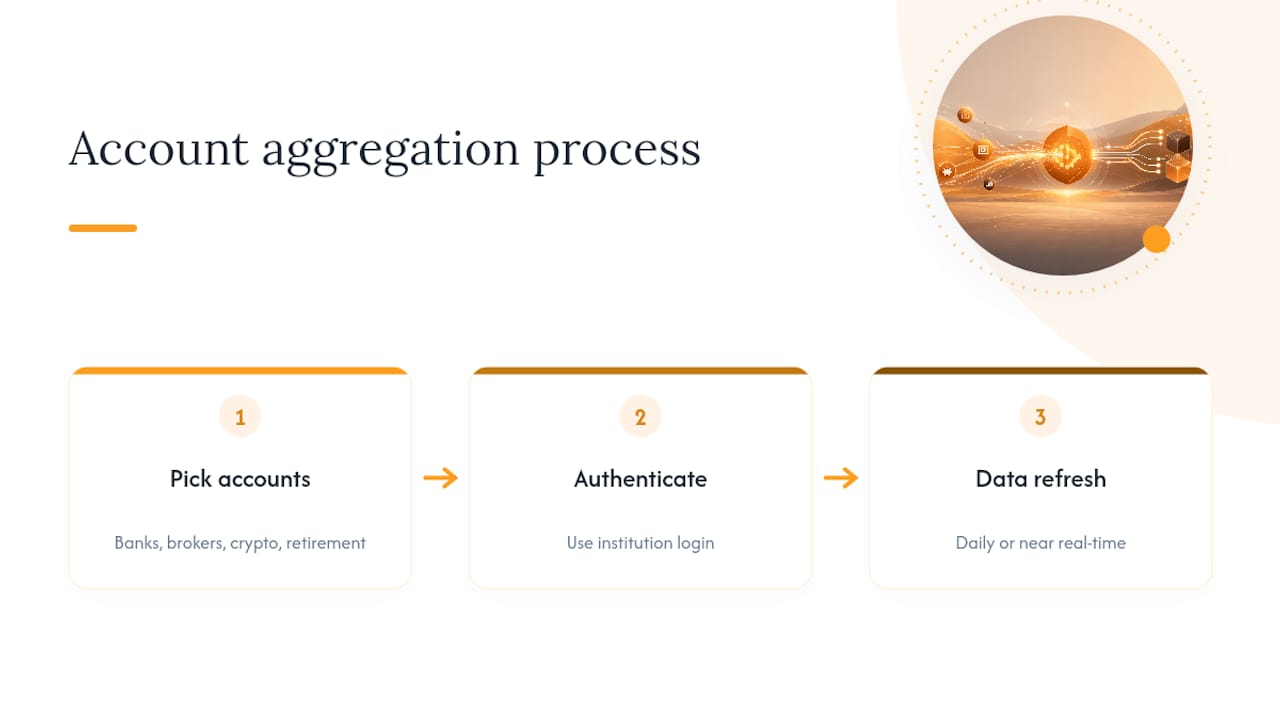
Getting started usually takes three steps. First, you pick the accounts you want connected, banks, brokerages, crypto exchanges, sometimes retirement plans. Second, you authenticate, ideally through your institution's own login screen rather than typing your password into the aggregator's app. Third, the aggregator pulls your data on a recurring schedule, often daily, sometimes in near real time, and refreshes what you see.
That's the mechanical version. The more important distinction, and the one that separates a trustworthy aggregator from a risky one, is how that connection happens under the hood. That's where API-based aggregation and older screen-scraping methods part ways, and it matters more than most users realize.
How Does Account Aggregation Work Under the Hood?
Every aggregator has to solve the same problem: get your data out of a bank's system and into an app, without asking you to manually enter every transaction. There are two ways to do that, and they are not equally good.
API-based aggregation uses a secure, standardized connection where your institution grants the aggregator a token, not your password, through an OAuth-style handshake. You log in directly with your bank, approve specific data permissions, and the bank issues a token the aggregator uses to fetch data going forward. Your actual credentials never touch the aggregator's servers.
Screen scraping is the older method. The aggregator logs into your account using your actual username and password, then reads the page the way a browser would. It works, but it's fragile: a redesigned login page can break the connection overnight, and your credentials sit stored somewhere outside your bank's own systems.
The data flow itself follows a consistent pattern regardless of method:
- Verification: the aggregator confirms the account is real and the connection is authorized.
- Retrieval: transactions, balances, and holdings are pulled from the institution.
- Normalization and enrichment: raw data (often messy merchant strings like "SQ *COFFEE013_XX") gets cleaned, categorized, and standardized.
- Presentation: the cleaned data appears in your dashboard, updated on whatever cadence the app supports.
Adoption of the API model has moved fast. API-based linking is now the mainstream way into consumer finance apps, a shift that would have been unthinkable a decade ago when screen scraping was still the default. "Read-only" access typically permits viewing balances, transactions, and holdings. It does not permit moving funds, changing account settings, or authorizing payments, regardless of which connection method is used underneath.
Who Actually Benefits From Aggregated Accounts?
Account aggregation solves a different problem depending on who's using it, but the core value, one view instead of ten, stays constant.
For individuals, the main win is visibility. Instead of logging into five bank apps and two brokerages to figure out your net worth, aggregation does the math automatically and keeps a running total. Householding, tracking spending across joint accounts and shared expenses, gets dramatically easier once everything sits in one feed.
For financial advisors and wealth managers, aggregation underpins consolidated client reporting. A single dashboard showing a client's held-away 401(k), outside brokerage accounts, and managed assets makes performance reporting and compliance documentation far less manual than pulling statements one institution at a time.
For businesses and fintechs, aggregation speeds up onboarding, identity verification, and underwriting. Typical aggregator use cases include instant account verification for funding transfers and income data for lending decisions, tasks that used to require faxed bank statements.
None of this works well without enrichment. Raw transaction data is a mess of abbreviated merchant codes; enrichment pipelines that map those codes to real merchant names and spending categories are what turn a data feed into something a person can actually read.
Is Account Aggregation Safe? Security and Privacy Realities
The honest answer is: it depends heavily on the connection method and the provider's practices, and it's worth understanding both before you link a single account.
Credential storage is the biggest fault line; understanding account management risks and how to mitigate them is essential before choosing an aggregator. API-based aggregators typically never see your bank password at all; they get a token instead. Screen-scraping tools, by contrast, need your actual login credentials to function, which creates a second place your password could leak if that vendor is ever breached. Even token-based systems sometimes store hashed or encrypted credentials to support reauthentication, so it's worth asking any provider directly whether they retain credentials and for how long.
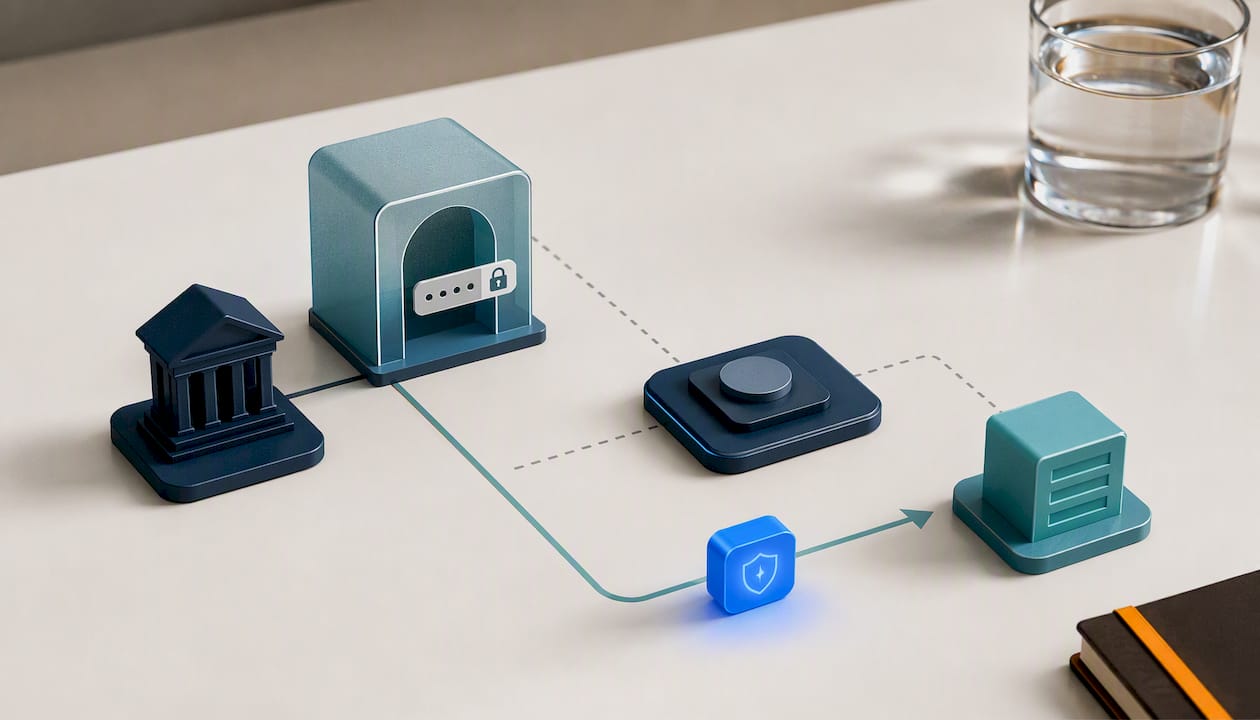
Privacy concerns run deeper than breach risk. The real question is what happens to your data after it's pulled: does the provider sell it, share it with advertisers, or use it to build marketing profiles? Read the consent language before you connect anything.
The regulatory backdrop is shifting in the industry's favor. The Consumer Financial Protection Bureau approved an application from the Financial Data Exchange to issue common standards for open banking, a signal that the U.S. is moving toward consent-based, standardized data sharing rather than the patchwork of one-off agreements that defined the industry's early years. Open banking is still more mature in the UK and Europe than in the U.S., but the gap is closing.
Before trusting any aggregator, check for:
- SOC 2 or equivalent third-party security attestations
- Encrypted data in transit and at rest, plus multi-factor authentication on the app itself
- Clear, specific language on data retention and whether data is shared with third parties
Pro Tip: If a provider can't tell you plainly whether it stores your bank password or only a token, treat that as a red flag, not a technicality.
How to Evaluate an Account Aggregator: A Practical Checklist
Not every aggregator is built the same way, and the differences show up exactly when you need reliability most, during market volatility or tax season. Work through this list before you commit:
- Confirm it's API-first. Ask whether the provider connects primarily through APIs rather than screen scraping, and how it handles institutions that don't yet support API access.
- Check security attestations. Look for SOC 2 reports, stated encryption standards, and whether credentials are stored or tokenized.
- Test data quality. Poorly enriched feeds show up as garbled merchant names and miscategorised transactions; a quick trial account will reveal this fast.
- Read the consent and retention terms. Understand exactly what data is pulled, how long it's kept, and whether you can revoke access cleanly.
- Check pricing and data practices. Does the app sell or share your data to subsidize a free tier, or is the business model a straightforward subscription?
Pro Tip: Ask specifically about refresh frequency. Daily refreshes are standard, but active traders may want faster updates, which sometimes come with extra consent requirements or added API costs on the provider's end.
What Aggregation Looks Like Inside a Portfolio Tracker
Inside a modern portfolio tracker, aggregation is the invisible layer that makes everything else possible. Evibe connects to banks and brokerages automatically, syncing stocks, ETFs, crypto, and cash accounts, while real estate, art, and other illiquid assets get added manually alongside the synced feeds.
The raw data alone isn't the interesting part. What matters is what happens after:
- Enrichment cleans up transaction labels so dividend payments, fees, and trades are correctly tagged rather than showing up as cryptic ticker codes.
- Analysis can turn that cleaned data into readable metrics on risk, diversification, and performance against major indices.
- A dividend tracker uses the same aggregated feed to show executed, declared, and estimated payouts in one place.
- Multi-currency support applies historical FX rates automatically, allowing accounts in different countries to line up correctly.
Readers who want the technical details on how encryption and account linking work can review Evibe's security documentation directly.
Where Account Aggregation Came From
Account aggregation didn't start with sleek apps. In the late 1990s and early 2000s, the first aggregation services relied entirely on screen scraping, software that logged into your bank using your own credentials and copied whatever appeared on the page. It was clunky, prone to breaking whenever a bank redesigned its site, and required users to hand over passwords to third-party companies with little oversight.
The 2010s brought a shift. Companies built purpose-built APIs specifically for financial data sharing, replacing the scrape-and-hope model with structured, permissioned connections. Instead of pretending to be the user, the aggregator asked the bank directly for specific data, verified through a token rather than a stored password. This is when personal finance apps and budgeting tools went from a niche interest to mainstream.
The 2020s have been about standardization. Rather than every bank and every aggregator negotiating one-off technical agreements, industry groups have pushed toward common data formats and consent frameworks so a connection built for one app works consistently across others. The regulatory recognition of the Financial Data Exchange as a standards body is the clearest marker yet that this consolidation is becoming institutional rather than informal.
Where Account Aggregation Still Breaks Down
Aggregation has gotten dramatically more reliable, but it isn't frictionless. A few structural limitations persist across the industry, regardless of provider.
Institution coverage gaps. Not every bank, credit union, or brokerage supports a direct API connection. Smaller regional institutions in particular sometimes lag, forcing providers to fall back on older connection methods or leave certain accounts unsupported entirely.
Multi-factor authentication friction. Every added security layer, which is a good thing for account safety, adds a step where a connection can fail or require re-authentication. Users who enable strict MFA on their bank accounts sometimes find aggregated connections need periodic manual refreshing.
Data normalization errors. Even with strong enrichment pipelines, merchant name resolution isn't perfect. A charge from a payment processor acting on behalf of multiple small merchants can get mislabeled, which matters more for budgeting apps than for balance tracking, but it's a real gap.
Refresh latency versus cost. Real-time data sounds ideal, but constant API polling has a cost, both for the provider and, indirectly, for the institution being polled. Most aggregators settle on daily or several-times-daily refreshes rather than continuous polling, which occasionally means the number you see is a few hours stale.
None of these are dealbreakers, but they're worth knowing before you assume every number in your dashboard updated the instant something changed at your bank.
What's Next for Account Aggregation Technology
The clearest trend is the continued decline of screen scraping. As more institutions build out API infrastructure and regulators like the CFPB push standardized frameworks through bodies like FDX, the incentive to maintain fragile scraping connections keeps shrinking. Expect API coverage to keep expanding into smaller and regional institutions that have historically lagged behind the large national banks.
AI is starting to do more than clean up transaction labels. The next generation of aggregation tools uses machine learning not just for merchant categorization but for pattern detection, flagging unusual account activity, projecting cash flow, and surfacing portfolio risk that would take a human hours to calculate manually.
Expect tighter consent controls, too. Instead of an all-or-nothing connection, granular permissions, sharing balances but not transaction history, for example, are likely to become standard as consumer-protection expectations rise alongside the CFPB's open banking work.
The direction is consistent: fewer passwords changing hands, more standardized data formats, and smarter interpretation of the data once it arrives.
What Most People Get Wrong About Aggregation
The biggest mistake I see is treating read-only visibility as if it were control. Seeing your accounts in one dashboard feels like mastery over your finances, but the aggregator can't rebalance a portfolio, stop a fee, or fix a bad trade. It shows you the problem; it doesn't solve it.
Consumer apps make sense for people who want visibility and are comfortable managing their own decisions. Advisor-driven aggregation earns its cost when you need someone else acting on the data, not just displaying it.
Before committing to any aggregator, check whether you can export your data. Vendor lock-in is a quiet cost that only becomes obvious the day you want to leave.
— Vincent
This article is general information, not a substitute for advice from a qualified financial advisor. Consult a qualified financial professional about your own circumstances before acting on anything here.
Sources
- CFPB approves application from Financial Data Exchange to issue standards for open banking
- What Is Account Aggregation? | Investopedia