Investors: Track Loan Payoff by Current Principal
Track each loan by current principal so your net worth reflects real liabilities. Update monthly, cross-check payoff quotes, or let Evibe sync balances...
Investors: Track Loan Payoff by Current Principal

Track each loan by its current outstanding principal balance in your portfolio tracker. That figure, not the original loan amount or the monthly payment, reduces net worth dollar for dollar. Record it as a liability, update it monthly or right after any major payment, and let automatic syncing handle the rest whenever your lender supports it.
TL;DR:
- Always record current outstanding loan balances, not original amounts, to ensure net worth accuracy and avoid overstatement over time.
- Sync loan data automatically when possible, but verify payoff figures quarterly and manually update when sync support is unavailable.
- Paying down principal immediately increases net worth dollar-for-dollar, and tracking this progress prevents misleading trend distortions.
- Reconcile balances monthly against lender payoff quotes to catch pending payments, fees, or sync issues that could misrepresent debt levels.
- Standardize loan tracking by always noting the current principal balance to maintain consistent data, critical for meaningful net worth analysis.
Table of Contents
- What to Record for Each Loan in Your Net Worth Tracker
- How to Add Loans to a Portfolio Tracker: Sync vs. Manual Entry
- How Loan Paydown Moves Your Net Worth and Portfolio Metrics
- Monitoring Cadence and Reconciliation That Actually Holds Up
- Why Standardized Loan Tracking Matters for Portfolio Users
- Evibe Handles Loan Tracking So the Balance Is Never Stale
- Sources
What to Record for Each Loan in Your Net Worth Tracker
Net worth is assets minus liabilities, and that arithmetic only holds up if the liability side reflects current outstanding balances, not what you originally borrowed. A mortgage you took out several years ago might have a current balance notably lower today. If your tracker still shows the original figure, your net worth will be misstated, and it remains inaccurate every month you skip the update.
Every debt type belongs in the liability column, not just the obvious ones:
- Mortgages and HELOCs — current principal, not the original note amount
- Student loans — federal and private balances tracked separately, since rates and terms differ
- Auto loans — current payoff figure, which usually runs slightly below the statement balance
- Credit cards — statement balance is fine here, since these are revolving, not amortizing
- Personal loans — current principal plus any origination fees still being amortized
- Margin loans — the drawn balance against your brokerage account, which can shift daily
- Tax liabilities — any outstanding balance owed, especially if it's on a payment plan
For each entry, capture six fields: current principal balance with an as-of date, APR, scheduled payment, remaining term, whether the rate is fixed or variable, and the payoff amount if your lender quotes one separately. That last field matters more than it sounds. A payoff quote often includes small per-diem interest or fees that the "balance" line on your statement does not, and tracking guidance from Aplos flags this gap as one of the most common sources of inflated net worth figures. Use principal, and use it consistently, or your trendline will zigzag for reasons that have nothing to do with your actual progress.
How to Add Loans to a Portfolio Tracker: Sync vs. Manual Entry
Getting loans into a dashboard accurately comes down to two paths, and most portfolios end up using both.
- Sync automatically where your lender supports it. Link the loan servicer or brokerage account, then verify the synced field is actually current principal or payoff amount, not the original loan amount some lender portals still display on the account summary page.
- Map the account to "liability," not "asset." This sounds obvious, but auto-imported accounts sometimes land in the wrong bucket on first sync, especially margin accounts that carry both a security value and a debit balance.
- Enter manually when sync isn't available. Use a consistent naming convention (lender plus loan type, like "Chase Auto Loan") and date-stamp every balance you input by hand.
- Store the amortization schedule or payoff quote separately if your tracker allows notes or attachments. This gives you a reference point when reconciling months later.
- Handle credit lines carefully. For HELOCs, margin, and other lines of credit, track only the drawn amount as the liability. Note the credit limit in a separate field so it never gets counted as debt you owe.
Pro Tip: Cross-check your tracker's balance against the lender's "current payoff" figure once a quarter, not just the statement balance. Pending payments and fees can create a gap of a few hundred dollars that otherwise sits unnoticed for months.
Whichever path you use, the goal is the same: the number sitting in your liabilities column should match what you'd actually owe if you called the lender today and asked for a payoff quote.
How Loan Paydown Moves Your Net Worth and Portfolio Metrics
Every dollar of principal you pay down reduces liabilities and increases net worth by that same dollar, independent of what markets are doing elsewhere in your portfolio. A $500 extra payment on a car loan raises net worth by $500 that month, full stop. That's a rare thing in investing: a guaranteed, non-market-dependent gain, and it's why loan tracking deserves the same attention as your equity positions.
The second piece worth watching is freed cash flow. Once a loan is paid off, that monthly payment becomes available for something else, whether that's investing, building cash reserves, or paying down a different loan faster. Tracking that number ahead of time lets you plan the reallocation instead of letting it drift into your checking account with no destination.
If you're deciding whether to prepay a loan or invest the same cash, the comparison hinges on the loan's APR versus your expected after-tax return, plus your time horizon. Prepaying delivers a guaranteed return equal to the APR; investing delivers an expected return that can be higher or lower. Timing matters too, since early cash flow in a finite horizon tends to favor prepayment in a lot of scenarios. This is a modeling question, not a universal answer, and it's worth running your own numbers rather than following a blanket rule.
A useful dashboard shows four things at a glance:
- Liability trendline over time
- Net worth trendline alongside it
- Projected payoff date at current payment pace
- Percent of total portfolio value that debt represents
Monthly snapshots, tracked over 6 to 12 months, are what reveal the pattern that matters most: debt trending down while net worth trends up, often called the "scissors pattern" because the two lines cross and spread apart.
Monitoring Cadence and Reconciliation That Actually Holds Up
Update loan balances monthly as a baseline, and immediately after any event that changes the picture materially: a refinance, a full payoff, or a large extra payment. Waiting until quarter-end to log a payoff you made six weeks ago means your net worth chart is lying to you for that whole stretch.
Run this reconciliation routine on the same day each month:
- Check the as-of date on every synced balance. Anything older than 30 days needs a manual refresh.
- Compare your tracker's figure against the lender's current payoff quote, not just the last statement.
- Audit automatic feeds for accounts that silently stopped syncing, which happens more often than most people expect.
- Log any adjustment (extra payment, fee, pending transaction) in a notes field so future you understands why a number moved.
The most common pitfalls all distort net worth in the same direction, toward overstating debt paid or understating what's owed: recording the original loan amount instead of current principal, using the payment amount as if it were the balance, forgetting that a variable-rate loan's payoff estimate shifts with rate changes, and double-counting escrowed funds that are already reflected elsewhere.
Pro Tip: If your tracked balance and your lender's payoff figure disagree by more than a normal month of interest, check for a pending transaction before assuming your tracker is broken. Payments in transit are the single most common cause of that mismatch.
Why Standardized Loan Tracking Matters for Portfolio Users
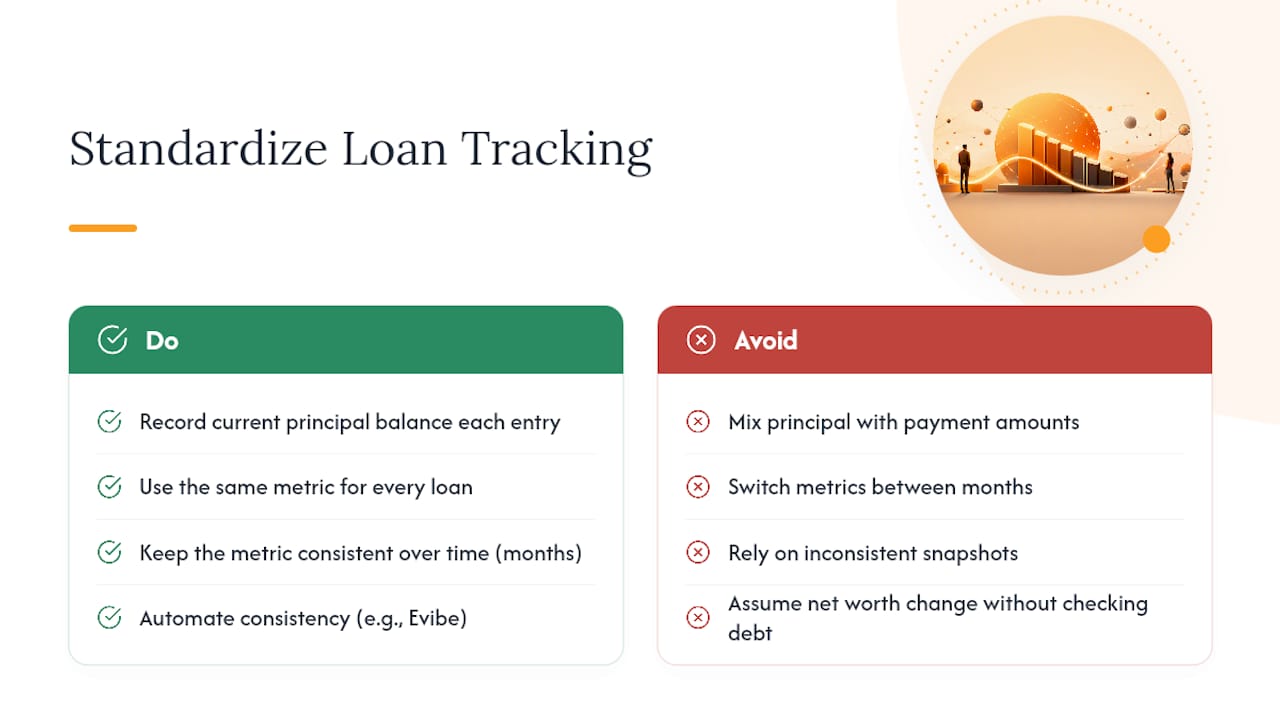
The biggest mistake I see in personal net worth tracking isn't laziness. It's inconsistency. Someone logs principal balance in January, switches to a payment amount in February because it was faster to grab from a bank app, then wonders why their trendline looks broken by March.
Standardizing on current principal balance, every time, for every loan, is what makes six months of data mean anything. Without that discipline, you can't tell whether your net worth grew because you paid down debt or because your brokerage account had a good quarter. That distinction shapes real decisions: whether to rebalance, whether to accelerate a payoff, whether your actual risk exposure looks different once you subtract what you owe from what you own. Evibe was built to keep that calculation consistent automatically, which is where the practical side of this comes in next.
— Vincent
Evibe Handles Loan Tracking So the Balance Is Never Stale
This portfolio dashboard is built for investors who want loans treated as real liabilities, not an afterthought bolted onto a spreadsheet. It syncs directly with banks and brokerages to pull current payoff balances automatically, so the principal figure in your dashboard updates without manual entry.

Once your loans are synced, the dashboard plots them against your assets to show a live net worth trendline, tracks the cash flow that frees up once a loan is paid off, and layers in AI-driven signals about how your debt load affects overall portfolio risk and diversification. That's the same principal-balance discipline covered above, minus the manual reconciliation. If you're also carrying ETF or dividend positions alongside those loans, Evibe's ETF portfolio tracker and dividend tracker roll into the same dashboard, so your full net worth picture, assets and liabilities both, lives in one place. Start free at Evibe and see your actual net worth the next time a loan payment clears.
Sources
- How to Record and Manage Long-Term Liabilities—Mortgages & Loans — Aplos Help Center
- Your personal net worth — Schwab MoneyWise
This article is general information, not a substitute for advice from a qualified financial advisor. Consult a qualified financial professional about your own circumstances before acting on anything here.