Traders: One Option Can Equal 100 Shares, Measure and Control Risk
Measure and control options-driven portfolio risk. Convert net Greeks into share equivalents, run VaR and stress tests, and enforce position-size and...
Traders: One Option Can Equal 100 Shares, Measure and Control Risk

Options can raise or lower your portfolio's risk, and the direction depends entirely on how you use them. A covered call trims volatility; a naked short put concentrates it. The mechanics that matter are delta, gamma, vega, and theta, and they aggregate across every position you hold. Before adding another contract, calculate your net portfolio Greeks, convert delta into share equivalents, and set a hard cap on per-trade risk.
TL;DR:
- Most options risks stem from size and concentration, requiring strict position sizing rules to prevent large losses from seemingly small trades.
- Aggregating Greeks across the entire portfolio and converting delta and vega into share-equivalent and dollar impacts helps estimate potential losses from market moves or volatility spikes.
- Regular stress testing for market drops, volatility surges, and single-stock shocks is essential to identify hidden vulnerabilities and manage correlated risks.
- Proper operational discipline, including understanding broker approval levels, monitoring liquidity, and using limit orders, reduces the risk of unexpected costs or forced liquidation.
- An automated options tracker that consolidates Greeks and triggers alerts improves risk management by enforcing disciplined adjustments before risks become unmanageable.
Table of Contents
- What Portfolio Risks Do Options Actually Introduce?
- How Do You Measure an Options Portfolio's Contribution to Total Risk?
- What Position-Sizing Rules Actually Prevent Blowups?
- When Should You Hedge Options-Driven Portfolio Risk?
- What Operational Risks Catch Options Traders Off Guard?
- How Often Should You Monitor and Stress-Test an Options Portfolio?
- How a Consolidated Tracker Supports Options Risk Control
- A Trader's Honest Take on Options Risk Discipline
- Put These Controls to Work With Evibe
- Sources
- FAQ
What Portfolio Risks Do Options Actually Introduce?
Options don't create a new category of risk so much as they amplify or reshape the risks already sitting in your portfolio. A single contract controls 100 shares, so a modest options position can carry the same directional punch as a much larger stock trade. That leverage cuts both ways.
Here's what to track before it surprises you:
- Directional risk (delta): net delta across all positions tells you how much your portfolio moves with the underlying, and it's easy to underestimate how large that number gets once you stack several trades on correlated names.
- Volatility exposure (vega): a portfolio can lose money even when the stock price barely moves, simply because implied volatility drops after an earnings event or a Fed announcement.
- Time decay (theta): premium sellers collect it, premium buyers bleed it, and it accelerates as expiration approaches.
- Gamma risk near expiration: delta itself becomes unstable in the final days before expiry, and a position that looked market-neutral in the morning can look aggressively directional by the close.
- Liquidity, execution, and assignment risk: wide bid-ask spreads and thin open interest can turn a routine exit into a costly one, and early assignment can land you in an unexpected stock position overnight.
- Correlation and concentration risk: five "different" trades on five correlated tech names aren't five bets; this is why it's important to understand kodėl diversifikuoti valiutų portfelį: rizika ir nauda when managing your overall portfolio risk. They're one large bet wearing five costumes.
Each of these risks compounds the others. A large net delta combined with high portfolio vega during earnings season is a materially different risk profile than the same delta in a quiet market.
How Do You Measure an Options Portfolio's Contribution to Total Risk?
Measurement starts with aggregation. Every option position has its own delta, gamma, theta, and vega, and the first job is summing them across the entire portfolio—not just eyeballing individual trades.
Pro Tip: Convert your net delta to a share-equivalent figure by multiplying it by 100 per contract. A net delta of 3.2 across your options book behaves like 320 shares of directional exposure, which you can then weigh directly against your stock holdings.
Vega works similarly. Multiply portfolio vega by an expected move in implied volatility (say, a five-point IV spike around an earnings date) to estimate the potential dollar impact from a volatility shift alone, independent of price direction.
From there, follow a sequence that scales with complexity:
- Delta-gamma approximation. This works well for small moves and short time horizons, since it estimates portfolio P&L using first and second derivatives without repricing every contract.
- Full revaluation or Monte Carlo simulation. Once a portfolio holds multiple expirations, strikes, and underlyings, the delta-gamma shortcut loses accuracy fast, especially in large moves. Full repricing or simulation catches nonlinearities the approximation misses.
- Parametric (variance-covariance) VaR. This estimates a loss threshold at a given confidence level using volatility and correlation assumptions, and it's fast to compute but leans hard on the assumption of normal returns.
- Historical VaR. This replays actual past return sequences against your current positions, which captures real fat-tail behavior that parametric models tend to smooth over.
- Expected shortfall. This measures the average loss beyond your VaR threshold, and it's generally the more honest number for options portfolios because option payoffs are asymmetric by design.
A widely cited extension of Markowitz's mean-variance framework applied to option portfolios found that naive formulations can produce mathematically "zero-risk" solutions that don't hold up once transaction costs and realistic constraints are added. Robust, cost-aware optimization is necessary, not optional, once options enter the mix.
You'll need live Greeks per contract, an implied volatility surface, a correlation matrix across underlyings, and realistic transaction cost estimates. Skip any one of those inputs and your risk number is a guess dressed up as math.
What Position-Sizing Rules Actually Prevent Blowups?
Most options losses trace back to sizing, not strategy selection. A well-chosen spread executed at triple the appropriate size is still a bad trade.
Practical guides commonly recommend 0.5% to 5% of account value per trade, with the exact number depending on the strategy class:
- Directional single-leg trades: stay near the low end, around 0.5% to 1.5% of account value, since undefined-risk exposure can move against you faster than a spread.
- Defined-risk income strategies (credit spreads, iron condors): moderately sized risk per trade is common, since the max loss is known up front.
- Speculative or high-conviction trades: cap risk tightly, even when conviction runs high, as this is when traders tend to oversize.
Layer account-level limits on top of trade-level ones: a maximum total portfolio risk percentage, a cap on exposure to any single sector, and a ceiling on notional exposure relative to account size. Mechanical triggers matter more than intentions. Set a net delta threshold that forces a review, a gamma ceiling that flags expiration-week risk, and a stop-loss rule you follow regardless of how confident you feel in the moment.
Defined-risk strategies also ease margin strain considerably. Margin requirements for naked positions run far higher than for spreads with the same directional exposure, which means the margin math itself often pushes you toward better-sized trades.
When Should You Hedge Options-Driven Portfolio Risk?
Hedging isn't a permanent state. It's a response to a specific risk that's grown larger than your tolerance for it.
- Convert undefined risk to defined risk first. Buying a protective wing against a short option turns unlimited exposure into a known, bounded loss. This is the cheapest form of insurance most traders skip.
- Use index protection for correlated exposure. Broad hedges through SPY or QQQ puts address the market-wide component of risk when your book is heavy in correlated single-name positions, without requiring you to unwind every trade individually.
- Roll or trim before you're forced to close. Rolling a threatened position out in time, or trimming size, often preserves the trade's thesis better than an outright exit triggered by panic.
- Weigh the cost against the exposure it removes. Insurance is only worth buying when the premium is smaller than the loss you're realistically protecting against. Hedging every position all the time just guarantees a slow bleed from theta.
Industry risk guides also flag a practical stop rule worth adopting directly: a 30% to 50% premium stop for option buyers, which caps losses before a losing thesis becomes a catastrophic one.
What Operational Risks Catch Options Traders Off Guard?
Strategy risk gets the attention, but operational risk causes plenty of avoidable losses.
Broker-dealers require specific approval levels before allowing certain options strategies, and margin accounts can trigger forced liquidation if a position moves against you faster than your maintenance margin allows. Know your approval level and your broker's margin triggers before you place the trade, not after a margin call.
- Check open interest and bid-ask spreads before entering, since a wide spread on a thinly traded strike can cost you more on the exit than the trade's original edge.
- Watch expiration week closely. Gamma accelerates, and assignment risk rises sharply around ex-dividend dates on in-the-money short calls.
- Use limit orders on illiquid contracts. A market order on a wide spread can fill at a price that erases your entire expected edge.
- Consider bracket orders to automate your exit discipline instead of relying on manually watching every position.
How Often Should You Monitor and Stress-Test an Options Portfolio?
Daily monitoring should cover net delta, net vega, and any position nearing expiration. Weekly reviews should widen the lens to sector concentration, total portfolio gamma, and P&L attribution by strategy so you know which trades are actually driving results.
Stress testing translates that monitoring into a forward-looking check against scenarios your recent history hasn't shown you yet.
| Stress scenario | Parameter shock | What it reveals |
|---|---|---|
| Broad market drop | Underlying prices down 10% | Directional exposure and correlated concentration |
| Volatility spike | Implied volatility up 10 points | Vega risk and mispriced skew |
| Single-stock shock | One holding gaps — | Idiosyncratic concentration in one name |
Backtesting your expected shortfall over rolling windows helps calibrate whether your limits are realistic or just comfortable. Automated alerts that fire when a threshold is breached remove the temptation to rationalize "just one more day" before acting.
How a Consolidated Tracker Supports Options Risk Control
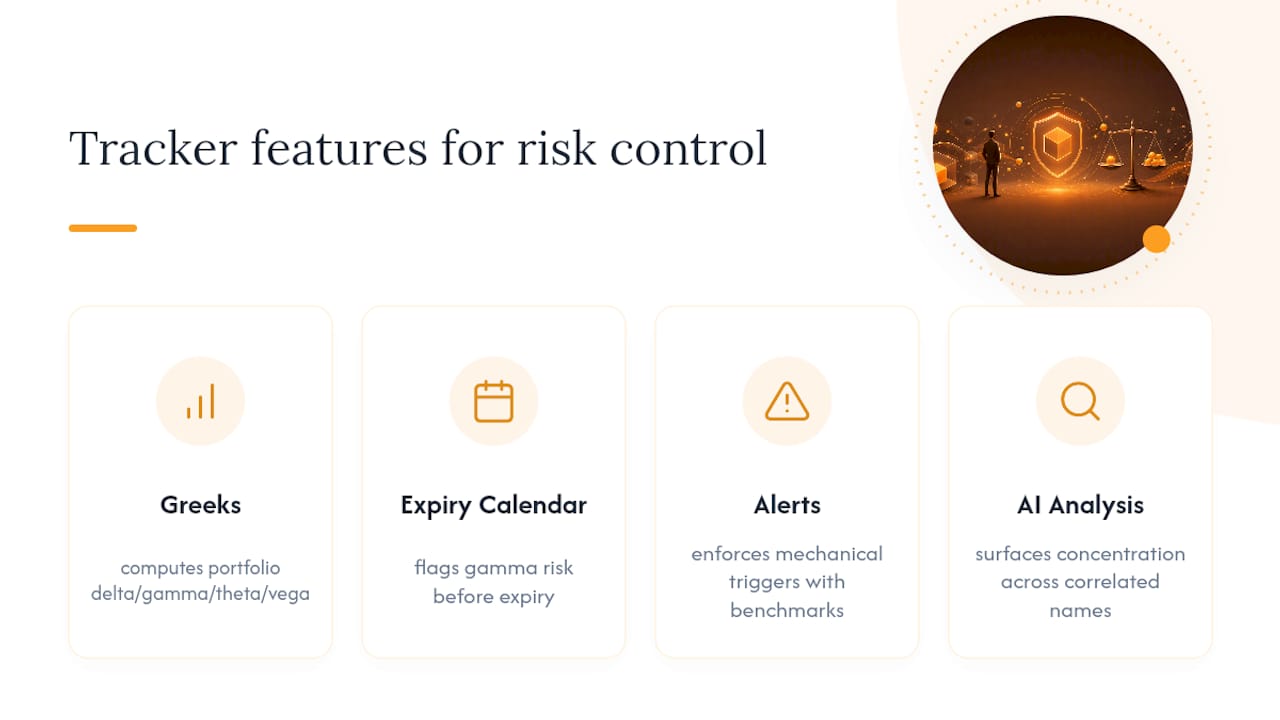
Manually recalculating portfolio Greeks every time you add a position doesn't scale. Evibe's options tracker consolidates every contract you hold and computes portfolio-level delta, gamma, theta, and vega automatically, alongside expiry calendars that flag gamma risk before it sneaks up on you. Smart alerts and benchmark tracking help enforce the mechanical triggers this article recommends, and the AI-driven analysis can surface concentration you didn't realize you were carrying across correlated names.
A Trader's Honest Take on Options Risk Discipline
Strict sizing rules and a weekly aggregated Greeks review will save more portfolios than any clever strategy will. Predefined adjustment triggers matter because they remove the moment of temptation. Emotional decisions happen in real time; rules happen before the trade.
— Vincent
Put These Controls to Work With Evibe
Evibe is the tool that turns everything in this article from theory into a habit. Instead of pulling Greeks from three broker screens and reconciling them by hand, the Evibe Options Portfolio Tracker aggregates every contract automatically and surfaces your net delta, gamma, theta, and vega in one view, updated with your synced brokerage data.
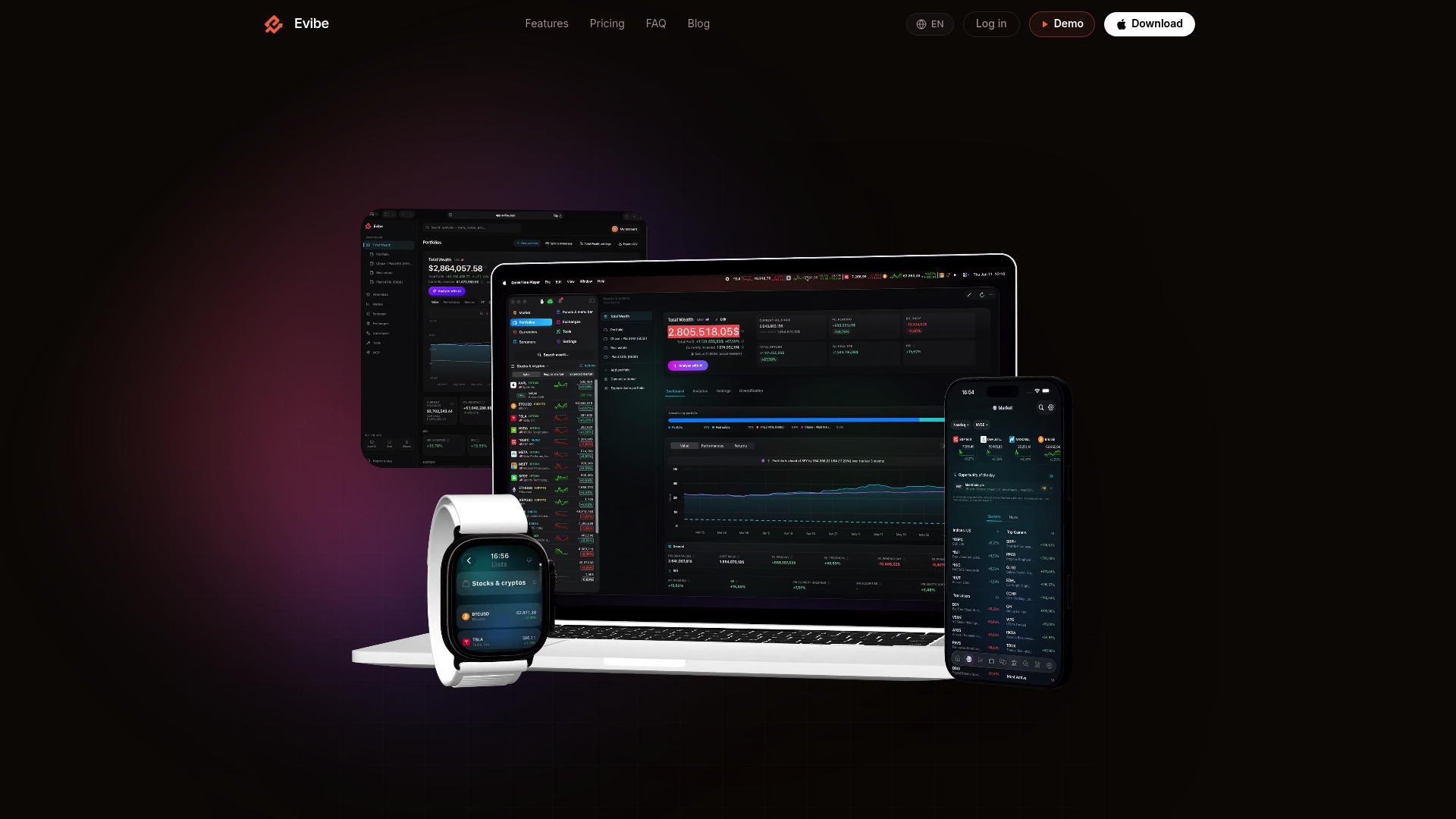
Smart alerts flag when your net delta or vega crosses a threshold you've set, which is exactly the kind of mechanical trigger this article argues is the difference between discipline and regret. If your options exposure sits alongside ETFs or index positions you're using as a hedge, the ETF Portfolio Tracker shows how that hedge is performing against the same dashboard. Connect your brokerage account to see your current portfolio Greeks today.
This article is general information, not a substitute for advice from a qualified financial advisor. Consult a qualified financial professional about your own circumstances before acting on anything here.
Sources
- FINRA — Options
- A Markowitz portfolio approach to options trading (IEEE TSP, 2018)
- Options risk management | FinWiz
- Risks of options trading: Common pitfalls and fixes | Intrinio (2025)
FAQ
What Does Warren Buffett Say About Options?
Buffett has long warned that derivatives can act as financial weapons of mass destruction when used with excessive leverage, though Berkshire Hathaway itself has sold long-dated index puts as a deliberate, sized strategy rather than avoiding options entirely.
Why Do Most Options Traders Lose Money?
Oversized positions, undefined risk left unhedged, and ignoring liquidity are the most common causes, and industry guides consistently point to poor position sizing as the single largest factor behind large losses.
What Is the 3-5-7 Rule in Options Trading?
Definitions vary across trading communities, but a common version caps risk at roughly 3% on any single trade and 5% across related positions. Treat it as a starting framework, not a fixed standard, and adjust the percentages to your own account size and strategy mix.
What Does Portfolio Risk Mean?
Portfolio risk is the potential for your total holdings to lose value, driven by price movement, volatility, correlation between positions, and concentration in any single asset or sector. With options involved, that risk also includes time decay and the accelerating effect of gamma near expiration.
How Do I Know if My Options Positions Are Too Concentrated?
Check whether several positions share the same underlying sector or move together during market stress. A beta-weighted delta calculation and a correlation matrix across your holdings will show whether your "diversified" options book is actually one large correlated bet.