Options Traders: Delta and Gamma for Sizing, Hedging, and Short Gamma Risk
Options traders’ guide to delta and gamma: how delta swings, why gamma shifts hedge cadence, and how Evibe privately tracks your net exposure.
Options Traders: Delta and Gamma for Sizing, Hedging, and Short Gamma Risk

Delta tells you how much an option's price moves when the underlying stock moves $1. Gamma tells you how much delta itself moves after that same $1 shift. In practical terms: delta gives you direction and rough odds of finishing in the money, while gamma tells you how fast that directional exposure can change underneath you, which matters most when you're hedging or when you've sold options.
TL;DR:
- Gamma risk peaks at the at-the-money strike and increases sharply as expiration approaches, especially for weekly options near the strike price.
- Short options carry negative gamma, which causes delta to move against the position during sharp underlying moves, risking exponential losses.
- Managing gamma requires careful position sizing, timely rebalancing, and spreads, because gamma exposure can escalate quickly and erode profitability.
- Tracking net gamma across the entire portfolio provides a clearer risk picture than individual options, preventing surprises from cumulative delta accelerations.
- Using tools that visualize and alert net delta and gamma can help traders react proactively to changing exposure near expiration or during volatile markets.
Table of Contents
- Delta vs Gamma: Defining Delta and Why Traders Watch It
- Gamma: The Rate at Which Delta Changes
- The Math Behind Delta and Gamma (Without the Jargon)
- How Moneyness, Time, and Volatility Reshape Delta and Gamma
- Long vs Short Gamma: Why Sellers Call It "The Enemy"
- Worked Examples: Turning Delta and Gamma Into Real Numbers
- Delta Hedging, Gamma Scalping, and a Practical Checklist
- Who's Behind This Breakdown, and Where Evibe Fits
- A Practitioner's Note on Managing Gamma in Live Trading
- Evibe: See Your Net Delta and Gamma Across Every Account
- Sources
Delta vs Gamma: Defining Delta and Why Traders Watch It
Delta is the first derivative of an option's price with respect to the underlying stock price. Strip out the calculus and it just means this: delta measures the change in an option's price for a $1 change in the underlying, and it's the number every trader checks first before entering a position.
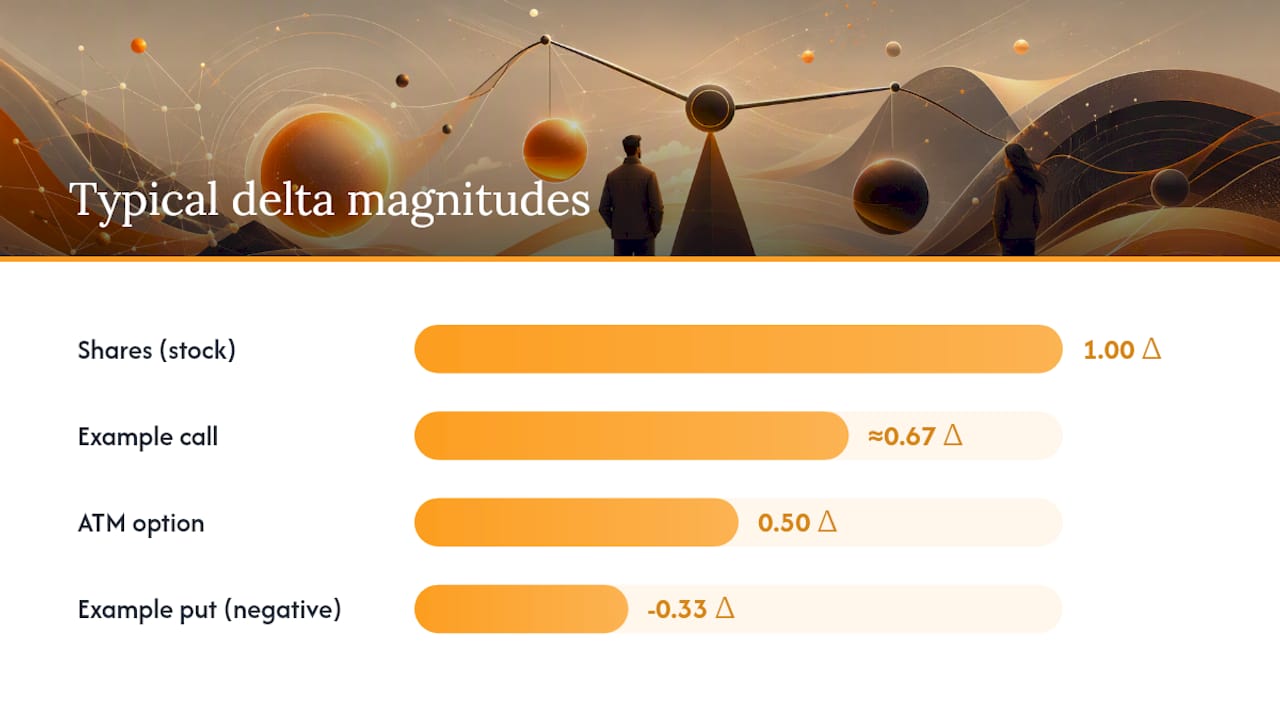
Call deltas run from 0 to +1. Put deltas run from 0 to negative 1, since puts gain value as the stock falls. A call with a delta around two thirds gains roughly two thirds of the stock move for every $1 the stock rises. A put with a negative delta around a third gains roughly a third of the stock move for every $1 the stock drops.
Delta does double duty for traders:
- Directional exposure. It tells you how much your option behaves like the underlying stock. A delta of 1.00 means the option moves almost dollar for dollar with shares.
- Rough probability read. A 0.50 delta option is often treated as having roughly a 50% chance of expiring in the money, though this is an approximation, not a formal probability.
- Hedge ratio. If you're short 100 shares worth of delta, you need options carrying a combined delta of positive 100 to flatten your exposure.
Delta shifts constantly. As expiration nears, in-the-money options push their deltas toward 1 (or negative 1 for puts), while out-of-the-money options drift toward zero. Rising implied volatility tends to pull deltas closer to 0.50, because more uncertainty makes even far-out strikes seem plausible.
Here's a quick example. Say a stock trades at $100 and you own a call with a 0.50 delta. If the stock rises to $101, the call's price should rise by roughly $0.50, all else equal. That's the entire idea behind delta meaning options pricing sensitivity: one number, one dollar move, one estimated price change.
Gamma: The Rate at Which Delta Changes
Gamma measures how quickly delta changes as the underlying moves, and traders sometimes call it "the delta of the delta." If delta tells you your current directional exposure, gamma tells you how unstable that exposure is.
Gamma is highest for at-the-money options and increases sharply as expiration approaches, since Investopedia's explanation of gamma confirms. That's the single most important shape to memorize in gamma risk explained terms: it peaks near the strike price and gets more extreme the closer you get to expiration.
Sign conventions are non-negotiable here, and they diverge sharply from delta's calls-versus-puts split:
- Long options (calls or puts) always carry positive gamma. Your delta moves in your favor as the stock moves in your favor.
- Short options (calls or puts) always carry negative gamma. Your delta moves against you as the stock moves against you, according to Options Education's gamma primer.
- Underlying stock positions have zero gamma. A share of stock has a fixed delta of 1 that never changes.
This is why gamma matters more for position management than delta alone. Delta gives you a snapshot. Gamma tells you whether that snapshot is about to become obsolete. A trader who only watches delta on a short options position can get blindsided when the stock makes a sharp move and delta accelerates against them in a way the earlier reading never predicted.
The Math Behind Delta and Gamma (Without the Jargon)
Delta and gamma both come from calculus, but you don't need to solve equations to use them. Delta is written as ∂C/∂S, meaning the change in the call price (C) relative to a small change in the stock price (S). Gamma is ∂²C/∂S², the second derivative, or the rate of change of that first rate of change.
Here's how traders actually apply this in practice:
- Delta-only estimate. Multiply delta by the price move: Δ × ΔS. If delta is 0.50 and the stock rises $2, your estimated gain is $1.00.
- Delta-plus-gamma correction. Add a convexity adjustment: Δ × ΔS + 0.5 × Γ × (ΔS)². This accounts for the fact that delta itself shifted during the move.
- Re-price when the move is large. Both formulas are local approximations. Once the underlying moves several dollars or volatility spikes, the estimate drifts from the option's actual value, and you should re-price in a full model instead of trusting the approximation.
This second-order correction is exactly what makes gamma useful. As CME Group's education material on options delta notes, delta is the first derivative and gamma the second, and combining them produces a materially better estimate than delta alone for anything beyond a small move. Most trading platforms and Black-Scholes-based pricing tools report both figures directly next to the quote, so you rarely calculate this by hand. What matters is knowing what the numbers imply before you act on them.
How Moneyness, Time, and Volatility Reshape Delta and Gamma
Gamma isn't a fixed number sitting quietly on your position. It shifts constantly based on three factors: how close the strike is to the current stock price, how many days remain until expiration, and where implied volatility sits.
At-the-money options carry the highest gamma of any strike. Deep in-the-money and deep out-of-the-money options carry low gamma, because their deltas are already near 1 or 0 and have little room left to move. The effect intensifies as expiration approaches:
- Long-dated options, including LEAPS, carry comparatively low gamma even at the money, because time cushions the delta from sudden swings.
- Front-month, at-the-money options can see gamma spike sharply in the final days before expiration.
- Weekly options near the strike are where gamma risk gets most extreme, since delta can swing from 0.20 to 0.80 in a single session.
Implied volatility complicates the picture further. Lower implied volatility tends to increase at-the-money gamma, while higher implied volatility tends to flatten gamma across strikes, according to Options Education's gamma analysis. That seems backwards until you think it through: high volatility already prices in big swings across every strike, so no single strike carries a disproportionate share of the delta risk. Low volatility concentrates that risk right around the current price.
Gamma peaks around the at-the-money strike and climbs as expiration nears — a pattern that holds across nearly every underlying, which is why market makers watch the front-month, at-the-money gamma exposure so closely heading into expiration weeks.
Long vs Short Gamma: Why Sellers Call It "The Enemy"
Long gamma and short gamma create two completely different trading experiences, even when the delta reading looks identical at the moment you check it.
Long gamma means your delta moves in your favor as the stock moves. If you're long a call and the stock rallies, your delta increases, so you make money at an accelerating rate. If the stock falls, your delta shrinks, so you lose money at a decelerating rate. This asymmetry is the reason gamma scalping exists: a long-gamma trader can buy shares as the stock dips and sell as it rises, harvesting small profits from the swings themselves.

Short gamma flips that relationship on its head. If you've sold options, your delta moves against you as the stock moves. A losing position gets worse faster, not slower. This is the practical meaning behind the phrase "gamma is the enemy" for option sellers, a framing Britannica's overview of delta and gamma uses to describe how short gamma exposure can cause accelerating losses as the underlying moves against the position.
Traders manage this risk a few concrete ways:
- Position sizing. Short-gamma sellers typically size positions smaller than long-gamma buyers, because losses can compound instead of decay.
- Rolling and adjusting. Rolling a short strike further out in time or further out of the money resets gamma exposure before it gets dangerous.
- Using spreads instead of naked positions. A credit spread caps the gamma risk at the width of the spread, unlike a naked short option with theoretically unlimited exposure.
- Watching net portfolio delta and gamma together. A trader with several positions needs the combined net figure, not just the reading on any single contract, since offsetting positions can mask real exposure.
Pro Tip: Check your account's total net gamma against your margin cushion before adding a new short position, not after. A portfolio that looks fine on delta alone can be dangerously exposed on gamma once you add up every open contract.
Worked Examples: Turning Delta and Gamma Into Real Numbers
Numbers make this concrete faster than any explanation. Here are two scenarios showing how delta and gamma actually move option premiums and how delta itself shifts afterward.
-
Example A: near-term at-the-money call. Say the call has a delta of 0.50 and a gamma of 0.06, and the underlying rises $1. The delta-only estimate says the premium gains about half the stock move. The delta-plus-gamma correction adds a small convexity adjustment proportionate to gamma, slightly increasing the estimate. Just as important, the option's delta itself climbs by the gamma amount, meaning your directional exposure just got noticeably larger from a single $1 move.
-
Example B: deep in-the-money call. This call carries a delta of about 0.85 and a gamma of about 0.03. The same $1 move produces a delta-only estimate close to 0.85 times the stock move, with a small gamma correction barely nudging the total. The new delta increases modestly above the original delta, a much smaller shift than the at-the-money case.
The gap between these two examples is the entire point of gamma risk explained in practice: it matters enormously for at-the-money contracts and comparatively little once an option is deep in the money. For a quick sanity check on a small move, the delta-only number gets you close. For anything beyond a dollar or two, or for at-the-money strikes near expiration, re-price the option in your platform rather than trust the approximation.
Delta Hedging, Gamma Scalping, and a Practical Checklist
Delta hedging strategies start with one calculation: how many shares or contracts do you need to bring your net delta to zero, or to whatever target exposure you actually want? A trader short 10 calls with a delta around 0.40 each carries approximately negative 400 delta and needs to buy a similar number of shares to flatten that exposure.
The hard part isn't the math. It's deciding when to rebalance. Every rebalance costs money in commissions and slippage, so hedging too frequently erodes the very edge you're trying to protect, per Investopedia's guidance on Greek-based trading.
Gamma scalping works best under specific conditions: you're long gamma, the underlying is liquid enough to trade in and out cheaply, and your execution is fast enough to capture the swings before they reverse. It rarely works in illiquid names or during periods when bid-ask spreads eat the profit from every scalp.
A compact pre-trade checklist covers the essentials:
- Confirm position size relative to account margin, not just relative to premium collected.
- Calculate expected gamma exposure at the strike you're considering, especially near expiration.
- Estimate realistic slippage for your hedge trades before committing to an active hedging plan.
- Set exit rules in advance, including a maximum loss level tied to gamma acceleration, not just price.
Pro Tip: If the expected hedging cost exceeds the premium edge you're trying to capture, skip the active hedge entirely. Not every short-gamma position needs constant babysitting. Sometimes closing the trade is cheaper than defending it. For deeper background on how these numbers interact with the other Greeks, Evibe's guide to options Greeks walks through theta and vega alongside delta and gamma.
Who's Behind This Breakdown, and Where Evibe Fits
This article was written by Vincent, whose companion piece on options Greeks explained covers theta, vega, and rho alongside delta and gamma in more depth.
The options tracker was built for exactly the mechanics described here: it aggregates net delta and net gamma across every position you hold, visualizes expiration risk on a calendar, and sends alerts when exposure crosses thresholds you set. That combination matters more than checking one contract's Greeks in isolation, since portfolio-level gamma is what actually determines your risk on a volatile day.
A Practitioner's Note on Managing Gamma in Live Trading
The sizing decision that sticks with me most: cutting a short strangle in half the week before earnings, not because the delta looked bad, but because net gamma on the position had crept up faster than the account's margin cushion could absorb. Delta looked fine. Gamma didn't.
The habit worth stealing is a weekly net-Greeks review before Monday's open, checking gamma exposure against account size before adding anything new. Evibe's blog has more on building that habit into a routine.
— Vincent
Evibe: See Your Net Delta and Gamma Across Every Account
This tool is designed for traders who want to avoid reconstructing net delta and gamma by hand across multiple brokerage tabs. Instead of pulling up each position separately, it consolidates every options contract into one dashboard, calculates net delta and net gamma across your entire portfolio, and visualizes how that exposure shifts as expiration approaches.

That matters most in exactly the moments this article walked through: when gamma is climbing near an expiration date, or when a short position's delta starts accelerating faster than expected. Smart alerts flag those shifts before they become a problem instead of after, so you're reacting to a threshold crossing rather than a surprise on your statement. If you're actively trading options and want your Greeks tracked automatically instead of recalculated manually every session, check out Evibe's options tracker and start free to see your current net exposure.
Sources
This article is general information, not a substitute for advice from a qualified financial advisor. Consult a qualified financial professional about your own circumstances before acting on anything here.
- Option Greeks: The 4 Factors to Measure Risk
- Gamma
- Options Delta - The Greeks - CME Group
- Directional risk in options: Understanding delta and gamma