Track Options Expirations: Calendar, Alerts, Checklist
Track options expirations with a live calendar, timely alerts, and a broker checklist — avoid costly surprises and stay in control of your portfolio.
Track Options Expirations: Calendar, Alerts, Checklist

The most reliable way to track options expirations is to combine a live expiration calendar with account-linked alerts and a final broker confirmation before the closing bell. No single tool does all three jobs well, so relying on just one is where most tracking breakdowns happen.
Here's the quick setup we recommend:
- Check a live, computed expiration calendar (not a static PDF) for the exact date.
- Add that date to your trading calendar with alerts at two days out and on expiration morning.
- Verify the position status directly with your broker before the market closes.
For active traders juggling multiple positions, an account-linked tracker that surfaces expirations automatically beats manual calendar entry every time. It removes the step where a forgotten copy-paste turns into an assignment surprise.
Key Takeaways
Tracking options expirations reliably requires a live computed calendar, milestone alerts at set days-to-expiration intervals, and a final broker confirmation before the close.
| Point | Details |
|---|---|
| Use the third-Friday rule | Standard monthly equity options expire the third Friday; compute it as first Friday plus two weeks. |
| Set milestone alerts | Flag positions at seven days, two days, and expiration morning to avoid last-minute surprises. |
| Confirm settlement type | Check whether a contract settles AM or PM, since the mechanics and timing differ. |
| Assignment can't be blocked | Short options remain subject to assignment regardless of any instruction you submit. |
| Consolidate with Evibe | Evibe's options tracker surfaces expirations, DTE, and Greeks across linked brokerage accounts in one calendar. |
Table of Contents
- How Are Options Expiration Dates Scheduled?
- Where Can You See Live Options Expiration Dates?
- How Do You Build a Reliable Tracking Workflow?
- What Should Your Pre-Expiration Checklist Include?
- What Actually Happens at Expiration and Where Traders Get Burned
- Why a Connected Calendar Beats a Manual Spreadsheet
- Track Every Expiration Without Switching Apps
- Frequently Asked Questions
- Sources
How Are Options Expiration Dates Scheduled?
Standard monthly U.S. equity options expire on the third Friday of the month. Calculate it by finding the first Friday, then adding two weeks. It's a fixed rule, not a published schedule that changes year to year, which means you can compute expirations for years in advance without waiting on an exchange announcement.
That fixed structure branches into several product types with very different rhythms:
- Weeklies expire every Friday and dominate short-term trading volume on liquid names.
- Monthlies follow the third-Friday rule and carry the deepest open interest for most equities.
- Quarterlies land on the last trading day of March, June, September, and December.
- LEAPS stretch out one to three years and behave more like long-term stock proxies than short-term trades.
Timing terms trip up even experienced traders. The last trade day is the final session you can buy or sell the contract, which for standard equity options is expiration Friday itself. Settlement happens after that, and the mechanics differ by product: equity options settle based on the closing price of the underlying, while many index options settle at the opening price the next trading day, known as AM settlement, versus the more common PM settlement used by equities. The CME Group's explainer on AM versus PM expirations breaks down exactly how that timing difference changes exercise and settlement outcomes.
Holidays shift the calendar in predictable ways. When expiration Friday falls on a market holiday, the date moves to the preceding trading day. Macroption's 2026 calendar flags one concrete example: the June 18, 2026, weekly expiration shifts to Thursday because of the Juneteenth holiday. Good Friday causes similar adjustments in years when it lands on a normal expiration Friday.
Where Can You See Live Options Expiration Dates?
The Options Industry Council maintains an official expiration calendar covering contract specs across equity, index, and ETF products, and it's the closest thing to a ground-truth reference for U.S.-listed options. Exchange-level tools go a step further: CME's QuikStrike calendar lets you download listings and overlay them against scheduled economic events, so you can see expiration clusters alongside Fed announcements or jobs reports in one view.
Your broker's own "expiring options" or "positions expiring soon" view matters more than any external source, because it reflects your actual account, not a generic product list. Independent calculators like TheOptionsBench compute days-to-expiration live rather than pulling from a static table, and consumer sites like MarketWatch offer quick filters for spotting what expires today across the broader market.
Each source has a different strength:
- OIC calendar: authoritative for contract specs, not built for daily monitoring.
- Exchange tools (QuikStrike): strong for event overlays, less useful for single-position tracking.
- Broker platforms: tied directly to your positions, the most actionable source.
- Independent calculators: fast, live-computed dates, good for cross-checking.
Pro Tip: Cross-check the exchange calendar against your broker's last-trade-day confirmation before you assume a date. Brokers occasionally display cutoff times in a way that doesn't match the exchange's official close, especially around holiday weeks.
How Do You Build a Reliable Tracking Workflow?
A workflow beats a bookmark folder. Here's the sequence that holds up across a full portfolio of positions:
- Aggregate every expiration across your open positions into one list, pulled from your broker or a consolidated tracker.
- Add each date to a trading calendar, ideally one that also shows earnings dates and macro events so you can see collisions coming.
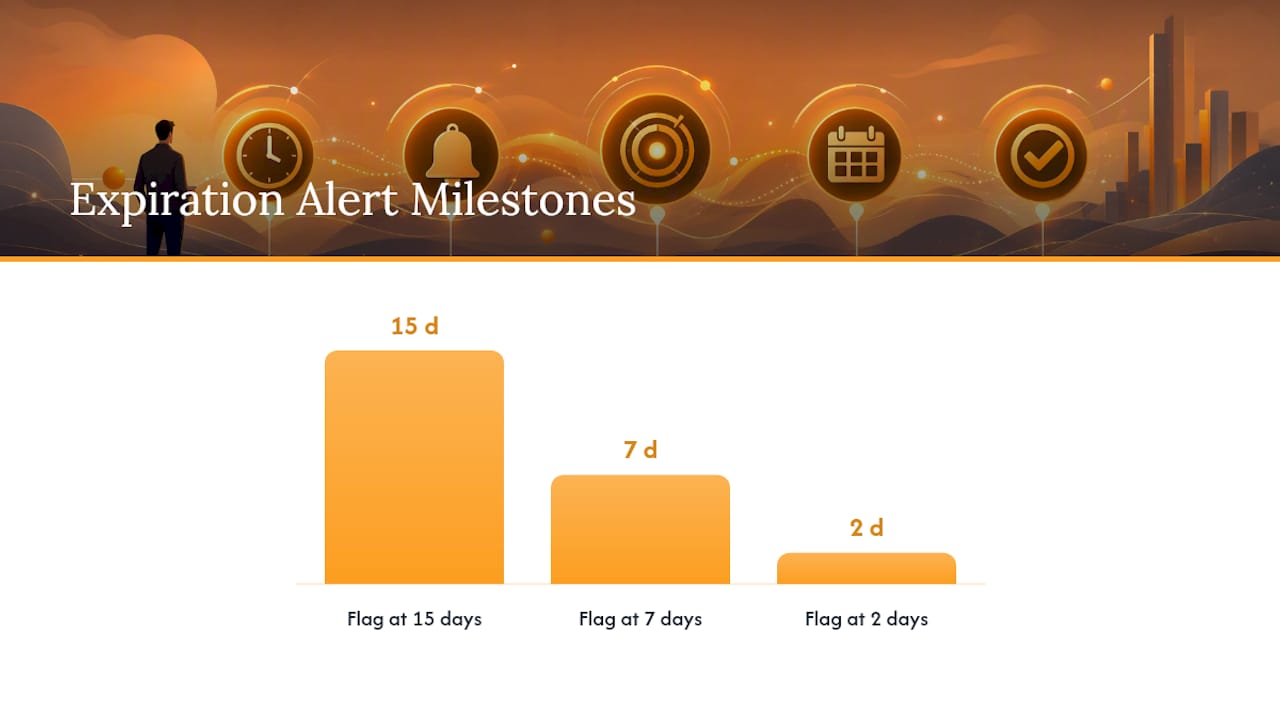
- Set alert milestones at seven days out, two days out, and expiration morning. Option Tracker's documentation on milestone-based alerts recommends exactly this cadence, flagging positions at 15, 7, and 2 days to expiration so nothing surfaces for the first time on the final day.
- Verify with your broker on the last trade day, since account-level status always overrides what a third-party calendar shows.
The visual timeline approach, where expirations sit on the same calendar view as earnings dates, helps you spot "busy expiration weeks" before they become chaotic. Macroption's research on expiration calendar patterns points to this as standard practice among professional traders managing multiple positions at once, since a cluster of expirations landing near an earnings report changes how you should size and time trades that week. A partner tool like TradeDupe's economic calendar can layer in macro events for an even fuller picture.
Inside that timeline, prioritize by days-to-expiration bucket, position size, and how far the option sits from being in the money. A small, far-out-of-the-money position doesn't need the same attention as a large position sitting near the strike three days before expiration.
Pro Tip: Color-code your calendar by DTE bucket, not by ticker. It's faster to scan a week and immediately see which positions need action today versus which ones have breathing room.
What Should Your Pre-Expiration Checklist Include?
Run this sequence starting a week out, and don't skip steps just because a position looks safe:
- Seven days out: review every open position's DTE, moneyness, and whether you plan to close, roll, or hold to expiration.
- Two days out: confirm alerts are active and check that you have enough buying power if any short position could get assigned.
- One day out: verify your broker's specific settlement and cutoff rules for each contract type you hold.
- Expiration day: make your final close, roll, or hold decision before your broker's stated cutoff time, which is often earlier than the market close.
If you hold a long option you don't intend to exercise, most brokers let you submit a Do Not Exercise instruction to prevent automatic exercise on an in-the-money contract. Short options work differently. Fidelity's guidance on managing expirations is direct on this point: assignment on a short option is an obligation you cannot block, regardless of what instructions you submit.
That distinction matters for how you plan around expiration. The final responsibility sits with you, not your broker. Firms may send alerts or auto-liquidate positions with insufficient margin, but FINRA's broker oversight framework makes clear that trade decisions and their consequences rest with the account holder, not the platform.
Pro Tip: Never assume "the broker will handle it." Auto-exercise thresholds vary by firm, and some brokers use different in-the-money margins for deciding what gets exercised automatically.
What Actually Happens at Expiration and Where Traders Get Burned
At market close on expiration day, trading in that contract stops, and the exercise decision process begins. In-the-money options typically get exercised automatically past a firm-specific threshold, usually one cent or more in the money, while out-of-the-money contracts expire worthless.
The most common mistakes cluster around a few predictable spots:
- Forgetting a short position can get assigned overnight, leaving insufficient buying power the next morning.
- Confusing AM-settled index options with PM-settled equity options, leading to a surprise settlement price.
- Assuming a broker will auto-close a losing position before assignment risk kicks in.
- Missing a holiday-driven date shift and tracking the wrong Friday entirely.
Triple witching days, when stock options, index options, and index futures all expire simultaneously, bring noticeably higher volatility and thinner liquidity in the final hour of trading. These fall on the third Friday of March, June, September, and December, and premiums can swing sharply into the close as market makers unwind hedges.
Why a Connected Calendar Beats a Manual Spreadsheet
Every trader eventually learns the hard way that a static spreadsheet of expiration dates goes stale the moment you open a new position. The workflow that actually holds up combines a visual timeline with alerts tied directly to your account, not a list you update by hand once a week.

What surprises people most is how much attention a busy expiration week demands compared to a quiet one. Positions that would otherwise sit untouched suddenly need review because an earnings date landed two days before expiration. A calendar view that shows both events side by side catches that collision automatically, while a plain list of dates never will.
Evibe's options tracking feature grew directly out of watching traders miss exactly this kind of overlap.
Track Every Expiration Without Switching Apps
Evibe gives you one place to see every options position across every linked brokerage account, with expiration dates, Greeks, and days-to-expiration surfaced automatically instead of buried in a broker's positions tab.

That matters most when you hold contracts across multiple brokers, since no single platform shows you the full picture otherwise. Evibe's options tracker displays a calendar view alongside your other holdings, so an expiration date sits next to the earnings report or dividend event that might move the underlying that same week. Smart alerts flag approaching expirations before they become last-minute scrambles.
- See every expiration across linked accounts in one calendar view.
- Get automated alerts before expiration day, not on it.
Get started free at Evibe — 7 days of Premium included — and connect your brokerage accounts to see your own expiration calendar built automatically.
Frequently Asked Questions
How do I track options expirations across multiple brokerage accounts? Use a consolidated tracker that syncs directly with each brokerage, since checking several broker apps separately is where dates get missed. Evibe's options feature pulls expirations from all linked accounts into a single calendar.
What is the best options expiry calendar for U.S. traders? The OIC calendar is the most authoritative for contract specs, while live tools like TheOptionsBench compute days-to-expiration in real time for daily monitoring.
Do options expiration dates ever change because of holidays? Yes. When the standard expiration Friday falls on a market holiday, the date shifts to the prior trading day. The June 2026 Juneteenth holiday is one documented example of this shift.
What's the difference between AM and PM settlement? AM-settled contracts, common with some index options, settle based on the opening price the day after expiration. PM-settled contracts, the norm for equities, settle based on the closing price on expiration day itself.
Can my broker exercise my options automatically? Yes, past a certain in-the-money threshold that varies by firm. You can submit a Do Not Exercise instruction on long options, but short-option assignment is an obligation you cannot block.
This article is general information, not a substitute for advice from a qualified financial advisor. Consult a qualified financial professional about your own circumstances before acting on anything here.
Sources
Bookmark the OIC expiration calendar, CME's QuikStrike tool, and Fidelity's expiration guidance. Always confirm your specific contract's date directly with your broker before acting.
- Options Expiration Calendar
- Understanding AM/PM Expirations
- Options Expiration Calendar 2026 (US Equity, Index, ETF Options) - Macroption
- Options Expiration Calendar — Monthly & Weekly Dates
- Expiration Management Guide - Option Tracker Documentation