High Yield ETF With No NAV Erosion: 2026 Guide
Discover how a high yield ETF with no NAV erosion can generate strong income while preserving your capital long-term. Learn the strategy now!
High Yield ETF With No NAV Erosion: 2026 Guide

TL;DR:
- High yield ETFs with no NAV erosion deliver strong income while maintaining or increasing their net asset value. They achieve this through options overlays, active credit management, and tax-efficient structures like Section 1256 contracts. Investors should monitor NAV trends and total returns to avoid principal depletion despite high advertised yields.
A high yield ETF with no NAV erosion is an investment vehicle that delivers strong income distributions while preserving its net asset value over time. Most investors treat yield and capital preservation as opposing forces, but a growing category of actively managed and options-based ETFs proves that trade-off is not inevitable. Funds like SPYI, QQQI, and BIGY have drawn serious attention from income-focused investors by combining double-digit yields with disciplined NAV management. Understanding how these funds work, where they fall short, and how to evaluate them is the difference between building a reliable income stream and slowly depleting your principal.
How high yield ETFs generate income without NAV erosion
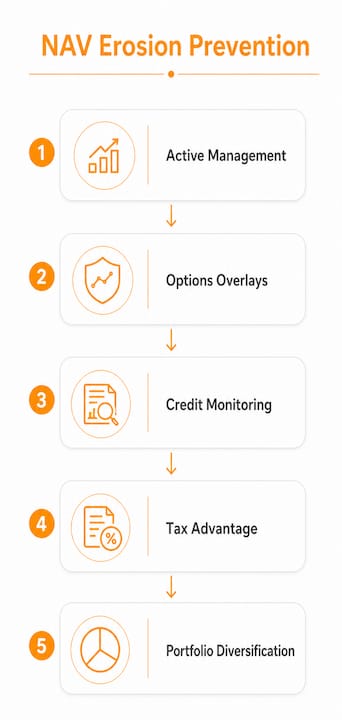
The core mechanism behind a stable high yield ETF with no NAV loss is not magic. It is a combination of options overlays, active credit selection, and tax-efficient fund structures working together.

Options overlays: covered calls and call spreads
Many income-focused ETFs write covered calls or call spreads on major indexes like the S&P 500 or Nasdaq-100. This generates premium income that funds monthly distributions without requiring the fund to sell underlying assets. The critical distinction is between funds that write simple covered calls and those that use call spread strategies. Call spreads cap the premium collected but also limit the fund's exposure to sharp market rallies, which is the primary cause of NAV erosion in options-writing strategies. Options strategies that fail to offset market rallies are the main reason funds using aggressive options writing often fail to regain pre-downturn share price peaks.
Active credit management in bond ETFs
For high yield bond ETFs, active credit management is the primary defense against NAV erosion. Passive high yield bond funds hold every constituent in their index, including credits heading toward default. Active managers like those running SYFI use bottom-up and quantitative analysis to sidestep deteriorating credits before they default. SYFI has avoided over 85% of US high yield defaults since inception. That number reflects a deliberate strategy of prioritizing capital preservation over chasing the highest available yields.
Pro Tip: When evaluating a high yield bond ETF, check whether it is actively or passively managed. Passive funds carry index-level default exposure. Active funds can avoid the worst credits before they drag down NAV.
Key income generation mechanisms in stable high yield ETFs include:
- Options premium income: Call spreads on indexes like the S&P 500 generate monthly cash flow without asset sales.
- Active credit avoidance: Managers exit deteriorating credits before default, protecting the fund's asset base.
- Short duration positioning: Shorter bond maturities reduce interest rate sensitivity and limit price swings.
- Tax-efficient structures: Section 1256 contracts defer tax obligations and reduce immediate distribution drag.
The Section 1256 tax advantage
Section 1256 contracts receive a 60/40 tax treatment, meaning 60% of gains are taxed at long-term capital gains rates and 40% at short-term rates, regardless of how long the position was held. For funds like SPYI, approximately 95% of 2026 distributions were classified as return of capital. That classification defers the investor's tax liability until the shares are sold, which meaningfully improves after-tax yield compared to ordinary income distributions.
How do "Blue Chip" high yield ETFs perform on NAV stability?
Performance data from 2025 through 2026 shows a clear split among funds marketed as stable high yield options. Some delivered on the promise. Others did not.
| ETF | Approximate Yield | NAV Performance (14 months to April 2026) | Key Strategy |
|---|---|---|---|
| SPYI | ~12% annually | Stable to positive | S&P 500 call spread, Section 1256 |
| QQQI | High double-digit | Near flat | Nasdaq-100 options overlay |
| BIGY | High income | Full NAV recovery after drawdown | Active equity income |
| EGGY | High income | Approximately -6% NAV loss | Options writing, less conservative |
SPYI grew its assets from $2.83 billion in january 2025 to over $10 billion by may 2026, a 3.5x increase. That asset growth reflects investor confidence in the fund's ability to sustain distributions without eroding principal. Distributions also grew 15% since inception, which is a meaningful signal of yield sustainability rather than yield decay.
EGGY tells the opposite story. Some funds in the "Blue Chip" high yield category experienced approximately -6% NAV loss over a 14-month period ending april 2026. A -6% NAV decline over 14 months effectively cancels out a significant portion of the income received. Total return, not headline yield, is the only metric that tells the full story.
Distribution analysis of high yield ETF categories consistently shows that funds with the highest advertised yields often carry the most NAV pressure. The yield number on a fund's homepage is not a promise. It is a trailing calculation that can mask ongoing principal erosion.
Pro Tip: Track a fund's NAV trend over at least 12 months alongside its total return versus a benchmark like the S&P 500. A fund yielding 15% but losing 10% in NAV annually is delivering 5% total return, not 15%.
What risks do investors need to understand about these ETFs?
Stable high yield ETFs carry real risks that are easy to miss when the monthly distributions look attractive. Understanding these risks is not optional. It is the foundation of a sound income strategy.
-
High yields can signal credit risk. A bond ETF yielding significantly above the market average is compensating investors for elevated default risk. Headline distribution rates are not the same as sustainable yield. Some ETFs with very high yields show ongoing NAV pressure that slowly depletes principal over time.
-
Conservative positioning limits upside. Funds that protect NAV during downturns often do so by holding more defensive positions. That same conservatism can reduce participation in market rallies. Conservative positioning protects NAV but may reduce total return compared to broader indexes when markets recover sharply.
-
Options strategies are sensitive to volatility regimes. Call spread strategies generate premium income based on implied volatility. When volatility collapses, premiums shrink and distributions can fall. When volatility spikes, the fund may face losses on its options positions that offset income.
-
Passive high yield bond funds carry index-level default exposure. Active management improves returns by avoiding credit risk that passive strategies cannot sidestep. A passive fund must hold every index constituent, including those heading toward default.
-
Tax treatment varies by fund structure. Not every high yield ETF qualifies for Section 1256 treatment. Investors who assume all options-based ETFs carry the same tax efficiency will be surprised at tax time.
The classic conundrum for income investors is this: the funds with the most stable NAV often underperform during bull markets, while the funds with the highest yields often carry the most NAV risk. The goal is not to find the perfect fund. The goal is to understand exactly what trade-off each fund is making and decide whether that trade-off fits your portfolio.
How to incorporate stable high yield ETFs into your portfolio
Adding a high yield ETF with no NAV erosion to your portfolio requires more than picking the fund with the highest yield. Position sizing, tax placement, and ongoing monitoring all determine whether the strategy actually works.
- Allocate based on income need, not yield envy. Determine how much monthly income your portfolio needs, then size the position to meet that need without overconcentrating in a single strategy. A 5%–15% allocation to income-focused ETFs is a reasonable starting range for most diversified portfolios.
- Place tax-inefficient distributions in tax-advantaged accounts. If a fund distributes ordinary income rather than return of capital, holding it inside an IRA or 401(k) eliminates the immediate tax drag. Funds with Section 1256 treatment are more efficient in taxable accounts. Review the fund's tax-efficient structures before deciding where to hold it.
- Monitor NAV monthly, not just distribution amounts. A fund that maintains or grows its NAV while paying income is performing as intended. A fund whose NAV trends downward quarter after quarter is returning your own capital to you, not generating new income.
- Balance with investment-grade fixed income and equities. High yield ETFs carry more credit risk and volatility than investment-grade bond funds. Pairing them with lower-risk fixed income assets and broad equity exposure reduces overall portfolio volatility without sacrificing all income potential.
- Understand the mark-to-market valuation of your ETF holdings. Options-based ETFs reprice daily based on market conditions. Knowing how your fund's NAV is calculated helps you distinguish between temporary price swings and genuine capital erosion.
Pro Tip: Review a fund's coverage ratio before investing. A fund whose income generation consistently covers its distribution is sustainable. A fund paying out more than it earns is eroding NAV by design.
Key Takeaways
Avoiding NAV erosion in high yield ETFs requires active credit management, disciplined options strategies, and a clear-eyed view of total return rather than headline yield.
| Point | Details |
|---|---|
| NAV stability requires active management | Passive high yield bond funds hold defaulting credits; active managers avoid over 85% of defaults. |
| Section 1256 structures improve net yield | Funds like SPYI classified approximately 95% of 2026 distributions as return of capital, deferring taxes. |
| Total return beats headline yield | A fund losing 6% in NAV annually offsets a significant portion of its income; always evaluate both together. |
| Options strategy design matters | Call spread strategies limit NAV erosion better than simple covered calls during market rallies. |
| Portfolio placement affects after-tax income | Tax-inefficient distributions belong in tax-advantaged accounts; Section 1256 funds work better in taxable accounts. |
What I've learned from watching investors chase yield
Most investors who get burned by high yield ETFs make the same mistake. They look at the distribution rate and stop there. They do not check whether the fund's NAV has been drifting lower for 18 months. They do not ask whether the yield is funded by genuine income or by returning their own capital.
I have watched investors hold funds paying 20% annual distributions while their principal quietly declined 12% per year. The net result was an 8% total return, which they could have achieved with far less complexity and risk. The yield number felt like a win. The portfolio statement told a different story.
The funds that actually deliver on the promise of high income with stable NAV share a few traits. They use disciplined options strategies that do not overwrite positions. They employ active credit teams that exit deteriorating bonds before default. They operate in tax-efficient structures that reduce the immediate drag on after-tax returns. And they are transparent about total return, not just distribution rates.
The UCITS ETF framework and similar regulatory structures in the US require meaningful disclosure, which gives you the data you need. The problem is not a lack of information. The problem is that most investors do not look at the right metrics. Track NAV trends. Track total return. Track the coverage ratio. Those three numbers tell you more than any marketing document ever will.
— Vincent
Track your high yield ETF income and NAV with Evibe
Managing a high yield income strategy means watching more than just your monthly distributions. NAV trends, total return versus benchmarks, and distribution sustainability all require ongoing attention.

Evibe's ETF portfolio tracker consolidates all of that data in one place. You can monitor NAV performance, track income from your dividend distributions, and get AI-driven alerts when a fund's metrics shift. Evibe syncs automatically with your brokerage accounts, so you see real-time performance without manual entry. If you are managing a portfolio that includes options-based income ETFs, Evibe also tracks your options positions alongside your ETF holdings. The picture is finally complete when all your income sources appear in one view.
FAQ
What does "no NAV erosion" mean in a high yield ETF?
No NAV erosion means the fund's net asset value remains stable or grows over time while paying income distributions. A fund with NAV erosion is effectively returning investor capital as part of its distributions, reducing the principal base.
Are options-based high yield ETFs tax-efficient?
Some are. Funds using Section 1256 contracts receive 60/40 long-term and short-term capital gains treatment, and distributions may be classified largely as return of capital, deferring taxes until the investor sells shares.
How do I tell if a high yield ETF is eroding its NAV?
Compare the fund's NAV at two points 12 months apart, then add total distributions received. If NAV has declined by more than a small margin, the fund is paying out more than it earns. Total return is the correct metric to evaluate.
Why do some high yield bond ETFs lose NAV over time?
Passive high yield bond funds hold all index constituents, including bonds from issuers heading toward default. When those defaults occur, the fund's NAV falls. Active management avoids this by exiting deteriorating credits before default.
What allocation to high yield ETFs is appropriate for most investors?
A 5%–15% allocation to income-focused ETFs is a reasonable range for most diversified portfolios. The exact size depends on your income needs, risk tolerance, and how the fund's strategy interacts with your other holdings.